Eurogroup president: Europe is prepared for a Grexit

Just one more thing...
Jeroen Dijsselbloem, the president of the eurogroup (eurozone finance ministers) and Dutch finance minister, has said the eurozone is prepared for every eventuality regarding the Greek crisis.
Asked in Amserdam whether there was a plan B for Greece, he said:
The question is, is the Netherlands prepared, or is the eurozone prepared for eventualities. The answer to that is yes.
He was also quoted by Reuters as saying the Greek government should spend less time on interviews, and more time on avoiding the abyss.
Thank you for reading the blog today, and for commenting. Please join us again tomorrow morning.

Another headache for Greece, as an apparent “technical hitch” delays pension payments.
This report from the FT:
The Greek government was struggling on Thursday to complete payments to more than 2m pensioners after claiming that a “technical hitch” delayed an earlier disbursement.
Elderly Athenians waited at branches of the National Bank of Greece, the state-controlled lender handling the bulk of pension payments, which are staggered over several days.
“Normally I only withdraw half the money at the end of the month but today I’m taking it all,” said Sotiria Zlatini, a 75-year-old former civil servant. “There are so many rumours going round because of the government’s problems and what happened two days ago.”
On Tuesday, the main state social security fund, IKA, delayed pension payments by almost eight hours. The heavily loss-making fund relies on a monthly subsidy from the budget to be able to cover its obligations.
Pensioners brake into board mtng of #Greece's biggest pension fund IKA, demand rejection of funds' transfer to State pic.twitter.com/nuufNM1J7p
— Yannis Koutsomitis (@YanniKouts) April 30, 2015
Closing summary
Before we close the blog for the day, here is a quick summary of the main news and events.
- The major news on the data front was eurozone inflation, which showed the region escaped deflation in April. The small but symbolically significant rise to 0% from -o.1% in March will be welcomed with relief by Mario Draghi and his colleagues at the ECB, coming a month after it began its €1.1 trillion QE programme
- Eurozone unemployment was unchanged in March at 11.3%, disappointing expectations of a fall to 11.2%
- Spain’s recovery accelerated in the first quarter, with growth of 0.9% exceeding expectations and fuelling hopes that the eurozone as a whole grew by about 0.5% in the first three months of the year. That would be faster than both the UK and the US
- Moody’s warned the risk of a Greek exit from the euro is rising, a day after it downgraded Greece plunging it deeper into junk territory
- Russia cut interest rates to 12.5% in 14% in a bid to boost the economy
- Greece continued negotiations with its creditors in Brussels, but still no agreement on a package of reforms. Finance minister Yanis Varoufakis said he was confident a deal would be struck imminently
- US markets opened lower; European markets remain mixed. The FTSE 100 is down 0.2% at 6,928.7
US markets open lower

Wall Street has opened lower, suggesting Wednesday’s surprisingly weak growth figures are still weighing on investor minds.
The strong US jobs numbers earlier today on the other hand have failed to lift market spirits so far.
- Dow Jones: -0.5% at 17,941.24
- S&P 500: -0.1% at 2,104.31
- Nasdaq: -0.5% at 4,465.73
The US data appears to have boosted European stock markets somewhat, while the euro trimmed gains against the dollar. The dollar hit session highs against the yen and the dollar.
Updated
US jobless claims at lowest level since 2000
Here’s some good news on the US economy, after yesterday’s GDP shocker: the number of Americans filing new claims for unemployment benefits dropped to the lowest level since 2000.
Jobless claims fell 34,000 to 262,000 for the week ended 25 April, the lowest reading since April 2000, the Labor Department said. The figures are seasonally adjusted.
Yesterday’s GDP figures were far worse than expected, showing a sharp slowdown in economic growth to an annualised rate of 0.2% in the first quarter.
Time for a look at European stock markets: all the main indices are in positive territory, just about. The FTSE 100 index in London has edged up 0.1% (nearly 9 points) to 6995.07. The Dax in Frankfurt is up 0.5% at 11,491.05 while the CAC in Paris is up 3 points at 5042.44. The Ibex in Madrid is 0.26% ahead at 11,408.8 and the FTSE MiB in Milan gained 0.5% to 23,118.73.
Yanis Varoufakis, the embattled Greek finance minister apparently sidelined in negotiations with the country’s creditors, has been speaking to the Greek parliament.
He insisted that the latest negotiations with its creditors on a reform package would end in agreement.
The negotiation will be successfully concluded, the climate will calm down, and then we will be speaking of the post-June recovery.
Varoufakis said the government would do everything possible to expose those who were making profit at the country’s expense.
According to Greek news service enikos, he also spoke about his recent assault in the Exarcheia neighbourhood of Athens, where he was dining with his wife on Tuesday.
It reports:
Greek Finance minister Yanis Varoufakis, speaking in the parliament, briefly referred to his recent assault in Exarcheia neighbourhood.
“We all try not to resort to ‘easy solutions’ when it comes to violence matters. It’s imperative not to look for easy solutions. It is not a solution to fighting violence with violence, or by running away”.
And then he started his speech on financial matters by launching an attack on Greece’s lenders that imposed austerity in Greece: “There is also another type of violence, a very ‘civilized’ violence, but at the same time brutal and destructive”, he said .
Varoufakis on his assault: 'We should not fight violence with violence' – VIDEO - http://t.co/yLs1H2VsXG
— enikos_en (@enikos_en) April 30, 2015
This morning’s French consumer spending figures are not so gloomy once the fall in energy consumption is taken into account.
Energy consumption has been a drag on GDP and consumer spending figures for the first quarter across much of Europe.
Households have switched off their central heating following one of the mildest winters on record. It means there is a drop in income for energy suppliers, but not really a drop in general activity across the economy.
France enjoyed the third mildest winter in 50 years and that led to a 3.2% drop in consumer spending on energy (though the word enjoyed is out of place if the implications for global warming are considered).
There was a 1% rise in the consumption of durable goods. So the French consumer is feeling better than the headline figures would appear to indicate
Updated
Russia cuts interest rates
Russia has lowered its key interest rate to 12.5% from 14%, in a bid to boost the faltering economy amid signs that inflation has peaked.
Economists had predicted a smaller cut to 13%.
Russia Lowers Key Rate More Than Forecast as Economy Slumps http://t.co/8yYaES16OT via @business pic.twitter.com/vCOnsQkXB2
— Dan Popescu (@PopescuCo) April 30, 2015
RUSSIAN CENTRAL BANK LOWERS KEY RATE TO 12.50%; EST. 13%
— World First (@World_First) April 30, 2015
Moody’s: risk of Grexit is rising

Moody’s has issued another warning on Greece, a day after downgrading its credit rating and plunging it deeper into junk territory.
Today it is warning the impact of a Greek exit from the euro should not be underestimated.
The direct economic and financial impact of a Greek exit from the euro area would be small, but an exit would undermine the euro area’s longer-term resilience somewhat and could yet trigger a more immediate confidence shock, disrupting government debt markets.
Moody’s expects Greece (Caa2, negative outlook) to reach an agreement with its creditors and avoid default. However, lack of progress so far means the probability of a default, and of exit, is rising.
Default would not necessarily lead to Greece’s exit from the euro area. The chain of events that could lead to exit is difficult to predict. Moody’s would expect negotiations to continue for a period. However, should exit occur, it would set a significant precedent, undermining the resilience of a currency union that was designed to be irreversible.
Greece leaving the euro area would offer an example that might be
followed in future. That would inevitably influence the course of future reform and fiscal consolidation programmes. It would raise, even if only a little, the likelihood that they too could end in default and exit.
Some reaction now to the eurozone inflation and unemployment data.
Inflation increased to zero in April, ending a four-month run of deflation. The jobless rate was unchanged at 11.3% in March.
Jonathan Loynes, chief European economist at Capital Economics, says we shouldn’t get too excited about the end of eurozone deflation because price pressures are still very weak.
The latest eurozone inflation and labour market data paint a mixed picture, with deflation ending - for now at least - but unemployment stuck at a very high level.
The general picture remains one of very weak underlying price pressures in the eurozone, reflecting both the weakness of pipeline cost pressures and the spare capacity left in the economy.
The latter was underlined by the March labour market figures showing the unemployment rate holding at 11.3% for the third successive month.
It is of some relief that the bout of technical deflation has been shorter-lived than we had feared. But it could return if oil and commodity prices fall again and even continued low inflation will hinder the indebted countries’ fiscal consolidation efforts.
Christian Schulz, senior economist at Berenberg:
After four months with negative inflation rates, the eurozone officially exited deflation in April. However, this is not yet a sign of fading domestic disinflationary pressures, as the painfully slow decline in unemployment evidenced in today’s unemployment data for March reminds us.
Eurozone inflation will move up further towards the end of the year and then gradually beyond. But to get back to the ECB’s 2% target, it is still a long way to go.
Unemployment continued to fall for a fourth successive month in the eurozone, but declines remain modest and uneven. Overall unemployment dropped by 36k in March, but, at that pace, it would take 14 years to return to pre-crisis levels. Reform countries Spain, Portugal and Ireland remained best in class in March, with unemployment rates declining by 0.1 percentage points each.
Teunis Brosens, economist at ING.
Headline deflation is over. The drag of energy prices on headline inflation should gradually diminish further in the course of this year and our baseline scenario is for headline inflation to slowly rise, surpassing 1% by the end of the year.
Taken together with an improving macro outlook, a pickup in bank lending and absent a deepening of the Greek crisis, ECB-president Draghi could face increasing questions about the continued need for quantitative easing in the second half of the year.
But the ECB, bruised by tightening decisions in both 2008 and 2011 that it had to reverse only months later, will want to err on the side of caution when considering tapering.
Howard Archer, chief European and UK economist at IHS Global Insight:
Highly welcome news for the ECB as the Eurozone exited deflation in April as consumer prices were flat year-on-year.
Adding to the good news Eurozone unemployment dropped 36,000 in March which was a fourth successive decline. However, it was the smallest decline since November, largely due to Italian unemployment rising by a disappointing 52,000. Nevertheless, the number of Eurozone unemployed has fallen by 418,000 since November 2014.
Meanwhile, it looks like Eurozone GDP growth may well have picked up to 0.5% quarter-on-quarter in the first quarter of 2015 from 0.3% in the fourth quarter of 2014.
Eurozone unemployment unchanged at 11.3%
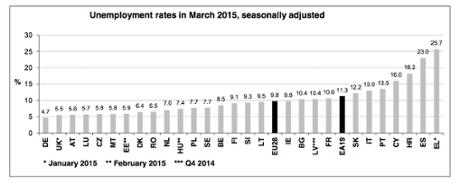
The jobless rate in the eurozone was unchanged in March at 11.3% according to official Eurostat figures.
It disappointed expectations of a fall to 11.2%.
Greece has the highest jobless rate at 25.7% (in January), followed by Spain at 23%. Germany has the lowest rate at 4.7% according to the Eurostat definition.
There were 18.1m people out of work in the whole region last month, down 36,000.
Eurozone inflation rises to zero
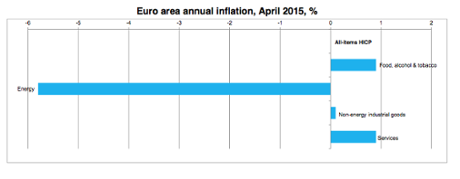
Eurozone inflation picked up in April to 0%, from -0.1% in March. It brings to an end a four-month run of deflation.
The biggest driver behind the increase was a rise in food, alcohol, and tobacco inflation according to the flash estimate from Eurostat.
Updated
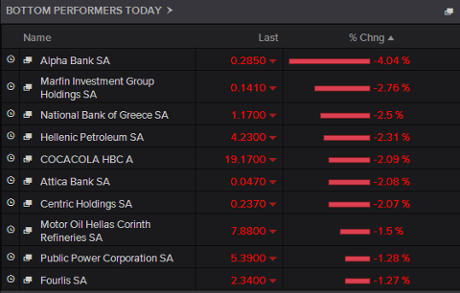
Greek shares fall
Greek shares are down this morning, with the banks the main losers. The ATG index in Athens is down 1% at 790.
Confidence about a deal between Greece and its creditors over a set of crucial reforms is faltering as time ticks on.
A majority of investors, traders and analysts surveyed by Bloomberg now believe Greece is heading for the eurozone exit doors.
Fifty-two percent of respondents in the Bloomberg Markets Global Poll believe Greece will leave the single currency bloc at some point, while 43% believe the country will remain in the eurozone for the foreseeable future.
Back in January, just 31% predicted a Greek exit and 61% were convinced the country would remain.
Majority sees Greece headed for euro exit in Bloomberg user poll http://t.co/EyPbmkcfSM
— Kathimerini English (@ekathimerini) April 30, 2015
German unemployment data disappoints
The number of people out of work in Germany dropped by 8,000 on a seasonally adjusted basis in April, to 2.792m. A bigger fall of about 15,000 had been expected.
It left the unemployment rate unchanged at 6.4%, as expected.
Carsten Brzeski, economist at ING, said despite the smaller than expected fall in unemployment, the jobs market in Germany was unchanged.
Despite some unsolved structural issues (think of female labour market participation, demographic change or the low-wage sector) and still some room for improvement, the extremely solid labour market remains the showcase model of the German recovery.
Christian Schulz, economist at German bank Berenberg, says stronger-than-expected Spanish growth in the first quarter is positive on many levels, with lessons to be learned by Greece.
It shows that reforms work, it should help reduce unemployment much further and thus political fragility and it serves as a shining example to Greeks of what their country could have if its government finally returns to the path of virtue.
Sustained performances like this, in particular when core countries like Austria and Belgium underperform, show that the periphery can grow faster than the core of the eurozone.
Economic strength in the Eurozone can converge again, which raises the attractiveness of euro membership to potential new members.
Spain’s performance has boosted hopes that growth in the eurozone overall picked up in the first quarter, beating 0.3% growth in the fourth quarter. The first official estimate will be published by Eurostat on 13 May.
Eurozone GDP growth may well have picked up to 0.5% quarter-on-quarter in first quarter given improved growth in Spain, Belgium & Austria
— Howard Archer (@HowardArcherUK) April 30, 2015
It would mean the eurozone economy grew faster in the first three months of the year than the UK and the US...
Updated
Spanish growth accelerates
Spain’s recovery gained momentum in the first quarter of 2015, with growth of 0.9% following 0.7% growth in the fourth quarter of 2014.
It beat expectations, with economists polled by Reuters forecasting growth of 0.8%.
It was the fastest rate of growth since the end of 2007, boosted by a recovery in household spending.
It looks like negative inflation in the country (-0.7% in April) has helped to boost household budgets.
GDP rises 0.9% in #Spain in Q1, strongest gain since end of 2007. Economy has grown continually since mid-2013 pic.twitter.com/4MZa75TluV
— Chris Williamson (@WilliamsonChris) April 30, 2015
European markets open lower
Europe’s major indices are down this morning following Wall Street losses on Wednesday.
- FTSE 100: -0.1% at 6,941.1
- Germany’s DAX: -0.1% at 11,425.39
- France’s CAC: -0.5% at 5,016.06
- Italy’s FTSE MIB: -0.5% at 22,871.09
- Spain’s IBEX: -0.5% at 11,325
French consumer spending falls

Consumers were less willing to part with their money in March according to figures from INSEE, the national statistics office.
Consumer spending dropped 0.6% over the month, following a 0.2% rise in February. Economists had forecast a smaller fall of 0.3%.
The main driver of the fall was a 3.2% drop in spending on energy. However, household spending on durable goods was up 1%.
Updated
The agenda: eurozone inflation and unemployment; Greek talks resume
Good morning, and welcome to our rolling coverage of the world economy, the financial markets, the eurozone and business.
Following’s yesterday’s shockingly weak US growth numbers (read our full story here), the key data out this morning is the flash estimate of eurozone inflation at 10am.
Markets are expecting the figures to show a pick-up in annual inflation in April to 0% from -0.1%.
A move out of negative territory will be symbolically significant for the region, coming only a month or so after the European Central Bank started its €1 trillion quantitative easing programme.
Also at 10am we will be getting eurozone unemployment data for March. The jobless rate is expected to fall to 11.2% from 11.3%.
European markets meanwhile will be absorbing the poor US GDP figures, as well as the latest Fed minutes out last night.
And last but not least, Greece’s new-look negotiating team will press on with negotiations in Brussels. The bid continues to agree a set of reforms with Greece’s creditors in order to unlock urgently needed funds. More on that soon.
I’ll be tracking all the main events through the day....