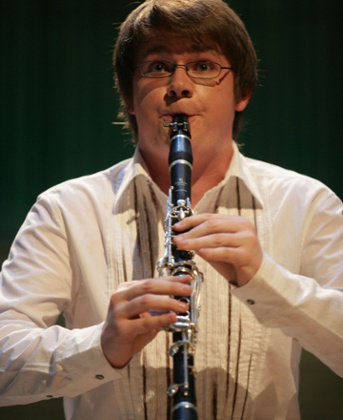
Mark Simpson is showing me the score of his new piece, The Immortal. “I felt like I was in a trance when I was writing it,” says the 26-year-old composer, clarinettist, and Liverpudlian musical polymath. “There was a period when I didn’t leave the house for 10 days. When I finished it, after seven solid months – and even now when I look at it – I just thought, ‘What the fuck’s that? It’s so big!’ This scale and scope, it’s on a different level from anything I’ve done before.”
Awe seems the correct response. The Immortal – which premieres at the Manchester international festival this week – requires a cast of hundreds: a huge orchestra, two choirs and a baritone soloist, and its subject is life, love, death and life after death.
Simpson and his librettist Melanie Challenger have written about the world of the Victorian spiritualists. Simpson dramatises the story of Frederic WH Myers, whose obsessive search for proof of the afterlife was founded in personal tragedy after his first love killed herself when she was a teenager. “Behind this veil of scientific rigour was simply this deep, human, emotional loss,” Simpson says. “But this search for something beyond was spurred on by the intellectual scene at the time. After Darwin – who is known to have gone to a seance – they could accept that there was no God, but they couldn’t accept that there was no life after death.”
Simpson goes through the score with me, singing, declaiming, and gesticulating as the two-part, 30-minute work heaves and slews from one existential crisis to another, from the surreal, chaotic texts taken from actual seances to the story of Annie Marshall, Myers’ beloved. It’s music that’s pitched at a level of sustained emotional intensity; a heightened, dangerous, disorienting place where Simpson wants to take his listeners.
But it also contains – unusually for Simpson – a moment of compositional tribute. “Have you seen the film Interstellar?” he asks. “Did you notice Hans Zimmer’s score? One section of it reminded me strongly of the fifth minute of Unsuk Chin’s orchestral piece Rocaná. It’s basically a D flat major chord with a sharp fourth, and made me realise I really liked the chord myself too, so I put it in my piece!”
This isn’t typical of Simpson’s music, which has already found its own, individual and instantly compelling language. Listen to the irresistible energy of his recent orchestral piece Israfel to hear what I mean – but the instinctive, visceral approach to the stuff of music certainly is. He lives for music. “I couldn’t do anything else – I was supposed to do this stuff,” he says, entirely without ego, because he’s only too aware of the sacrifices that composition and performance have demanded of him. The Immortal, he says, is “blood, sweat, and tears”; there are the tens of thousands of hours of practice, the missed family holidays, the self-imposed periods of compositional purdah in Bordeaux, where he now lives with his partner.
Amid an infectious humour and easy banter burns a ferocious and provocative idealism. “It means too much to me. There’s a great quote from Messiaen. He said that every time he sat down to write a piece, he thought, this is going to be the best piece I’ve ever done, a complete game-changer. And by the time he finished each piece, he said that he still hadn’t got his opus 1. I agree with that, with that searching. That’s my problem with contemporary music concerts. I don’t often go to them because I get scared of having a heart attack or a fit of rage at what I’m hearing. It’s depressing. People can be duped by mediocrity.
“For me, there’s no point in [composing] if you’re not trying to shake the world, to shake listeners to their core, to force people to re-evaulate themselves.”
Simpson has more righteous fire on the subject of what’s happening to music education in the UK. His own route to winning the BBC Young Musician of the Year in 2006 was possible only thanks to the clear progression he could make from playing the recorder at his primary school in Liverpool to clarinet in the Merseyside Youth Orchestra, from the National Youth Orchestra to university at Oxford, a masters degree at the Guildhall, and his career today. “I wouldn’t be where I am if I hadn’t had free music lessons. It’s morally wrong for a government to take away those opportunities. I don’t want to preach, and it’s not that I want everyone to play in an orchestra or listen to classical music, but I want everyone to have the opportunity.” He’s not hopeful about the prospects for change: what’s needed, he says, is “an ideological shift and a complete re-evaulation of how music is taught from primary up to tertiary – but it’s a cultural shift that’s almost too big to imagine.”
The week we meet, Simpson is performing in an all-star lineup at Aldeburgh festival, including pianist Pierre-Laurent Aimard and violinist Isabelle Faust. Has he played with them before? “Have I shite!” But Simpson belongs with them, not just as a player – he keeps up the clarinet by playing an hour a day, enough to keep everything in check, he says – but above all, of course, because of what he’s putting on the line as a composer every time he faces the terrifying new dawn of the next potential opus 1. “It’s such a weird thing to do. It’s really, really hard. You’ve got to believe in the stuff you do so much. Nothing else matters.”