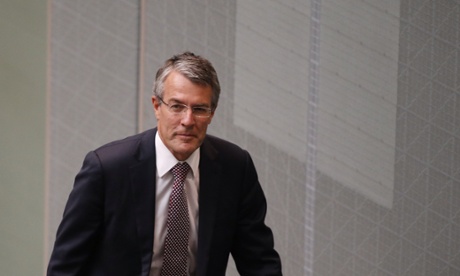
Labor says it is inclined to be cooperative in relation to looming reforms expanding the surveillance powers of Australia’s intelligence services – but the shadow attorney-general Mark Dreyfus has also signalled the opposition’s parliamentary support for the overhaul is not guaranteed.
Last week, the attorney-general, George Brandis, said he would bring forward new legislation giving effect to chapter four of the Parliamentary Joint Committee on Intelligence and Security (PJCIS) report in the next parliamentary sitting fortnight.
That report, released in 2013, presages a significant and, in some instances, highly controversial expansion of the surveillance powers of Australia’s intelligence agencies.
The recommendations in chapter four relate specifically to expanding the powers of agencies to access computers, including the computers of people who are not the primary subject of an investigation; and also changes to the warrant regime used by the Australian Security and Intelligence Organisation (Asio).
These changes, while contentious, are lesser order issues for the intelligence agencies.
Despite the prime minister dialing up the rhetoric on national security gradually over the past few weeks, linking border security, the emerging threats from Iraq, and future economic security in an effort to reframe the largely negative post-budget political conversation on more favourable political terms – the Abbott government is actually moving slowly on the bulk of the PJCIS report, a document which has been in the public domain for all of the Coalition’s ten months in office.
One of the reforms being sought most vigorously by Asio and federal and state police – a highly controversial recommendation to create a two year mandatory data retention regime to assist intelligence and police with their investigations – has been pushed back until later in the year.
There have been reports over the past week that Labor will simply wave through the first tranche of national security reforms being introduced by Brandis in the coming weeks.
But Dreyfus told Guardian Australia on Monday the opposition had no settled position on a package that had not yet been sighted.
He said all proposals in the national security space required proper public scrutiny.
“I have not seen the legislation and not only should I see the legislation in order to determine Labor’s position, the public should see it too as recommended by the Parliamentary Joint Committee on Intelligence and Security – a committee of which the current attorney-general was a member,” Dreyfus said.
“There should be public consultation on an exposure draft of the legislation.”
Dreyfus said Labor’s disposition in-principle was to be cooperative and bipartisan in legislative changes modernising the framework in which Australian intelligence agencies operated, and in strengthening powers where necessary to ensure the public was properly protected against emerging threats.
But he said in bringing forward the tranche dealing with chapter four, Brandis needed to respect the PJCIS’ recommendation to subject all reforms to proper scrutiny by parliament, intelligence watchdogs and the public.
Recommendation 41 of the report says “draft amendments to the Australian Security Intelligence Organisation Act 1979 and the Intelligence Services Act 2001, necessary to give effect to the committee’s recommendations, should be released as an exposure draft for public consultation.”
“The government should expressly seek the views of key stakeholders, including the Independent National Security Legislation Monitor and Inspector-General of Intelligence and Security. In addition, the committee recommends the government ensure that the draft legislation be subject to parliamentary committee scrutiny.”
In addition to signalling Labor’s support was not a foregone conclusion, Dreyfus was also highly critical of the Abbott government’s recent decision to axe the Independent National Security Legislation Monitor at a time when it was moving to implement significant changes to the policy framework.
The outgoing national security monitor, Bret Walker SC, recently used his final report to place on record the fact the abolition of his agency will result in a significant gap in national security oversight. “The INSLM is not aware of any other officer, agency or “level” of government doing what parliament required to be done by the INSLM Act enacted in 2010,” Walker said of the planned abolition.
The shadow attorney-general said the monitor played a unique and productive role in scrutinising the national security apparatus, conducting oversight that was not undertaken by either the Inspector General of Intelligence and Security or by the attorney-general’s department.
“This is not the time to be abolishing the national security monitor,” Dreyfus said on Monday.





.jpg?w=600)