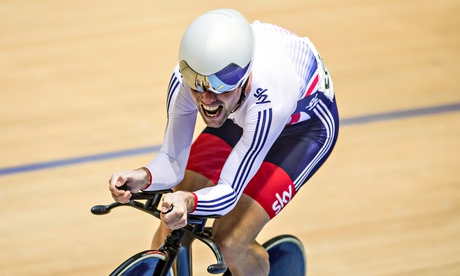
Mark Cavendish has begun his attempt to secure the single place available to Great Britain in the omnium at next year’s Rio Olympic Games in impressive style.
Returning to competitive track cycling after an absence of more than seven years, the 30-year-old finished second in a high-class international field of 21.
The man who finished ahead of him, however, was Ed Clancy and the Yorkshireman, who won the bronze medal in this discipline at London 2012, made it clear he fully intends to take that place for himself.
Cavendish is targeting the six-discipline omnium because it has been reformatted in a manner that makes the final race, the points race, much more important.
Riders now accrue points in each discipline, rather than simply trying to score as few as possible based on finishing positions. The winner of each of the first five races receives 40 points, second 38 and so forth. Riders then carry their total into that final race, in which they can gain 20 points for a lap gained and five for winning one of 16 one-lap sprints in the final 40km – 160-lap – race. This suits Cavendish, with his sprinting power, Tour de France-honed stamina and tactical knowhow.
He began the day lying third overall, trailing Clancy by 16 points, after finishing 11th in the scratch race, second in the 4km individual pursuit and then fourth in the spectacular and – according to Cavendish – spectacularly dangerous, elimination race.
The last was won by Clancy and the Yorkshireman stretched his lead by being fastest in the 1km time trial, more than two seconds ahead of Cavendish. He also won in the fifth discipline, the flying lap, with the Manxman third fastest.
Going into the points race, Cavendish trailed Clancy by 28 points and the two men fought it out in a brutal three-quarters of an hour, during which they rarely appeared separated by much more than a wheel’s width.
Cavendish picked up points in most of the sprints but Clancy was usually right behind him, limiting the damage, and when they crossed the line Clancy was on 228 points to Cavendish’s 210.
“Given the track time I’ve had, I’m really happy with where I’m at, to finish second behind an Olympic medallist is all right,” said Cavendish. “There’s no soreness and I’m very encouraged, given the last omnium I did was as a schoolboy.
“It’d be nice to have an Olympic medal, just to stop people banging on about it.”
For Clancy, Cavendish’s challenge was ominous. “It’s good to win but Cav has had eight days’ preparation, I’ve had eight years,” he said.
“My main focus is the team pursuit and making it three golds in a row but I’ll be very much fighting for the omnium place. I think we want the best for each other and for the best rider to go.”
Bradley Wiggins, whose return to competitive track cycling resulted in him winning the men’s pursuit with his Great Britain A team-mates Steven Burke, Owain Doull and Clancy on Friday evening – and was fined around 200 Swiss Francs, or about £130, for not attending the presentation – said the readjustment had not been problematical.
“It’s taken time to get my head around the fact I’m not a road rider any more but bike riding is bike riding at the end of the day; head down, arse up, there isn’t much to it, really.”
Laura Trott won the women’s omnium, in what boiled down to a direct duel with the Belgian cyclist Jolien D’Hoore. Trott did not seal victory until the second from last sprint of the points race, which she won by an inch from D’Hoore to extend her lead to five points. D’Hoore took the last, meaning Trott, a watchful second, won by three points.