In March 2025, a month before Canada’s federal election, Conservative Leader Pierre Poilievre accused Mark Carney of plagiarizing his policy ideas. Sure enough, Carney soon became a Liberal prime minister Conservatives could like, implementing Conservative policies while reportedly undoing Justin Trudeau’s legacy.
The Carney government has borrowed another page from the Conservative playbook: the brand politics strategy of Stephen Harper’s government from 2006 to 2015.
Domestic brand politics strategies link political party agendas to national identity through rhetorical, visual and symbolic means. They help create the impression that there’s little difference between the governing party, the state and Canadian identity.
Similar strategies
In 2007, I argued that Harper’s Conservatives wanted to remind Canadians that a non-Liberal regime was in power following more than a decade of Liberal rule.
Public servants were instructed to use “Canada’s new government” in place of the “government of Canada.” A scientist was fired (and later reinstated) for mocking the line.
Public servants were later told to use “Harper government,” reflecting the so-called Harperization of government communications.
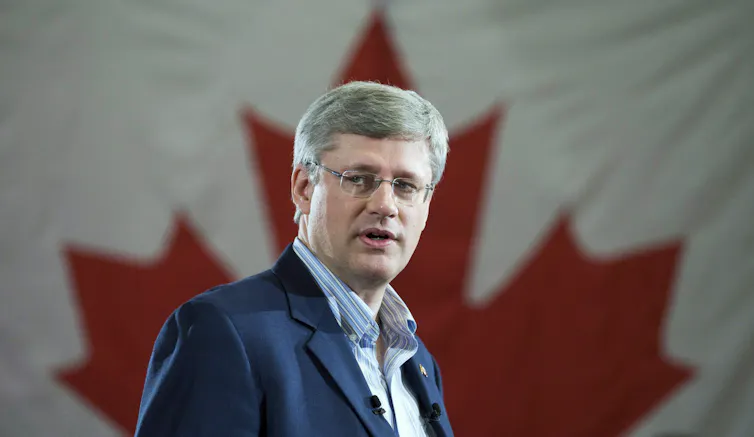
Carney became prime minister almost 18 months ago, yet news releases from his office still refer to “Canada’s new government.” The phrase’s meaning has evolved from “not Liberal” in the Harper era to “not Trudeau Liberal” in the Carney era, as Carney cannot seem to erase his predecessor’s memory fast enough.
This is reminiscent of Paul Martin Jr.’s less successful attempt to distinguish his brand from his Liberal predecessor Jean Chrétien’s.
From colours to slogans
Harper government websites featured a shade of blue similar to the blue used by the Conservative Party, minimizing Canada’s official red in the Federal Identity Program.
In 2008, the “True North Strong and Free” featured on both the Government of Canada portal and the cover of the 2008 Conservative election platform. In 2014, advertising for upcoming Canada 150 celebrations used language similar to the Conservative platform.
“Canada Strong,” the centrepiece of Carney’s 2025 election platform, is prominent in his government’s communications. It was the title of the 2025 budget and is featured in a range of initiatives — from recruiting skilled workers to the government’s sovereign wealth fund — blurring the line between party and state.
Read more: Canada’s new sovereign wealth fund is ambitious, but its design raises questions
The Harper government’s “royal rebrand” stressed Canada’s ties to the British monarchy and Conservative support for the Crown. It promoted Canadian history and launched a campaign to promote awareness of the War of 1812, including “The Fight for Canada” an expensive ad satirized by the Mercer Report television comedy series.
Carney has also stressed these ties to promote Canadian sovereignty, inviting King Charles to read the Speech from the Throne. The government continues to use British spelling in major documents like the 2026 Economic Update, a gesture many Canadians like despite a call by linguists to use Canadian spellings.
The perils of brand politics
A brand fails when its promise is not met, it no longer reflects its values or there is incoherence or a lack of clarity about what the brand represents.
For political brands, advertising and symbolism cannot overcome a loss of faith. A brand politics strategy could not salvage the Harper Conservatives’ fate in the 2015 federal election despite their efforts to replace the Liberals as Canada’s “natural governing party.”
Trudeau’s Liberals won because Conservative rhetoric and actions were out of sync with Canadian attitudes about diversity, rights, the Syrian refugee crisis and their own efforts to reach out to new Canadians.
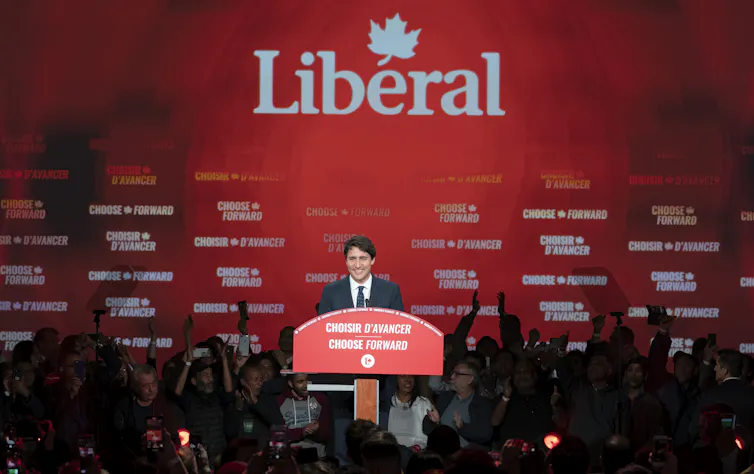
United States President Donald Trump’s latest 50 per cent tariff threats — with his deadline now this Friday, Aug. 21 instead of Aug. 19 — and his claim that “without us, there’s no way [Canada] can survive,” have prompted intense negotiations.
The Liberal government could suffer the same fate as the Harper government if it fails to deliver on Carney’s “elbows up” promise that “Canada is not for sale.”
Read more: Why Gordie Howe’s elbows are Canada’s answer to Donald Trump
Carney is far less “elbows up” than assumed, and Canadians’ faith in Brand Carney is starting to dissipate. Polling suggests Canadian confidence in Carney’s ability to secure a good deal is slipping as his room for reaching a deal satisfactory to both Trump and Canadians narrows.
Meanwhile, some provinces have said they, and not the federal government, will decide when or whether they will lift their bans on the sale of American alcohol.
Read more: Trump’s new tariffs give Ontario and Québec the perfect excuse to sell their unsold American booze
Results matter
Brand incoherence could lead a drop in popularity. Carney’s pursuit of Fortress North America and his pledge that “Canada Strong will help make America great again” have already challenged his brand.
The label of “Concession Carney,” buttressed by Poilievre’s demand that Carney start showing results and not just make concessions, could undermine his 2025 insistence that “the government of Canada will not accept a bad deal.”
Being seen as an effective crisis manager is central to Carney’s political brand. His press releases regularly remind Canadians that the world is perilous but his government can manage turbulence: “In a more dangerous and divided world, Canada’s new government is focused on what we can control: building a stronger, more independent, and more sustainable country.”
However, an emphasis on communication and symbolism in support of the brand can only go so far. Results matter, as seen in American filmmaker Rachel Boynton’s documentary on Bolivia’s 2002 presidential election, Our Brand is Crisis.
American campaign consultants for Gonzalo “Goni” Sánchez de Lozada developed a winning strategy emphasizing Goni as the candidate who could meet economic crises head-on. Protests soon followed after Goni failed to deliver the results voters expected, and he resigned.
As Boynton said in an interview, “The only thing about Goni that the consultants thought they could sell — at least the major thing — was his ability to handle the economy in a moment of crisis. Hence the title of the film.”
There is an important lesson here for Carney, who will be judged not by his brand strategy but by his actions. While there are many differences between Bolivia and Canada, the political consequences of not living up to a brand promise are universal.
This article was originally published on The Conversation. Read the original article.