European markets end higher
Investors have started the week in a fairly positive mood, writes Nick Fletcher. Talk of possible moves by Chinese authorities to boost the country’s economy following weak inflation numbers and mixed trade data helped sentiment initially, and with no obvious bad news to unsettle shares, markets ended the day higher. The final scores showed:
- The FTSE 100 finished 44.01 points or 0.67% higher at 6611.25, a six week high
- Germany’s Dax added 0.65% to 9351.87
- France’s Cac closed 0.79% better at 4222.82
- Italy’s FTSE MIB rose 0.85% to 19,258.54
- Spain’s Ibex ended 1.45% higher at 10,273.0
On Wall Street the Dow Jones Industrial Average is currently up 20.8 points or 0.12%, after earlier hitting yet another new record high.
On that note it’s time to close up for the evening. Thanks for all your comments, and we’ll be back again tomorrow.
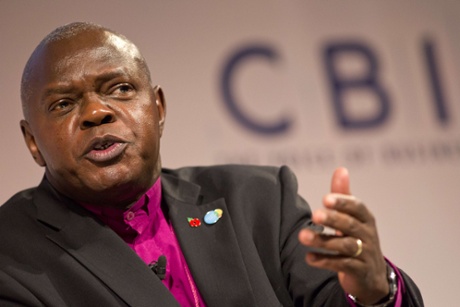
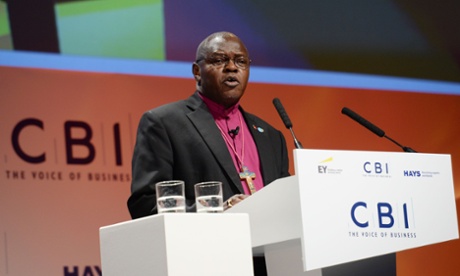
Here’s Katie Allen’s story on Dr John Sentamu’s speech to the CBI today:
Businesses should start paying living wage now, Archbishop of York says
In other news today....
And in the markets, shares in Tesco have jumped over 4% today, after analysts at Bernstein suggested that an aggressive price-cutting programme could help mend its fortunes.
The Archbishop of York, Dr John Sentamu, has uploaded the full transcript of his keynote address to the CBI 2014 Conference ‘Growth For All’; just click here.
Updated
Over in New York, the Dow Jones industrial average has nudged a new record high in early trading.
The Dow touched 17575 points, up 2 points on Friday’s close.
Traders are anticipating a quiet day, as tomorrow is a holiday (for Veterans Day).
Markets Now » Dow briefly touches a new intraday all-time high: http://t.co/Ew0MA9EIZw
— CNBC Now (@CNBCnow) November 10, 2014
Mili - If I am PM, I will not play games with our EU membership #CBI2014
— Ian Silvera (@ianjsilvera) November 10, 2014
Heads-up: Labour leader Ed Miliband is addressing the CBI’s annual conference, arguing that Britain should not leave the European Union.
#Miliband: No place for Britain to turn inward, #Brexit is a betrayal of our national interests. #CBI2014
— Open Europe (@OpenEurope) November 10, 2014
Full coverage here:
Ed Miliband speaks at the CBI annual conference: Politics Live blog
Aldi announces 35,000 new jobs (by 2022)

Discount supermarket chain Aldi has announced that it will create 35,000 new jobs in the UK, over the next eight years.
The employment splurge comes as Aldi spends £600m on expanding its store footprint, opening another 550 outlets by 2022 (which we’ve known about for some time)
The plan was announced as Prime Minister David Cameron visits Aldi UK’s Warwickshire headquarters:
Visiting Aldi's distribution centre, where today they're announcing 35,000 new jobs - good news for our economy. pic.twitter.com/ejp9wu8wFM
— David Cameron (@David_Cameron) November 10, 2014
Press Association has more details:
The company’s grocery market share now stands at 4.8% following the rapid growth of discounters in the UK, led by Aldi and German rival Lidl.
Aldi opened 42 new stores last year and is on course to open another 54 this year, with another 60-65 new stores planned to open in 2015. The Aldi group now has more than 7,000 stores across three continents.
Its job plans in the UK include the creation of at least one apprenticeship position per store, per year. This will be supported by a new academy located at Aldi’s office and distribution centre in Bolton, which is due to open in March.
Chancellor George Osborne said: “It is fantastic to see great success stories like Aldi creating jobs and increasing opportunities for young people.”
Worth noting that Aldi does not appear on the list of 1,000 firms paying the Living Wage.....
Updated
Lunchtime summary: Archbishop challenges CBI over wages

Time for a recap...
Archbishop of York Dr John Sentamu has made a passionate plea to businesses to end Britain’s income inequality.
Employers who can afford to pay the living wage “should just get on with it”, Sentamu, who chaired the living wage commission, told the CBI’s annual conference.
He told business leaders that:
“Work must pay but not pay poverty wages....”.
“The economic recovery provides the perfect opportunity for us to ensure many more people are paid a living wage.”
Sentamu also had little time for the suggestion that firms can’t afford to pay the living wage (£9.15 per hour in London and £7.85 outside the capital)
“Most businesses, sorry to say, they can afford to pay the living wage and they should just get on with it. I’m sorry, they should just get on with it,”
The latest European economic data has shown that the eurozone economy remains weak.
Fears have heightened that Italy is back in recession, after industrial production slid by 0.9% month-on-month in September. The last three months has been the weakest quarter since the end of 2012.
Here is longer view from Barclays on Italy's industrial output. This is worse than Italy's crisis in Great Depression pic.twitter.com/F0EJMZxQdJ
— A Evans-Pritchard (@AmbroseEP) November 10, 2014
The picture is no better in Greece -- where industrial production is down 5.1% in the last 12 months. The country has also fallen deeper into deflation, with prices down 1.7% year-on-year.
And investor confidence in the eurozone remains weak, despite rising for the first time in three months.
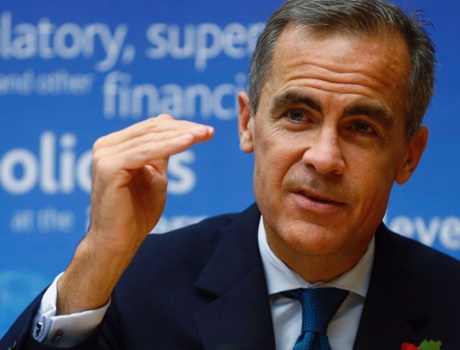
The day began with Bank of England governor Mark Carney warning that international regulators need to work more closely to stamp out bad behaviour in the banking sector.
Carney (in his role has chairman of the Financial Stability Board) also announced new proposals to make globally systemic banks hold more capital to cover losses. A “watershed moment”, he claims.
And in the markets, Serco shares remains at a 10-year low after slumping 30% following its latest profit warning, and plans to raise more cash from shareholders.
Over in Moscow, the Russian central bank has been counting the cost of the Ukraine crisis, and the decline in the oil price.
And it’s not cheap -- the bank has slashed its growth forecasts, expecting growth of just 0.3% this year, nothing at all next year, and just 0.1% in 2016.
That forecast of near-stagnation is based on Western government’s keeping sanctions on Russia until 2017.
Reminder: our politics liveblogger Andrew Sparrow is covering the main action from the CBI conference here:
Cameron and Miliband speak at the CBI annual conference: Politics Live blog
The Labour leader is due in under two hours, I believe. We’ve already heard from the prime minister - here’s a video clip:
The Archbishop of York may have won some converts to his call for businesses to fight inequality and embrace the living wage (see 12.08pm onwards for details)
CBI deputy director general Katja Hall closed today’s debate with a call to action, she paraphrases Sentamu and tells the business audience:
“You are the gatekeepers of opportunity, so go out and do your bit”.
John Sentamu asks why the best minds in business at #CBI2014 can't come up with a good way of #LivingWage being acceptable #Corpgov
— Dina Medland (@dinamedland) November 10, 2014
More stirring words from the Archbishop of York to Britain’s business leaders:
Sentamu wants to end income inequality:If someone is drowning we shd save them, but also go upstream and stop the people pushing them in.
— Katie Allen (@KatieAllenGdn) November 10, 2014
Updated
Archbishop of York: Most businesses can pay the living wage and should 'get on with it'

CBI deputy director-general Katja Hall has asked Dr John Sentamu what businesses can do if they cannot afford to pay the living wage.
The Archbishop of York starts off sympathetic, before turning to the majority of firms that can, in his view, afford to pay the living wage - which just as a reminder is a voluntary pay rate set to provide a decent standard of living. It is £9.15 in London and £7.85 outside the capital.
Sentamu says:
“I would rather businesses stay in business than go bust because they have to pay the living wage.”
He concedes for some retailers, for example, it is hard to pay the living wage.
But the archbishop adds: “I still think they could engage in what you call social mobility.”
Then the heart of the matter:
“Most businesses. sorry to say, they can afford to pay the living wage and they should just get on with it. I’m sorry, they should just get on with it.”
Strong words fr @JohnSentamu #CBI2014 "Most businesses, sorry to say, .. can afford to pay the living wage and should just get on with it."
— Katie Allen (@KatieAllenGdn) November 10, 2014
"Most businesses can afford to pay the Living Wage and they should just get on with it!" - Archbishop of York addresses the CBI.
— Joel Hills (@ITVJoel) November 10, 2014
Government also has a role in boosting pay, not just employers, Sentamu goes on to say.
He uses the example of contracts awarded to the private sector by the public in social care. He also says taxes must be set so “that those who are doing the right thing are not being penalised.”
Archbishop of York: UK income inequality "is a stain on all our consciences.”
Back at the CBI’s annual conference, Dr John Sentamu, the Archbishop of York is introducing a debate under the banner: ‘Fair for All’ not a ‘Free for All’.
He warns that Britain is at risk of becoming a divided country of haves and have-nots living in parallel worlds, Katie Allen reports.
Sentamu begins by highlighting growing inequality, the number of people in work living in poverty and his push for the living wage to be paid by all who can afford it.
'there's a strong role for gov & biz to take a lead on the #livingwage' - Archbishop of York #CBI2014
— GreatBusinessDebate (@bizdebate) November 10, 2014
Sentamu, who headed the living wage commission, describes what he sees as “flaws in the practice of free market economies” with “no mechanism to reduce disparities between the haves and have-nots.”
Economic models, he says, are based on idealism and dogma and on projecting the future but in reality the future is an unknown.
He highlights the latest research on low pay by consultants KPMG last week that found a fifth of workers are on less than the living wage.
He lauds CBI members for getting behind the living wage, which now has more than 1,000 accredited employers. But he flags up the higher likelihood that the young and women will be trapped in low pay.
“But there is still a long way to go. Recent research shows there are a number of group that are still suffering disproportionately,”.
The Archbishop also has strong words of warning on pay:
“Britain is at risk of becoming a place where the haves and have-nots live in separate parallel worlds... Income inequality is a stain on all our consciences.”
Dr John Sentamu, Archbishop of York gives great speech at #cbi2014 about UK poverty & importance of business to be responsible @CBItweets
— Guy Grainger (@JLL_Guy) November 10, 2014
Updated
On a slightly brighter note, eurozone investor confidence has stopped falling, but remains close to an 18-month low.
The monthly measure of investor morale, from the Sentix research group, came in at minus 11.9 this month, up from minus 13.7 in October.

Sentix says the recent “strong downtrend” of falling economic expectations has now stopped.
Investors are more confident about future prospects, following the latest announcements by the Bank of Japan and the European Central Bank. However, their assessment of the current situation worsened again.
Sentix says fears of a global downturn have eased.
Nevertheless, it remains unclear if the current month’s rise in economic expectations is just a one-off or a more important turn to the positive. The sentix data justify cautious optimism, but not more than that.

Deflation in Greece - 20 months and counting: pic.twitter.com/pMQ8doqqYY
— Jamie McGeever (@ReutersJamie) November 10, 2014
And another: (see 9.30am for details of today’s disappointing data)
Here is longer view from Barclays on Italy's industrial output. This is worse than Italy's crisis in Great Depression pic.twitter.com/F0EJMZxQdJ
— A Evans-Pritchard (@AmbroseEP) November 10, 2014
Hat-tip to the Telegraph’s Ambrose Evans-Pritchard for tweeting this chart showing how Italy’s industrial production has deteriorated in recent months:
Italy's industrial output keeps falling and falling pic.twitter.com/fJ9P3dC12N
— A Evans-Pritchard (@AmbroseEP) November 10, 2014
Another reason to worry about the eurozone -- Italian banks have reported that bad debts are up by almost a fifth in the last year.
The amount of non-performing loans within the Italian banking sector rose by 19.7% year-on-year in September, to €176.85bn.
That suggests the weak Italian economy is taking its toll on the banking sector - which fared badly in last month’s eurozone stress tests.
Updated
Back at the CBI conference, Fredrik Reinfeldt, leader of the Moderate Party and former Prime Minister of Sweden is telling business leaders“how to restore Europe’s competitive advantage”.
Reinfeldt sets out what he sees as four priorities to boost competitiveness.
- “You need to be able to handle a financial crisis”, a future one, not the last one, he adds. [this is something Mark Carney tried to address this morning with new capital rules for the biggest banks]
- Europe needs to address highly indebted countries, which are creating uncertainties about public finances.
- “You need to address the fact of your unit labour cost, this is at the core of being competitive”.
- “You need to have [a] better functioning internal market”.
Britain’s PM has also addressed the event -- full highlights here:
Cameron and Miliband speak at the CBI annual conference: Politics Live blog
Greek deflation picks up in October, prices drop for 20th month pic.twitter.com/I1fwiKXCyw
— cigolo (@cigolo) November 10, 2014
I see the deepening of deflation in Greece as a result of lack of liquidity and increased political risk.
— Yannis Koutsomitis (@YanniKouts) November 10, 2014
Greece inflation hits -1.7% in October
Greece has fallen deeper into deflation, according to the latest consumer prices data just released.
CPI fell by an alarming 1.7% year-on-year in October, from ‘just’ minus 0.8% in September. That’s the biggest drop this year.

On an EU harmonised basis, prices are down by 1.8% over the last year, from minus 1.1% last month.
Greek October HICP *inflation* -1.8% YoY.
— Frederik Ducrozet (@fwred) November 10, 2014
That means prices have now been falling for the last 20 months running, as Greece’s austerity programme hits demand and forces down wages.
Ugly numbers out of Greece.
— Jonathan Ferro (@FerroTV) November 10, 2014
Updated
Just getting some Greek industrial production data on the wires, suggesting the country’s downturn continued....
Industrial output in September was 5.1% lower than a year ago, following a 5.9% annual slide in August.
Greek Sept Industrial Production comes in at -5.1% y/y from -5.9% in Aug
— Mauro Ippolito (@MauroIppolito) November 10, 2014
#Greece | SEPT INDUSTRIAL PRODUCTION Y/Y: -5.1% V -3.8%E pic.twitter.com/15kELoAV0p
— Ioan Smith (@moved_average) November 10, 2014
Updated
“Do not be fooled: by withdrawing from Europe we do not somehow become more open to trade elsewhere; " CBI President Mike Rake
— Faisal Islam (@faisalislam) November 10, 2014
CBI warns of tough choices, and eurozone risks

Back in London, Sir Mike Rake is kicking off the CBI conference with a speech outlining the business lobby group’s case for Britain staying in the EU.
He also has a list of reasons to be nervous about the pace of recovery, my colleague Katie Allen reports.
Rake says Britain is “continuing its journey back to growth”....
...But he adds that “many challenges remain”: export performance is “not matching our ambitions”, wages “remain subdued”, productivity is “disappointing” and on the public finances front more work is needed with “one of the largest deficits” in the OECD group of mainly rich countries.
“There are tough decisions ahead for the next government if it is to balance the books.”
Rake also highlights risks in the eurozone and further afield. Rake, says:
“We cannot afford to make matters worse for ourselves... Underpinning many of the major political debates of our time is thus fundamental question about Britain’s role in the world in the face of globalisation and increased competition.”
The full conference being webcast here.
And my colleague Andrew Sparrow is covering the political action (speeches from David Cameron and Ed Miliband) in his liveblog.
Cameron and Miliband speak at the CBI annual conference: Politics Live blog
Updated
Italy's Industrial Production in SEP dropped like a stone to -2.9% y/y #EuropeSlowing
— Keith McCullough (@KeithMcCullough) November 10, 2014
Maxime Sbaihi, Eurozone economist at Bloomberg, also reckons that the decline in Italian industrial output will drag down its economy.
Italy is already on the brink of recession, after seeing its GDP decline by 0.2% in the second quarter of the year (Q1 was flat)
Italian Industrial production goes diving in September. Sector's Q3 contraction will weigh on GDP over that period. pic.twitter.com/DA0iQ7LiWL
— Maxime Sbaihi (@MxSba) November 10, 2014
Updated
Italy Industrial Production fell 1.1% Q/Q in Q3 - doesn't look good for GDP.
— MineForNothing (@minefornothing) November 10, 2014
Updated
Italian industrial production fell 0.9% in September
Fears over Italy’s weak economy have just deepened, with the news that manufacturing output has fallen again.
Statistics body ISTAT reports that Italian industrial production shrank by 0.9% month-on-month in September. Economists had expected a 0.2% decline.
That means that industrial production has shrunk by 1.1% over the last quarter, accelerating from a 0.5% decline in April-June. That’s the biggest fall since the last three months of 2012.
And on an annual basis. production was 2.9% lower than in September 2013 (when you adjust for the fact there was an extra working day this year).

I fear this makes it more likely that Italy will officially enter recession again on Friday, when eurozone GDP figures for the third quarter of the year are released.
Italy's industrial output down 0.9% m/m in Sep (RT poll: -0.2%, +0.2% in Aug) IP down 1.1% in Q3 (-0.5% in Q2), steepest drop since Q4 2012
— Markit Economics (@MarkitEconomics) November 10, 2014
Further grim news from Italy. Industrial output in September dropped 0.9% - a bigger than expected drop. Leaving recession may take longer.
— Gavin Hewitt (@BBCGavinHewitt) November 10, 2014
Updated
Full story: Serco shares crash after latest profits warning
Serco shares plunge 30% to 10-year low
Ouch. In the City, shares in outsourcing firm Serco have tumbled by around 30% after it hit shareholders with a profits warning, and a big cash call.
Serco is proposing to raise £550m through a rights issue after cutting its earnings forecast again.
It also identified £1.5bn of impairments on a string of public sector contracts, including maintaining patrol boats for the Royal Australian Navy, and various deals with the UK government.
That sent Serco’s share price down to a 10-year low:

Rupert Soames, the newish CEO, reckons Serco is taking its medicine now.
“The rapid progress we have made in recent weeks on the Strategy Review and the Contract & Balance Sheet Reviews has brought us to the point that we are able to provide an initial estimate of the impairments, write-downs and Onerous Contract Provisions that are likely to be required at year end.
Whilst it is a bitter pill, it is better for all concerned that we swallow it now and establish a really solid foundation on which to build Serco’s future.”
There’s a spot of French in the statement too.
Rupert Soames-isms in Serco's update: "like the French phrase "reculer pour mieux sauter"; we need a step back to leap forward"
— Lucy Tobin (@lucytobin) November 10, 2014
Even when he speaks French, Soames' corporate lingo is more like speaking understandable English than most corporate dullards
— Lucy Tobin (@lucytobin) November 10, 2014
Updated
Europe’s stock markets are have risen a little in early trading.
No major dramas - Danish brewer Carlsberg are up 3% in Copenhagen, after posting higher sales despite the impact of Russian sanctions.

Britain’s CBI set the scene for today’s annual conference by backing two new policies to help working families:
My colleague Angela Monaghan explains:
The CBI is calling for a gradual increase in the threshold at which employees pay national insurance to £10,500 – bringing it line with the income tax personal allowance – over the next parliament.
It calculates that for a family with two earners, it would mean an extra £363 a year in take-home pay. “I think that would make a difference,” Cridland said.
The CBI calls for an extension of the 15 hours a week of free childcare for three- and four-year-olds to all one- and two-year-olds, saving the average family with a one-year-old £3,430 a year.
But as many readers have pointed out, perhaps business leaders could do their bit and actually push wages up too, rather than expecting government to do everything.....
CBI calls for tax cuts and childcare subsidies for working families
The FSB has also predicted that these new capital rules for the world’s most powerful banks could push up their cost of doing business.
That could make them less competitive, or able to pay smaller salaries. An incentive to not become a globally systemic bank....
What the FSB thinks ending Too Big To Fail will mean pic.twitter.com/3lLu9puyIc
— James Titcomb (@jamestitcomb) November 10, 2014
Carney: 'watershed moment' in avoiding more bank bailouts
Mark Carney has also declared this morning that regulators have reached a “watershed moment” in squashing the “too big to fail” problem.
The Financial Stability Board has agreed new standards for globally systemic banks, which should force them to hold enough capital to absorb losses without threatening financial stability.
Carney said:
“Once implemented, these agreements will play important roles in enabling globally systemic banks to be resolved without recourse to public subsidy and without disruption to the wider financial system.”
If the FSB is right, the rules could avoid a repeat of the taxpayer bailouts that were implemented in the financial crisis of 2008-09.
Full story here: Mark Carney hails new deal for ‘too big to fail’ banks
Mark Carney hails new deal for too big to fail banks http://t.co/rMmaDtXgBm
— Jill Treanor (@jilltreanor) November 10, 2014
Mark Carney: We need closer co-operation to tackle bad bank behaviour
Mark Carney, governor of the Bank of England, has issued a plea for the world’s central banks and regulators to work more closely to tackle financial misconduct.
Speaking in Basel a few moments ago, Carney warned that authorities need closer co-operation to tackle bad behaviour.
He also cautioned that the culture of the sector needs to be improved -- simply announcing new market reforms isn’t enough to make miscreants toe the line.
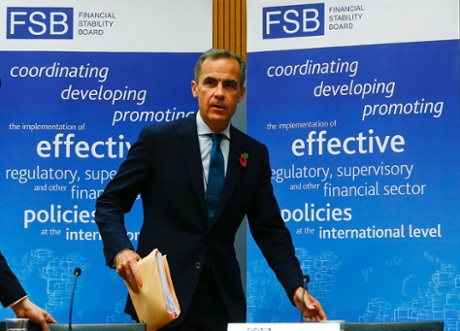
As Carney put it:
“We need the fixes to bank conduct but we also need to ensure that, to the maximum extent possible, there is coordination across authorities, both in terms of identifying, investigating and punishing misconduct,”
Carney was speaking in his role as chief of the Financial Stability Board, the body that overseas the global financial system.
And he warned that the stability of the system could be threatened by the failure
“We are undertaking a series of reforms that change the way markets work which reduce the opportunity of misconduct, but that’s not the same as having the right culture codes in order to perceive it.
This has risen to the level of financial stability and we need a comprehensive approach to address it.”
The warning comes as UK regulators prepare to impose large fines on a group of banks over allegations that their staff conspired to rig currency rates.
More to follow...
The agenda: Weak Eurozone economy in focus
Good morning, and welcome to our rolling coverage of the financial markets, the world economy, business and the eurozone.
Looks like a quiet start to the week, as the markets digest what last Friday’s unspectacular US jobs report means for the economy.
Two pieces of European economic data could be interesting, as the region’s economy continues to struggle.
The latest Sentix survey of eurozone investor confidence is released at 10am BST, and should show whether morale has deteriorated again this month.
And we get new Italian industrial production data for September -- which may fuel fears that Italy’s economy entered recession last quarter:
#Eurozone economy today: 10:00 Italian industrial production for September
— Forward Guidance (@ecoeurope) November 10, 2014
We’ll have an eye on the CBI’s Annual Conference in London, which will include appearances from several ‘senior cabinet ministers’.
Labour leader Ed Miliband is giving the keynote speech at 2.30pm, and will warn of the perils of Britain leaving the European Union. A high-pressure speech, given the rumours swirling about his own position.
Tune in & watch @CBITweets flagship Annual Conference #CBI2014 via the live webcast on Monday 10 Nov at 9.15am http://t.co/FR771FzA3h
— UKTI (@UKTI) November 7, 2014
I’ll be tracking the main events through the day...