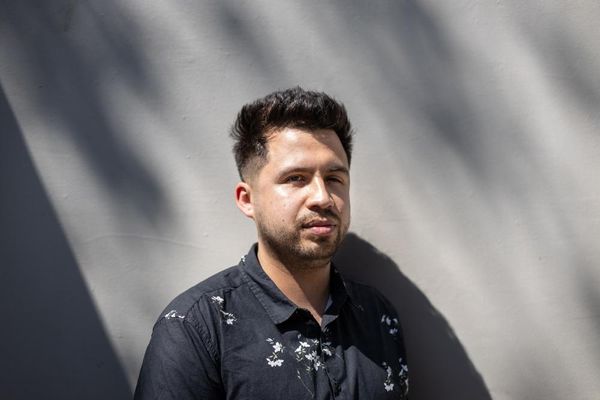
Mark Bonnar takes comfort in the fact that he once played the back end of a pantomime cow. It was the actor’s first stage role, at the amateur Leith theatre in Edinburgh, the city where he was born. It was a funny start for a man who would go on to be known for the icy stare of his green-grey eyes.
Back in 2008, he was in Michael Grandage’s Twelfth Night at Wyndham’s theatre, and on press night, he started to feel a serious case of nerves. “I knew Branagh was in the audience, and Judi … I was Orsino, so I opened the show with ‘if music be the food of love, play on.’” He starts to thump his chest. “My heart was giving it that,” he says, “and then I remembered about the pantomime cow. I thought, it’s all right, isn’t it?” He laughs. “It’s not a big deal, look …” If you can be the back end of a cow … “you can do anything”.
I meet Bonnar over hasty supermarket sandwiches in his lunch break. He’s much more twinkly in the flesh than his famous TV baddies and bastards, from Line of Duty to Apple Tree Yard, would suggest. But he’s also adept at comedy, playing the acerbic and pathologically dry Chris in Catastrophe, as well as popping up in Psychoville and the rebooted Porridge.

We’re at a rehearsal space in south London, where he’s finishing preparations for a new play at the Royal Court, Thomas Eccleshare’s Instructions for Correct Assembly. “It’s ostensibly about a man and a woman” – played by Jane Horrocks – “who have lost their son to a heroin overdose when he was 21,” he explains. “So they buy a new one, a flatpack son. A son they can construct. It’s about love and our relationship with technology, I suppose, and about parenting, and loss, obviously. All the big questions.”
It’s the first time Bonnar has been on stage in six years, bar a monologue for Mark Gatiss’s Queers at the Old Vic in 2017. “I made a conscious decision after I did The Duchess of Malfi at the Old Vic [in 2012], when my daughter was six months old, to try doing more screen work,” he says. By that point he’d been doing theatre almost exclusively for over 10 years, and wanted to see what it was like in front of the camera. It also meant he had more time to spend with his two young children. “Certainly with stage, as I’m remembering, you don’t get to spend any time at home. With film, you might do three, four days a week, and they might not be full days. So that aspect of it was a consideration. But I also just wanted to try different kinds of working.”

Almost immediately, he was cast as the philandering Duncan in BBC1’s Scottish take on scandi-noir, Shetland, a role that’s about to take him into its fifth series. “It’s a lovely thing to do,” he says. “And there were a few bits and bobs along the way, but Line of Duty was certainly a big break, if you like. It was the biggest part I’d played on telly, with the biggest profile.”
In fact, his turn in the second series of Jed Mercurio’s show, playing the incorrigibly corrupt DCC Dryden, almost didn’t happen. Robert Lindsay had been cast but left the production two days in; Bonnar stepped up with barely any time to prepare. At one crucial point in the show’s labyrinthine plot, Dryden faces an interrogation that lasts 17 unbroken minutes of screen time. The scene is breathtakingly intense. “Never in my life had I seen a script [for one TV scene] that had 19 pages in it. That’s the genius of Jed ’s writing. He’s unafraid to go places other people don’t.”
As the series progressed, its ratings grew, and by the finale, Line of Duty hype had reached fever pitch. “Man, I loved it. Who wouldn’t?” says Bonnar. “There was a point when somebody texted me a picture of me and Keeley [Hawes, who played Detective Inspector Lindsay Denton] on the front page of the Times! Just the name, and ‘whose team are you in?’ I thought, my god, it’s kind of mental.”

Since then, he’s been on a roll, jumping from one quality TV show to the next, most recently in the grimly gripping Unforgotten, where he was a gay barrister who had been sexually abused as a child. He puts some of his success down to luck, or, as he puts it, “a chaotic miasma of circumstance that brings you to somebody’s door”. For example, when he played Eric Morecambe in BBC4’s Eric, Ernie and Me, he was lucky that his wife, the actor Lucy Gaskell, was from Wigan, and could help him with his north-west accent. “But it also helped when I woke up the morning of the audition saying, ‘I’m not going to do it. I can’t, it’s not me, I’m not right.’ She was going, ‘Don’t be stupid, get out of the door and go.’”
He thinks it’s probably easier to be married to another actor, though he’s never been married to anyone else, he points out. “It’s a weird one, isn’t it, because sometimes you have to look deep into somebody’s eyes and tell them you love them and do it every night, or for millions of people to see on the telly. So yeah, I suppose it’s a bigger leap for those who don’t do it themselves, to imagine what the fuck you’re doing.” He laughs. “You have a shorthand: ‘God, I had to get my pants off today, it was really embarrassing.’ That’s all it would take, rather than, ‘You had to do what? Why? In front of how many people? 16?’”
It was the simple fact that he loved Instruction for Correct Assembly so much that brought Bonnar back to the stage, even though his TV career continues to go from strength to strength. While he acts in a dystopian play about rebuilding one’s dead child, he will appear on Channel 4 in another near-future role, the third series of Humans. He plays a government scientist – other details are secret, including whether he’s a goodie or a baddie. “I don’t know if I should tell you that. And anyway, I think it’s more complicated. He’s neither one nor t’other. But both, maybe,” he teases.

Why does he think audiences are so fascinated with the future right now? “I was in my 20s in the 90s, when mobile phones were first around,” he says. “That wasn’t that long ago. It feels like the rate at which it is evolving is far outstripping the rate at which we are.” He mentions fake news, Trump and the Cambridge Analytica revelations. “That kind of thing is exactly why we should be questioning our relationship with technology and truth and memory, and all the exciting things that this play brings up, albeit in a very domestic setting. That’s why things like Black Mirror are such a huge hit, because people are, rightly, terrified about what this all means.” He left Facebook himself a year ago, he says, and hasn’t missed it.
Bonnar will turn 50 in November. “It gets weirder, the older you get. You look in the mirror,” he says, with a dramatic sigh, “and go, Jesus Christ, it’s all going so fast. I certainly don’t feel 50.” It’s also his mum and dad’s 50th wedding anniversary this year, and their 70th birthdays, so they’re thinking about getting together for one massive party. “My dad went to art school when I was one. They scraped and continued scraping, because artists, as we all know, don’t earn a lot of money. It’s a precarious existence and my mum didn’t work, so dad sold paintings. He was town artist for a couple of places, in the glorious 70s, when a thing like that even existed. A town artist, wow.”
There’s a knock on the door, and Bonnar’s lunch break is up. This is the last day before they move into the theatre, and time is tight. Before he goes, I ask if he ever takes offence at being known as such a good villain. “No, I don’t think so,” he grins. “I relish it in a way, because you get to do things you would never obviously do. It’s more interesting to dive into those kinds of psyches.” And, he says, he’s got a good thousand-yard stare. “I do a good cold, hard stare,” he nods. Go on then. And he turns to me, and stares, and it’s so unnerving that I begin to squirm. “Yeah?” he says, refusing to drop it, for just a second too long. And then he starts to laugh.
- Instructions for Correct Assembly is at the Royal Court, London, until 19 May.