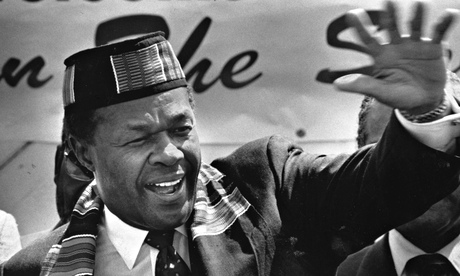
‘I may not be perfect,” said Marion Barry, four times mayor of the capital of the US, “but I’m perfect for Washington.” By any normal standard, Barry, known as Washington’s “mayor for life” – he was in fact mayor for four terms and a member of the city council off and on from 1974 until his death, at the age of 78 – was a highly imperfect human being. He was famously videotaped in an FBI sting using crack cocaine in the company of a woman who was not his wife. At other times, he was in trouble for drug offences, for stalking and for political misdemeanours and hypocrisies, going all the way from ruining the finances of the national capital to stuffing his cronies into jobs and taking 17 of them on a jolly in the Virgin Islands when the city was on its knees.
Nor was he right for that part of the District of Columbia, Northwest, that accommodates the White House, the government of the nation, the embassies along Massachusetts Avenue or the elegant suburbs from Georgetown and Cleveland Park to Chevy Chase, where congressmen, lawyers and lobbyists live. Barry’s Washington was in Northeast and especially Ward 8, beyond the Anacostia river, where his constituents loved him and forgave him for all his trespasses, personal and political.
Barry was born, like the great blues guitarist BB King, in Itta Bena, Mississippi, the son of a sharecropper in the heart of the Delta, that torrid oval of cotton, blues music and racial oppression that has been for two centuries the heart of American darkness, the deepest of the Deep South. He was born, like Harry Truman, with a middle initial S that stood for nothing; it was young Marion himself who said that it stood for Shepilov, the name of a disgraced Soviet politico of the 1950s. Marion’s father, Marion Sr, died when he was four, and he helped his mother, Mattie, by working at many jobs, including chopping cotton. But he contrived to get an education, first at LeMoyne College, Memphis, Tennessee, then at Fisk, an all-black college in Nashville, Tennessee.
In 1965 he was one of the founders and the first national chairman of “Snick”, the famous Student Nonviolent Co-ordinating Committee, which supported Martin Luther King Jr. In 1967 Barry went to Washington, where he founded Pride Inc, an outfit that benefited from President Lyndon Johnson’s war on poverty, finding jobs for inner-city African-American youth. Good-looking and fluent, he swiftly rose in politics from the school board to the city council to, in 1978, challenging and beating the mayor Walter Washington. He was lucky, too: he was shot by radical black Muslims who invaded his office in 1977, but the bullet stopped just short of his heart.
Barry was re-elected mayor in 1982, 1986 and, after an interval due to the FBI bust and a six-month prison sentence, again in 1994. From his first term, his time in office was plagued with financial problems. Part of this was caused by his lavish expenditure, especially on well-paid city jobs for his supporters and other attempts to alleviate the desperate poverty to be found within a few hundred yards of Washington’s marble monuments. He liked to represent the District of Columbia as a colony, its black inhabitants oppressed by a white power structure.
He tried to tax the well-paid, mainly white people who worked in the District but lived in the Virginia and Maryland suburbs. The courts overruled him, and the District was indeed under the control of a congressional committee dominated by white southerners. One of many other complications was the hostility of the trade unions who saw Barry as “pitting black workers against the poor”, Barry’s core constituents from Ward 8 and the other desperate neighbourhoods in the east of the city.
Barry was genuine in his desire to help the District’s black underclass, but the city was considered the worst governed in the US, and widely known as the most murderous. At the same time the mayor’s private life was cheerfully self-indulgent: he was devoted, if not addicted, to marijuana, alcohol, crack cocaine and sexual adventure. He roamed far beyond marital boundaries, and many of his constituents loved him for living as they would have liked to. In spite of, indeed partly as a result of, his populist policies, his city, and perhaps especially the poor people who loved to vote for him, suffered miseries during his reign. While white Washington experienced a heady construction and property boom, the population of the District fell from over 700,000 to half a million, while the metropolitan area, with its ring of white suburbs, became one of the wealthiest areas in the US.
The District became a byword for crime and drug abuse, while its “mayor for life” lived high on the hog and lurched cheerfully from one scandal to the next. Shortly before his death, it transpired that he owed his own city $2,800 in motoring fines. He had no difficulty in finding the money to pay them.
If, to the District’s affluent inhabitants and commuters, Barry was the Sheriff of Nottingham, in the eastern wards he remained Robin Hood. In 1998 he announced he had “retired from politics”, and in 2002, after various shenanigans, including $35,000 in civil damages for a contretemps with a woman at an airport and a little matter of crack cocaine and marijuana found in his car, he was for once unsuccessful in an election to the council. But in 2004 he was back in the council and was still serving Ward 8 at the time of his death.
He is survived by his fourth wife, Cora, and a son, Marion.
• Marion Barry Jr, politician, born 6 March 1936; died 24 November 2014