On a Saturday evening in July 2013, Terrence Morales McWilliams had just stepped into a subway car on his way to play basketball with friends when he received a troubling text message about his brother. He immediately called his mother. “Mario got shot,” she said.
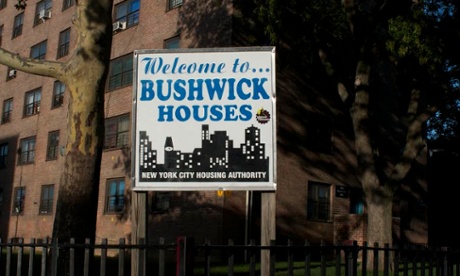
It was the kind of message that McWilliams and other residents of the Bushwick Houses, a New York City Public Housing Authority (NYCHA) development, dread getting. The details were unclear, but McWilliams, 21, jumped off the train at the next stop and rushed to nearby Woodhull medical center in Brooklyn. As he ran inside, he passed a group of neighbors who had gathered to support the family.
The news was not good. Shortly after arriving, McWilliams, his mother and older brother were taken into a private room. A doctor delivered the message they had been dreading: Mario, only 18, had died.
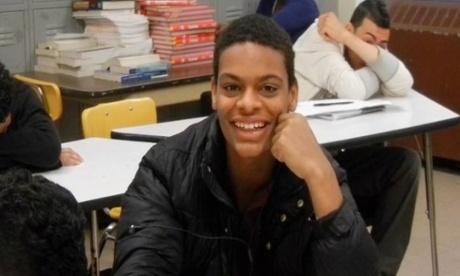
To many New Yorkers, Lopez may have been little more than a statistic, an easily forgotten casualty of one of the city’s most dangerous public housing developments. But McWilliams feels the loss constantly. His long-term relationship broke up. He started and dropped out of college, and he’s had to cope with his mother’s grief. “My little brother not being here changes a lot,” he said. “Everybody knew him, and they know me. But he’s not here, so it’s just weird now.”
McWilliams shares an apartment in the Bushwick Houses with his mother, Carmen Lopez, her husband, and his three younger sisters, aged five, seven and 16. His three older brothers have all left the development. Lopez’s death has been especially hard on McWilliams’s mother, and he said she plans to leave New York in the next couple of years and move to Puerto Rico to live near her father. She declined to be interviewed for this article.
While crime across the city decreased by about 5% between January and October last year, it increased by 44% in the Bushwick Houses. Summer is the most dangerous time to live in a NYCHA development. Jahmal Jerome, 24, was fatally shot on 10 August as the annual Bushwick Houses Family Fun Day was coming to a close. Two women, a 47-year-old and 50-year-old, were also injured in that shooting. At midday on 25 September , Bobby Roberts, 22, was also fatally shot as he came out of a building in the development.
While 5% of New Yorkers live in NYCHA developments, 16% of the city’s 235 murders occurred on NYCHA properties as of the end of September. The Bushwick Houses is one of 15 of the city’s housing developments singled out in an anti-violence initiative launched by Mayor Bill de Blasio in July. The $210m plan includes increased police patrols, installation of exterior lighting and expansion of community programs in the 15 selected developments.
‘A really sweet kid’ in dangerous circles
The initiative won’t bring back Lopez, who was known as funny, outgoing and smart, with a smile that filled his face and a personality to match. “If there were 10 people there, he’d be the funniest of the group,” McWilliams said. He was on the junior high school chess team and played chess regularly at the Bushwick-Hylan Community Center, which offers a range of programs geared toward helping teens stay off the streets.
For a while, it seemed to help him do that. Lopez attended the High School for Enterprise, Business and Technology and was well known to many of his teachers. “Mario was hard to miss,” said Angela Meloni, 25, an English teacher who taught Lopez. “He had a lot of friends and was a really sweet kid.”
In the years before his death, though, Lopez began to move in dangerous circles within the development. “He was real smart, he just did dumb things,” McWilliams said. He belonged to the Young Stackers, a crew of teenagers from the Bushwick Houses, according to Captain Julio Delgado of Police Service Area 3. The New York police department estimates about 300 crews made up of kids aged 12 to 20 operate within the city’s 334 public housing developments.
Lopez and the Young Stackers allegedly had an acrimonious rivalry with a crew from the nearby Tompkins Houses. The tension began to affect Lopez, said Meloni, and he missed days from school and was distracted in class.
After missing an extended period of school, Lopez told Meloni he’d been arrested, she said. She asked him what happened. “I didn’t know if he’d answer,” she said. “He looked at me for like three seconds, and he said, ‘I had a gun.’” McWilliams maintains Lopez was arrested because of a fight, not because he was carrying a gun. The Brooklyn district attorney’s office was unable to verify the charges.
Specifics of the charge aside, it was clear that in the months before Lopez died, the Young Stackers’ rivalry with other crews in the area intensified. Lopez confided in Meloni that he was getting in over his head with trouble in the neighborhood. After his death, McWilliams learned that there had been a number of violent incidents aimed at Lopez, including an attempted stabbing and an attempted shooting.
Realizing he was in a bad situation, Meloni said Lopez told her he wanted to join the army after graduation in January 2014. “He was trying to make moves to get away,” she said. “He felt like he had a lot of things stacked against him and like he had no place left to go.”
Meloni said while she advised Lopez to get out of the neighborhood, she never imagined his life was in danger. “I remember not even thinking about him dying being a possibility,” she said. “Jail was the worst thing.”
McWilliams also tried to steer Mario away from trouble. “He would never listen,” he said. He knew his brother had started getting into trouble, but he didn’t know it had become so dangerous. “You’d see him and everything would be all cool,” he said. Lopez’s mother thought he should join the army, according to McWilliams, “She wanted all of us to go.”
A summer of mourning
Exactly why Lopez became a target may never be clear. Lopez and three friends from the Young Stackers were at the Marcy Houses to attend a basketball tournament on the Saturday afternoon last year when the situation came to a head. Sometime around 6pm, a gunman approached them, fired multiple shots and fled.
Lopez had been hit in the torso, according to police reports. His three friends were also shot: a 13-year-old took a wound to the neck, a 14-year-old was hit in the leg and a 15-year-old was also hit in the leg. Police reported that nine shell casings were recovered from the scene.
Three days later, Brandon Reese, 21, was arrested in the Tompkins Houses and charged with murder, attempted murder and assault. He was sentenced to 47 years to life in prison in March. His lawyer Jonathan Strauss commented, “He’s a nice guy and he says he didn’t do it.”
Lopez’s death shocked the neighborhood. The teachers of Lopez’s school got together shortly after his death and arranged to help with the funeral costs, said Meloni. They aimed to raise $5,000 and collected $5,750.
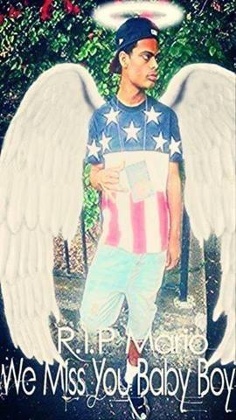
At Lopez’s wake, “boys were full on sobbing who you’d never see cry”, Meloni said. “The kids were shaken up.” Many young people, including McWilliams and one of his sisters, attended the wake wearing necklaces showing a photo of Lopez with angel wings attached. At the funeral, all the seats were taken and people overflowed into the corridor, McWilliams said.
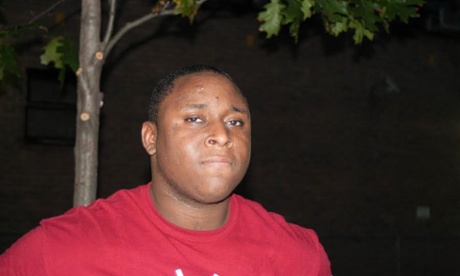
All of Bushwick Houses seemed to be in mourning. “That summer, you could tell,” McWilliams said. “Nobody would be outside in the day. The projects would be empty.” Home life was strange, too. “I was always a quiet, cool, calm person. My brother he was the opposite,” he said. “So now when you go in the house, everything is so quiet. You can tell the feeling is different.”
Soon after the shooting, McWilliams broke up with his girlfriend of three years. “I had to get my mom right and couldn’t think about females,” he said. A couple of months later he enrolled in liberal arts classes at LaGuardia Community College. He was taking three classes that started in September, but soon reduced this to just two classes.
He found it hard to concentrate on his studies. “After my brother died, my mind wasn’t right,” he said. “I would go to school every day, and I would try. But I would just be sitting there listening to teachers. I couldn’t focus. It would just be on my mind 24/7. I was stressed out.”
Adapting to loss
The upheaval caused by his brother’s death was overwhelming, said McWilliams. He tried to adapt, but he didn’t know how to do so. He ended up dropping out of school around the same time Lopez would have been graduating high school.
McWilliams is now working in the Bushwick-Hylan Community Center, trying to make sense of where his life is going. He had worked there on and off before Lopez’s death and started full-time after he left college last year.
At the community center, McWilliams works as a basketball coach and co-teaches an after-school class of seven to nine year olds, helping them with homework and reading.
His classroom is painted blue and yellow. One wall beam is covered with a checkerboard of “classroom expectations” on laminated white paper. The rules include “no bullying” and “respect all staff”.
The center offers respite from the violence in the neighborhood – and tries to prepare kids to deal with real-world problems like bullying. In the center, bullying might be over petty, childish things, but outside in the development it can be worse. “You might get approached by five guys from another project asking where you live,” McWilliams said. “If you do live in the place they have beef with, they just might beat you up.”
The center runs tournaments and programs geared towards keeping the children engaged and off the streets. “I’d rather have kids in here shooting hoops, than shooting guns,” said Kweci Luke, 32, who has been the center’s assistant director for almost two years. “A few years ago it was just a place to hang out, now it’s more. Kids come into the center and take their hats off and pull their pants up. Once you respect yourself, you’ll respect those around you.”
Luke realizes the center can’t help everyone. For all those who find shelter within its programs, others are still on the streets. And like McWilliams, many of them still mourn the loss of Lopez. His crew has changed its name from the Young Stackers to MarioWorld, and more than a year after his death they still post photos on Facebook showing themselves at Lopez’s grave or wearing the necklaces they made for his funeral.
Such feelings of loss fuel the rivalries that continue between the developments. “I don’t know if things will change, but I feel like it might just get worse,” McWilliams said. “It’s going to keep on happening. Retaliation is big.”
McWilliams hopes he can one day leave the neighborhood that has brought him so much pain. “You don’t get nothing good out of the projects,” he said. “I hate walking in the projects and just being reminded.” He would love to be an MTA train driver, but said the testing process is long and complicated.
In the meantime, he is doing his bit at the community center to alleviate the threat of violence, crime, death and jail that pervades life in the Bushwick Houses.