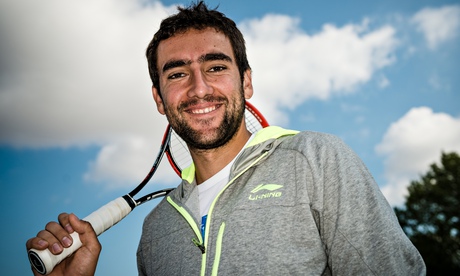
“You never know what’s behind the next hill,” Marin Cilic says in his intelligent and amused way. “It’s always the unknown and then, when the difficult times roll down the hill, you feel the same. ‘Why do these things happen to me?’ But in the end you understand that when you have some pain the good moments are even better.”
Cilic smiles in philosophical acceptance that his first grand slam victory, at the US Open last September, was made even sweeter by the turmoil of the previous year. Yet there is a stark undertow to Cilic’s memory of how, in his view, deceit and distortion implicated him in a scandal that suggested he had tested positive for nikethamide, an illegal substance, during competition.
Cilic’s ban was eventually reduced from nine months to four months by the court of arbitration for sport [Cas], and his appeal partially upheld, but his initial suspension meant that he missed Wimbledon and the US Open in 2013.
He makes some serious allegations against the International Tennis Federation [ITF] in concise detail. Cilic does not fume or rant as he reveals the way in which he alleges his test results were handled. But his disdain for the way in which “the system” works, and how his own career was affected, is plain.
The 26-year-old Croatian’s testimony is made more powerful by the considered approach he adopts in addressing the shock and distress he endured almost two years ago. Cilic, however, also deserves to linger first over his breakthrough victory at Flushing Meadows when, playing imperious tennis throughout the second week of the 2014 US Open, he produced three successive performances as sublime as they were powerful.
Cilic swept aside Tomas Berdych, Roger Federer and, in the final, Kei Nishikori, without ever looking like he might drop a set. He was especially impressive in the semi-final against Federer – who had won all five of their previous matches. “You know,” Cilic says, his face lighting up, “when I came on the court I had no nerves at all. It was a very interesting sensation. Normally in the warm-up or for the first three games you feel the nerves. But I felt so relaxed and that was a huge sign it was the right day for me.”
His free-flowing certainty was obvious in the final game. Serving at two sets and 5-4 up Cilic could have been excused for remembering that, in the quarter-finals, Federer had come back to win from a similar position against Gaël Monfils. Yet there was no recovery from a two-set deficit when Federer faced the booming Cilic serve. Three successive aces and a love game sealed Cilic’s victory.
“Absolutely,” Cilic says with a grin. “That was just being relaxed and so confident. But it doesn’t happen every day.” If he could bottle that sense of easy assurance he would be unplayable. “It would be so great,” Cilic chuckles.
Can he explain why such conviction surged through him in New York? “When you play well you have no nerves. You are calm. You know your abilities. You don’t need to get stressed. And we had so much fun with my team – stress could not come around and get in the way. Before the final I also felt completely relaxed – until about two hours before we went on court. Butterflies start to fly around the stomach. There was going to be a huge crowd and it was the most important match of my career and Kei’s career.
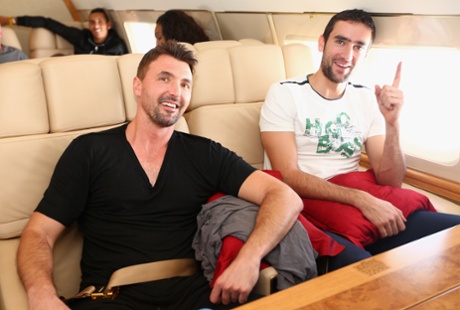
“But I spoke to Goran [Ivanisevic, my coach] and he obviously has huge experience playing in finals. His words were important. He said: ‘Look, both you and Kei will be tense but you must just play your own game and try to enjoy it. You deserve it.’ Those simple words worked.”
Did he get drunk that night? “Unfortunately not. There was a lot of media so I was at the court another three hours. We then went to a Croatian restaurant in Manhattan and celebrated there. Some of the guys got drunk and then we went out to 4am. But I knew I had to start giving interviews at 9am. I think the amazing feeling came to me more when I got to my hometown about 10 days later. The reception was overwhelming and very emotional.”
Such elation contrasted with a year earlier when he could not even play the US Open after the positive drug test. “I was more stressed than depressed,” Cilic explains, “especially when I found out later that it wasn’t clean from the other side. That caused complete stress.”
Cilic and I are in Barcelona and he leans forward as he begins to chart the fallout. Asked to clarify what he means when saying “it wasn’t clean from the other side”, Cilic looks up intently. “They were using things that were impossible to understand. They were trying to hide stuff. They sent me a notification letter of a wrong substance saying I was positive for nikethamide [in late June 2013]. That was absolutely incorrect. For me it was shocking to have people playing with my life and career.”
Why would the ITF, responsible for administering the testing procedure, adopt such an attitude? Cilic’s laugh sounds bleak. “I don’t know. We didn’t get that answer. Just to win the case, I guess. It doesn’t matter how they did it. It could have ruined me – but some people don’t care. Afterwards, when we found out in the arbitration court, it was easy to prove they had made a wrong allegation.”
Who gave out the wrong information? “You can easily see it. From the first ITF hearing it was written that I was positive to the one substance pushed by them – nikethamide. But it was not in my body. It was only the metabolites of nikethamide. The metabolites show the substance was in the system in the past. That substance is allowed out of competition – but not in competition. I played my only match in Munich that year and the test didn’t find this main substance. The Cas judgment showed it was just metabolites of nikethamide. But they put it as the main substance – they did that on purpose.”
Cilic does not deny he was guilty of taking nikethamide, by mistake, outside of tournament play. The essence of his complaint is that the ITF claimed the substance was still working actively in his system when, in reality, only a trace of metabolites showed in the test.
When asked by the Guardian to comment on these allegations, Stuart Miller of the ITF said: “Cilic was not accused of testing positive for the wrong substance. The Tennis Anti-Doping Programme rules state that the presence of a prohibited substance or its metabolites in a sample constitutes a violation. Cilic tested positive for the metabolites of a prohibited substance in an in-competition test.”
Cilic nods when I point out that he was also grossly negligent to have allowed someone in his team to buy a glucose supplement over the counter in a Monaco pharmacy – without checking the contents. “Of course I made a mistake, as did the team around me, in taking it without checking. But it can happen to anyone.”
How did Cilic discover his failed drug test? “I heard just before Wimbledon. I could not believe it. I got notification by letter. It said I was positive for nikethamide but in the end I wasn’t positive. If I knew this in the beginning I would just keep going rather than taking four months out.”
What did he feel in the first hour after receiving that damaging letter? “Just stress. Shaking. I didn’t know what to do. I knew I didn’t take it on purpose so I was trying to work out what it was. When I found out the truth about this I was confident I would be clear. But it still took four months to get the ruling corrected by Cas.”
The ITF, clearly, still stand by their own ruling. Cilic shrugs. “For some people it is just a game. Even in Croatia some of the people I was close to just crossed me. But the people around me were loyal and that makes you grateful. They are not fake. I saw that from the players. I didn’t know how they would react. But everyone was really correct and fair. Especially [world no1] Novak Djokovic. That meant a lot.”
Andy Murray, however, accused Cilic of being “unprofessional” for failing to check the contents of the pharmacy supplement. “Of course when you hear that it hurts you,” Cilic says. “But everybody looks at it differently.”
While clearing his name Cilic decided to appoint Ivanisevic as his coach. “Me and Goran started to work in September [2013]. I matured in those few months more than the last couple of years. I became more determined and dedicated because this [testing] problem gave me even a bigger push from behind.”
After they had watched Cilic lose the first two sets to Murray at Wimbledon in 2012, and rain suspended play, the BBC 5 Live commentator David Law asked Ivanisevic what he would say to his fellow Croat in the locker room if he were his coach? “Nothing,” Ivanisevic said, “I would just slap him.”
Cilic bursts out laughing before nodding when hearing that Ivanisevic went on to say that his countryman should stop trying to play tactically. At 6ft 6in, and with a huge serve, he needed to start playing aggressively. “Exactly,” Cilic says. “That’s what I have improved with Goran the last few years. I have built up my game to be very powerful and threatening to the other guys. Before I would overthink what was happening too much on court.
“Goran is down to earth. But he is passionate about playing, competing and winning. We work very hard but it is a good atmosphere. He gave me back my joy and, apart from improving my game, there was much more fun around my team. That translated into my play in New York.”
Cilic missed the next grand slam tournament, this year’s Australian Open, after injuring a shoulder. He has only recently returned to the tour and, with clay not being his best service, he is most likely to have a more sustained impact on grass – first at the Aegon Championship at Queen’s next month, in a tournament he won in 2012, and then at Wimbledon.
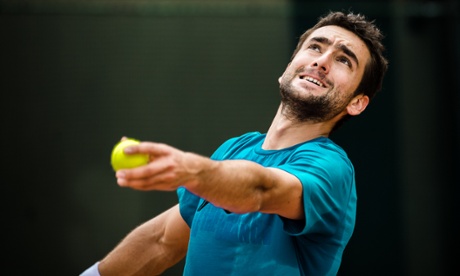
His first real breakthrough occurred at Queen’s in 2007 when, aged 18, he received a wildcard and promptly knocked out Tim Henman. “That was huge for me,” Cilic says, “and I have always felt at home in London. I think Wimbledon is a grand slam that really suits my game.”
Did Ivanisevic’s victory at Wimbledon in 2001 have a significant impact on the 12-year-old Cilic? “I was just a kid but the impact was massive in Croatia. There was a lot more funding for junior programmes after Goran won Wimbledon.”
Surely Cilic must have thought he could match Ivanisevic and also win Wimbledon? “No! Even when I was at home this Easter I saw in my room a few articles from when I was a kid. One of them said I was hoping just to play at Wimbledon. That was when I was 11 or 12. The dream then was to be in the top 100. To think about winning was too far. It was another world.”
Now, with positive drug tests and tangled allegations being replaced by his first grand slam victory, does he feel differently? “Definitely,” Cilic says with a smile. “If I am in form I have a really good chance to do well. Wimbledon’s the tournament I’ll really be focusing on. I’m feeling good. I have a lot to look forward to now.”
Marin Cilic will join Rafael Nadal and Andy Murray in the Aegon Championships at The Queen’s Club, 15th-21st June. For tickets go to www.aegonchampionships.com