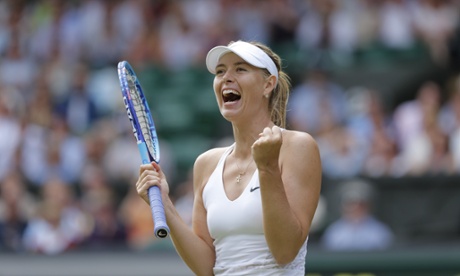
No one is better at shrugging off disappointment and regaining her focus than Maria Sharapova. Whatever life and tennis have thrown at her over the years, she has always found a way to recover. She made life tougher for herself than she would have likedon Tuesday, partly through 10 double faults and was even accused of gamesmanship but her 6-3, 6-7, 6-2 victory over the unseeded American Coco Vandeweghe was an exercise in resilience.
The Russian will play for a place in her third Wimbledon final on Thursday, 11 years after she won the title for the first and so far only time. Then she caused a huge shock when as a 17-year-old she beat Serena Williams in the final. The world No1, whom she has not beaten since the end of 2004, will be her semi-final opponent this time but having suffered early defeats in each of the past three years, Sharapova is simply relishing being back in the last four again.
“I had a really tough match last year against [Angelique] Kerber [in the fourth round],” she said. “I really felt like, although I lost, my game on grass had really improved from the year before. I really felt confident. That was a bit disappointing. So overall I am happy I was able to take that loss and move up a few steps further this year.”
Having eased into the quarter-finals without losing a set, Sharapova looked set to continue that pattern when she led Vandeweghe, ranked 47, by a set and 5-4, serving for victory. That was when things began to get more complicated as Vandeweghe hit back to win the set on the tie-break and force a decider.
A lesser player might have folded but Sharapova is a mental giant. Having raced to a 3-0 lead in the third, she dropped the next two games but broke serve twice more to clinch victory after two hours and 45 minutes.
“If you look at grand slam champions, you look at their draws, matches, results, everyone comes through a few challenges, being down in matches,” she said. “There’s no easy road to victory. You’re going to have your bumps. That’s the way I see it. Today could have been a match in two sets. I made it more difficult for myself but I’m still here.”
On her first appearance in a grand slam quarter-final, Vandeweghe caused Sharapova plenty of problems. Her nerves settled by a rain delay that took the players off during the warmup for around 20 minutes, the 23-year-old attacked Sharapova’s second serve, forcing her back and used her own big serve to keep the Russian off-balance.

Many players are intimidated in the face of the Sharapova onslaught but Vandeweghe, a former US Open junior champion whose mother was an Olympian and grandmother was Miss America, is about as far from a pushover as imaginable. When she was broken for 3-1 in the opening set, Vandeweghe approached the umpire to complain that Sharapova was moving just as she was beginning her service motion, a move not illegal but considered poor etiquette, at best, and at worst, gamesmanship.
“She was moving around in the middle of my motion on my second serve,” she said. “That’s why I spoke to the umpire. She said she didn’t believe she [Sharapova] was doing it during the motion. I strongly disagreed. Towards the latter end of the second set, I said if she had a problem speaking to Maria, if she’s too scared to do it, I had no problem speaking to her.
“What I experienced was not, I don’t think, sportsmanlike. I try to play as fair as I can. When I felt it wasn’t being reciprocated, that’s when I spoke with the umpire for her to deal with.”
Sharapova’s 10 double faults took her tally for the tournament to 38 but she was just as troubled by Vandeweghe’s power, especially on the return. The American hit 32 winners to her opponent’s 20 and made only four more unforced errors. On another day, she might have won but Sharapova stayed strong to reach what is her fifth semi-final here and 20th appearance in the last four of a grand slam.
Her record against Williams is pretty woeful – she is not the only one – but every match is different and as Sharapova likes to say: “That’s why we put up a net, you never know what’s going to happen.”
No one has won their second Wimbledon title so long after their first. Just two more matches to go.