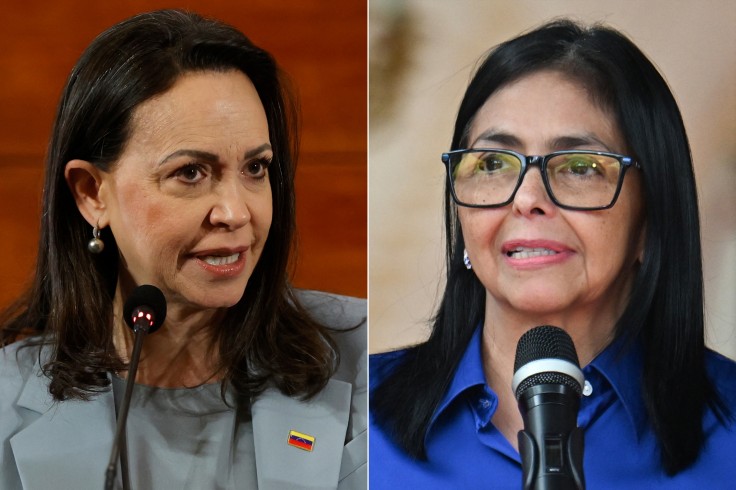
The 2026 Nobel Peace Prize winner María Corina Machado said she is ready to return to Venezuela after the devastating twin earthquakes that have left the country in mourning, but accused the Delcy Rodríguez-led government of trying to keep her out by closing the country's airspace and threatening those willing to help her come back.
The Venezuelan opposition leader delivered the message in a video posted on X from Panama City, where she said she had planned to travel to Venezuela to join emergency and reconstruction efforts after the catastrophe that struck the country's northwestern coast. The official tally puts the dead toll near 2,000, while NGOs calculate there are between 64,000 and 68,000 people missing.
"I am in Panama City, from where I planned to travel to Venezuela," Machado said. "The regime closed our country's airspace to try to prevent it."
Her message came after a failed effort to return through Curaçao, according to reports citing people familiar with the situation. The route was symbolically and politically charged: it was the same path Machado used when she secretly left Venezuela in December 2025, traveling by boat to the Dutch Caribbean island before heading to Norway after receiving the Nobel Peace Prize.
That escape turned Machado into one of the most visible symbols of Venezuela's political crisis. Barred from leaving the country and living under threat of arrest, she reportedly slipped out through the western coast and crossed by sea to Curaçao in a clandestine operation that U.S. officials later confirmed to international media. The trip allowed her to reappear abroad after months of hiding, but it also left unresolved the question she has carried ever since: when, and under what conditions, could she return?
The earthquakes have now forced that question back into the center of Venezuela's crisis.
Machado said June 24, the day the quakes struck, made her return "inaplazable," or impossible to postpone. She framed the decision not as a political maneuver, but as a personal and civic obligation during one of the country's darkest hours.
"I want to return to Venezuela to accompany all of us in these heartbreaking hours," she said. "I want my hands to join yours in the search, the comfort and the embrace."
The opposition leader accused the government of obstructing more than her own return. She said authorities have tried to block citizens distributing food and medicine, international rescue teams stranded in airports and journalists seeking to document the scale of the disaster.
"Blocking information and manipulating it in these situations produces even more victims," Machado said. "They want to bury the truth, when Venezuelans want to bury our dead with dignity."

The statement sharpened a political dilemma for Rodríguez, who has led Venezuela's interim government with U.S. backing since Nicolás Maduro was taken into American custody in January. The Trump administration has supported Rodríguez as a temporary stabilizing figure, arguing privately and publicly that Machado lacks the immediate institutional support to run the country in the short term. But Washington has also said that arrangement is not meant to be permanent and has continued to speak of a broader democratic transition.
Now Machado's attempted return is testing that delicate balance.
Senior U.S. officials have grown frustrated with her push to reenter Venezuela in the middle of the emergency, according to Reuters, with some warning that her arrival could create a confrontation with Rodríguez's government and distract from rescue operations. Others in the Trump administration have been more sympathetic, according to reports, viewing her return as morally powerful and politically inevitable.
The mixed signals have left Machado in a narrow space. She is still outside Venezuela, close enough to insist she is ready, but not yet able to enter.
"I am ready, and close to Venezuela," she said. "And I will do whatever has to be done so that we can meet there."
Venezolanos, sobre mi regreso a Venezuela: pic.twitter.com/UhSCsM3ovi
— María Corina Machado (@MariaCorinaYA) June 29, 2026
Her words landed as rescue crews continued searching through collapsed buildings, hospitals struggled with the injured and thousands of families waited for news of missing relatives. The disaster has intensified scrutiny of Rodríguez's government, which has accepted international help while facing growing anger over delays, access restrictions and uneven relief in the worst-hit areas.
Machado argued that the emergency should rise above political calculation.
"This is not about me," she said. "There are thousands and thousands of us who want to go. It is an entire country in mourning that needs to console itself together."
Still, her return would be intensely political. Machado remains the country's best-known opposition figure and a longtime critic of the Chavista power structure that Rodríguez inherited. She has accused Rodríguez of being one of the architects of Venezuela's repression and has rejected the idea that the current government can be trusted to lead a democratic transition without pressure.
That history makes her presence inside Venezuela potentially explosive, especially as the country navigates not only a humanitarian disaster, but also a fragile post-Maduro political order shaped by U.S. pressure, oil interests and competing visions for a transition.
In her video, Machado said she is willing to speak with anyone necessary to coordinate help for Venezuelans.
"In this hour, I am willing to do whatever has to be done, speak with whoever I have to speak with, to coordinate and serve our people," she said.
For now, she remains in Panama, publicly challenging the government to let her in and placing the Trump administration in an uncomfortable position: supporting Venezuela's official relief operation while watching the opposition leader it once championed accuse that same government of blocking her from reaching her country in its hour of grief.