Events in history, suggested Marx, occur the first time as tragedy, the second time as farce. So it is in the theatre, too. Station House Opera has followed its viciously brilliant Roadmetal Sweetbread with another piece in which live actors and their video doppelgangers interact. It doubles the number of actors, but twice as many doesn't mean double the effect.
Whereas Roadmetal Sweetbread was like a postmodern Miss Julie, Mare's Nest has a less concentrated appeal. It hovers largely in the realm of an arty, camp Whitehall farce. Station House Opera's Julian Maynard Smith spends most of the 75 minutes wandering around looking like a perplexed Eric Sykes.
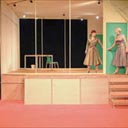
The audience enters the performance space to find a structure with two back- to-back stages, with a flat window/video screen on each side, and an interconnecting door. The four actors move between the two stages and the spaces in front of them; the audience can also move from one side of the structure to the other, watching one stage then the next in an attempt to piece together some kind of narrative.
Equally, you could follow events on just one of the stages, for it soon becomes apparent that while what is happening on one side of the structure is connected to what is happening on the other, the more intimate connection is between the live performers and their video doubles. The doubles are like clones who have escaped and are running mad in a virtual world, creating mayhem and murder.
This Alice-in-Wonderland aspect of the performance is great fun, and the piece captures all the nightmarish quality of life lived as farce. But Mare's Nest lacks real emotional impact; it comes across as a game of little consequence, rather than as a matter of life and death.
But it is very neatly done, with split-second timing from the live actors, a clever use of sound and plenty of novelty value. Those new to Station House Opera will be intrigued; old hands may find it a little tame.
Until December 22. Box office: 020-7960 4242.