AKRON, Ohio _ Meb Keflezighi knows what it's like to be underestimated by the odds-makers.
The 2004 Olympic silver medalist and 2009 New York Marathon winner was two weeks shy of his 39th birthday when he showed up for the Boston Marathon in 2014. The experts gave him a 1 percent chance of winning, given his age and an exceptionally strong field that ranked him as the 19th fastest man.
He won.
Natalie Strongoli also knows what it's like to be underestimated.
The 15-year-old Cuyahoga Falls, Ohio, volleyball player was dropped by a sudden and inexplicable brain bleed two months ago. The doctors gave her a 1 percent chance of making it through the surgery that was her only chance at life.
She survived.
On Thursday, Meb and Natalie exchanged high-fives in a therapy room at Akron Children's Hospital, where Natalie has spent the last 54 days learning how to talk and move again.
"I hate running," Natalie confessed, the pretty redhead smiling wryly at her visitor.
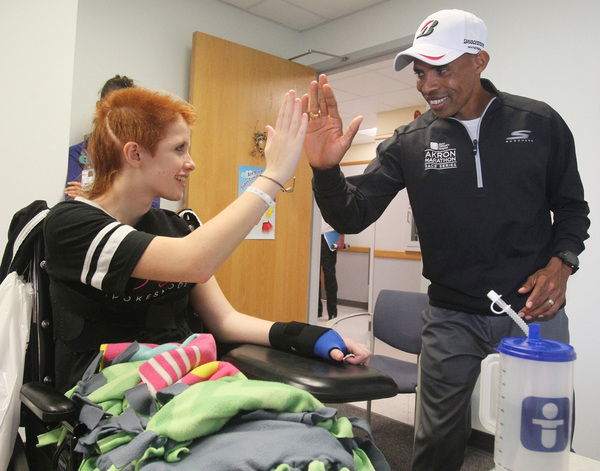
"That's OK. I hate jumping," Meb returned, revealing an easy charm.
Keflezighi _ the only man to ever collect an Olympic medal and win both the New York and Boston marathons _ was in town to accept the Akron Marathon's annual Ambassador Award Thursday night. He is scheduled to greet runners and sign autographs at Friday's Health & Fitness Expo at the John S. Knight Center.
But his first stop was the hospital, where Corey Ruble was "stoked" at the chance to meet one of his sports heroes.
Ruble, an extroverted 14-year-old Springfield Township, Ohio, freshman, had to put his love for cross country on hold for a couple of years to deal with three concussions. He was staying at Children's Hospital this week to have his diabetes diagnosed as well.
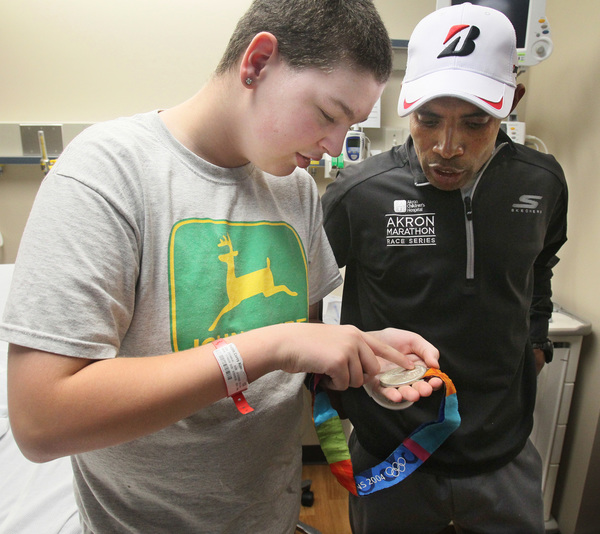
Corey sidled up to Keflezighi and took a selfie, and Keflezighi pulled out his Olympic medal and encouraged Corey to put it on.
As Corey tried to read the engraving, Keflezighi showed his quick wit again: "I was hoping you could translate that because it's all Greek to me."
Saying the marathon is a metaphor for life, where goals take time and every day offers a new chance, Keflezighi encouraged the young patients to keep defying the odds.
"People want to tell you what you can and can't do, but they don't see the training you put in and the hard work that you do," Keflezighi told Natalie. "They don't know you, what you're capable of. You have to show them."
"When you have the heart to do the best that you can, amazing things can happen," he told her.
While Keflezighi encouraged his fans by sharing his marathon stories, the challenges he faced in his own childhood go much deeper.
Growing up in the African country of Eritrea, Keflezighi remembers a village without electricity or running water, walking miles to collect wood for fire, and watching his family spend days trying to get medical attention for an injured sibling.
At the age of 10, he became a refugee, his family fleeing the homeland for Italy during a brutal war for independence that saw many neighbors and liberation supporters massacred.
He moved to the United States in 1987 to face a different kind of obstacle, that of a teenager wanting to fit in when every word betrayed his accent.
He found his calling in seventh grade when his teacher organized a run. The only thing at stake was a T-shirt and an A in physical education.
Keflezighi went on to graduate from UCLA, where he won four NCAA championships competing for the Bruins track and field team. Then he embarked on a marathon career that made him one of the most respected and revered runners in the industry.
"Challenges are a part of life. You go through disappointments and injuries and other obstacles," said Keflezighi, who still lives in San Diego. It's the city where his parents raised their 11 children, and where he's bringing up his own three daughters.
But walking through those fires is what made him what he is today, and he tells others to recognize how they are stronger for weathering their own daily battles.
"I am who I am because of the difficulties I faced," he said, "and I don't take anything for granted."