Thank you all for taking part in our mapping day.
Over the past 10 hours we been introduced to some brilliant NGOs all around the world – from Australia to Argentina – and we’ve been mapping them all throughout the day. Here’s what the map currently looks like:
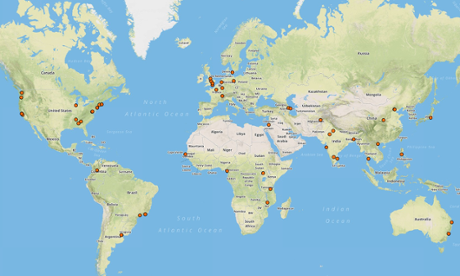
We’ll launch the map (with even more featured NGOs) tomorrow, but this is not the end. It’s just the start of a long-term project so if you haven’t filled in the form to let us know who you are, where you are and what you’re doing, you can do it now here.
Please continue sending us your suggestions for inclusions too – tweet us at @GuardianGDP and check out #NGOmap on Twitter to see what you might have missed.
Over the past 27 years, Fundación Escuela Nueva– a Colombian NGO – has worked to improve the lives of children through education.
By 2018, the organisation aims to be a global reference for active, cooperative and personalised learning based on the Escuela Nueva model, which places the learner at the centre of teaching. The model was recognised by the World Bank in 1989 as one of the three most successful innovations to impact public policy around the world.
Updated
Blue Sparrow partners with rural schools and communities in Peru near the Andean city of Huancayo to empower sustainable change through education, agriculture, and microbusiness.
In one of their projects, HectareMax, families join as a group to make bulk purchases of improved seed and fertiliser. At harvest time, their combined sales volume commands a higher price. Blue Sparrow organises the groups, provides loans to cover the initial cost of field preparation and planting, and organises a walking tractor rental system.
Following the devastating earthquake in Haiti in January 2010, San Francisco-based Architecture for Humanity has worked to help more than one million people in the country. The organisation built and opened 13 school projects, assisting more than 18,000 students and their families. Over the past five years, 50 other projects have been completed, including the building of homes, medical clinics, and offices.
Elsewhere, Architecture for Humanity works in Argentina, Mexico, Chile and Peru and aims to including community engagement throughout each project.
The organisation has launched the Open Architecture Network – an open-sourced digital destination and resource for sharing designs, projects, plans and competitions worldwide.
The Center for Digital Inclusion (CDI) is an international NGO with headquarters in Rio de Janeiro that provides low-income families with access to technology. Founder Rodrigo Baggio believes that social entrepreneur ship can bridge the digital divide. This idea is implemented through online courses and a network of IT community centres in several countries in Latin America, Mexico, the US, Spain and the UK. Baggio is an Ashoka ‘innovators for the public’ fellow.
.@GuardianGDP We're celebrating 40 yrs of helping smallholder farmers access #agriculture innovation. Video - http://t.co/CEmpAcObTW #NGOmap
— IFDC (@IFDCnews) December 10, 2014
Alabama-based IFDC have been helping improve agriculture in developing countries since 1974.
Updated
Trinidad and Tobago’s Victim Support Foundation offers counselling and practical help to those who experience violence, as well as raising awareness about victims’ rights. Its community support project uses ‘cinema therapy’ and music.
School teachers Lynne Patterson (American) and Carmen Velasco (Bolivian) started Pro Mujer (pro women) in 1990. They believed that education is the best way to break the cycle of poverty. Their first projects taught Bolivian women business skills and started a microfinance programme to offer them loans. Pro Mujer now work in Argentina, Bolivia, Mexico, Nicaragua and Peru and recently won the Vidanta Foundation lifetime achievement award for contributions to the reduction of poverty and inequality in Latin America and the Caribbean.
As hands-on and practical as they come, Riders for Health is an organisation based in the UK which trains health-workers how do daily checks on their vehicle engines. Founders Andrea and Barry Coleman both come from a motorcycling background. When they heard experts saying that distribution problems in Africa were in part due to the difficulty of keeping vehicles working there, they decided to do something about it. Riders for Health has now grown to an organisation that improves health care access for 12 million people.
'@GuardianGDP We're cultivating a movement of #youth #socent in #Guinea, Benin, & greater community thru training, mentorship, & incubation
— Dare to Innovate (@DaretoInnovate) December 10, 2014
Find out more on their website here.
The Center for Human Rights Education Advice and Assistance (CHREAA) has provided free paralegal advice in Malawi since 2000.
Currently, the not-for-profit is participating in a DfID-funded program called the Paralegal Advisory Service (PAS). Operating in seven prisons in the southern region of Malawi, the goal of the project is to improve the efficiency and effectiveness of the country’s criminal justice system, making it responsive to the needs of all users – especially poor and vulnerable groups.
Follow CHREAA on Twitter @chreaamalawi.
Updated
The Mifumi Project is a woman’s rights organisation in Uganda. Its work revolves around the protection of women and children experiencing violence and other forms of abuse, with the believe that “if women are empowered, they can rise above many of the cultural traditions holding them back, such as bride price”.
Mapping the efforts of NGOs in Iraq, Lebanon, Jordan and Iraq shows just how much humanitarian assistance to Syrian refugees is carried out in those bordering countries. Relief & Reconciliation for Syria (AISBL) for example runs a Peace Centre in Lebanon, only 12 km from the Syrian border. From there they provide educational, psychosocial and material support to young refugees.
@bibivanderzee Wow! Thank you so much for the mention. Humbled : )
— BRAC (@BRACworld) December 10, 2014
Based in London, Afghanaid has worked in Afghanistan since 1983. Today it provides rural communities with water, sanitation, roads, schools and livelihoods. The organisation welcomes volunteer internships and is currently running an appeal to help flood and landslide survivors.
Updated
Concern is Ireland’s largest NGO and started in 1968 with sending a ship of food and medicine to Biafra (now a state in Nigeria). The NGO now works in six countries in Asia, 19 in Africa, Haiti, Syria and Lebanon, focusing on ending poverty and hunger. Its Christmas appeal is to send food to malnourished children in South Sudan. One of their latest projects is working with a partner in Malawi, Merck for Mothers, to provide bicycle ambulances.
Targetting violence in their society, the Jordanian KAFA (Action Against Societal Violence) organise workshops in communities and schools. They aim “to arrive at a common understanding of the problem and ways and means to combat it at the local level”.
Formed in 1998, United Aid for Azerbaijan aids development in Azerbaijan with a particular focus on education, children, disability and welfare. It supports thousands of children across the country and their work includes community-based rehabilitation, pre-school education, social work and inclusive education. It fights for reforms and empower parents to become advocates on behalf of their children.
Updated
The Middle East Children’s Alliance (MECA) works on a variety of projects for the rights of children in Palestine, Iraq and Lebanon.
Working in these areas for 25 years, it delivers emergency aid (food, medicine and clothing) as well as supporting students from Gaza and the West Bank to attend university. It also installs water purification and desalination units in schools in the Gaza strip.
Updated
Over to the Middle East...
EcoPeace Middle East (formerly Friends of the Earth Middle East) brings together environmental campaigners from Jordan, Palestine and Israel. It is a project-orientated organisation and so far they have worked to rehabilitate the Jordan River, protect ground water, and have created EcoParks to preserve biodiversity and educate others about environmental issues.
Updated
The Midday Meal scheme in India is the largest scheme in the world aiming to provide free school lunches for children. One of the not-for-profit providers is Akshaya Patra, an organisation which began by providing free lunches to 1500 children in Bangalore, and now serves lunch to over 1.4m children.
The wonderful ‘Solar Grandmothers’ project, retraining women from rural communities as solar engineers, is just one of many projects from India’s Barefoot College. Set up in 1965, the College is devoted to finding innovative bottom-up solutions to poverty and environmental issues in rural areas, such as rainwater harvesting. “More than 6,525 unassuming housewives, mothers & grandmothers, midwives, farmers, daily wage labourers and small shopkeepers, who represent the profile of rural women from poor agricultural communities, have been trained as Barefoot midwives, handpump mechanics, solar engineers, artisans, weavers, balsevika (crèche teachers), parabolic solar cooker engineers, FM radio operators and fabricators, dentist, masons, and day and night school teachers.” That’s not a bad list.
Updated
Described in the New York Times as “the best aid group you’ve never heard of,” the gigantic BRAC (originally the Bangladesh Rehabilitation Assistance Committee) is one of the largest NGOs in the world.
It started off as a small-scale relief effort in Bangladesh in 1972 but has grown out of all recognition and now has over 100,000 employees and an annual budget of more than US$700m. Their focus is “a holistic development approach geared toward inclusion, using tools like microfinance, education, healthcare, legal services, community empowerment, social enterprises and BRAC University.”
Their incredible diverse projects include floating school boats and community health volunteers.
Updated
Same-language subtitling is one of those simple and yet brilliant ideas that you feel really can change the world. While working on his pHD at Cornell University, Brij Kothari realised that reading the Spanish subtitles on a Spanish film was helping him to learn the language. He brought the theory to India, and began adding subtitles to Bollywood films. Subsequent in-depth studies have shown that SLS can help enormously in lifting populations out of illiteracy - and already is, in some parts of India thanks to the work of Kothari and organisations like Planet Read.
Moving into central Asia now ... Teach for India, based in Mumbai, is a nationwide movement of college graduates and young professionals who commit two-years to teach full time in under-resourced schools, and become lifelong leaders working from within various sectors towards the pursuit of equity in education.
Aid to Children Without Parents, based in Vietnam, describe their mission as helping “disadvantaged children to become self-sufficient through educational and vocational training, provide preventive healthcare services, short- term financial support, and emergency relief program”
A special focus of their work is on child trafficking. They explain: “ACWP members had made trips (out-of-pocket expense) to Cambodia every year since 2004 such as Phnom Penh and Svay Pak. As ACWP members traveled further into these regions, the staff witnessed severe conditions such as young girls providing sex services, being victims of sexual abuse and sexual transmitted disease (STD) such as HIV/AIDS”
The organisation is developing different ways to help these children, including education or vocational training.
Travel to Teach is a lovely volunteer organisation with its head offices in Thailand and El Salvador that links volunteers from all over the world with grassroots community projects in South East Asia and Central America. They specialise in offering English teaching positions to volunteers - at prices that are much lower than some of the larger, Western-based organisations.
The practice of using bear bile in Chinese medicine has become increasingly controversial in recent years. Practitioners claim that it holds benefits for human livers and eyes. Campaigners argue that the practice means that bears are kept in captivity for a life time so that they can be “milked” of their bile.
Animals Asia, based in Hong Kong, is one of the groups which has led the campaigning on this subject. A couple of year ago they released a film focussed on a pharmaceutical company that markets bear bile and which was planning to float on the stock market. The film sparked a widespread backlash - and the plan to float did not go ahead.
To give you an idea of the scale of the NGO world, the Economist states that in the last 25 years, 500,000 NGOs have registered in China alone. It says: “The party does not allow independent fundraising, so it is still difficult for NGOs, even if allowed to register, to raise money without official help. They should be given full freedom to do so. Meanwhile, the party should also make its disbursal of funds to NGOs more transparent. Too much money is given to well-connected insiders and shell NGOs run by officials rather than to people in NGOs who actually know what they are doing.”
This is an amazing project - the Anti-Slavery Australia project, a team of qualified solicitors who provide comprehensive legal advice. They run the Sydney Community Trafficking Network, which brings together community-based groups to address trafficking, pool resources and consult on the development of policies. The number of investigations into human trafficking in Australia has doubled in the last two years.
We’re starting off in the east, with some of the exceptional organisations operating in Australia and Eastern Asia, such as Weinan Xinxing (New Star) Aid for Street Kids - a small non-profit organisation in China which provides beds and support for children.
Welcome to our mapping day
We’ve been making contact with groups around the world and reporting on your work for two years now – so we thought we might put you all on a map.
Tell us where you are in the world so we can add you.
We also want to know what you’re working on right now. Get in touch with your films, pictures, or comments, let us know your stories and ideas, tell us what you think we should be covering, either by emailing us on globaldevpros@guardian.co.uk, or by tweeting us at @GuardianGDP, with the hashtag #NGOmap
We’ll be working from East to West during the course of the day - starting in Australia this morning, and finishing off in Latin America this evening.
Updated