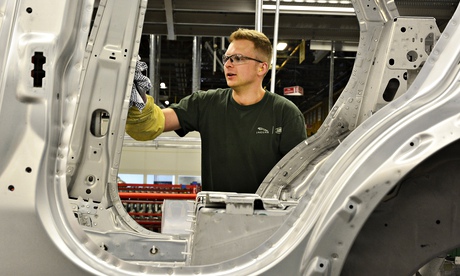
Exports from the West Midlands are soaring, having grown by over 100% in the past five years, according to figures from HMRC. While growth in exports from all other English regions have slowed this year, growth in the West Midlands has surged and the area is likely to outperform London in 2014. Only the South East will sell more to the world. Machinery and transport are the biggest sellers, accounting for 71% of its exports. Midlands factories are whirring proudly once again.
However, there is little doubt that the West Midlands’ recent export success has been powered by a few big manufacturers, the leading light being Jaguar Land Rover. During its last financial year, the company posted revenues of £19.4bn, up from £9.9bn in 2011. According to UKTI, about 20% of everything the UK exports to China is from Jaguar Land Rover. Its success can be attributed to the fact that, while other UK exporters have been hampered by the global recession and problems in the Eurozone, the Midlands-based car manufacturer has been taking major strides into rapidly growing markets such as China. “Jaguar Land Rover is a rightly celebrated turnaround story for the region. In 2003, it exported just 431 cars to China. By 2013, the figure was 77,075,” says Beverley Nielsen, founder of manufacturing think tank Idea Birmingham.
Nielsen, who previously managed Fired Earth, notes that Jaguar Land Rover’s success is not an isolated case and that the region as a whole is growing in importance on the global stage. “Four leading businesses – Jaguar Land Rover, Rolls-Royce Aerospace, GKN and JCB – have had a real impact on supply chains across the Midlands. Re-shoring is taking place, which is strengthening capability and, in turn, enhancing our capacity to export greater amounts,” she adds.
Powerhouse
The region’s exports are expected to continue growing. A report last year by Ernst & Young described the West Midlands as an export “powerhouse”, predicting growth of over 8% between 2012 and 2017. Alongside automotive, the main areas of growth are aerospace, health care, energy and advanced manufacturing. Small and medium sized companies are heavily active in providing components and services to all of these sectors. Paul Forrest, head of research at the West Midlands Economic Forum, says the West Midlands’ innovative SME manufacturers, currently doing well in the automotive sector, are well placed to take advantage of new opportunities in emerging fields. “Many small businesses supplying components to the automotive and aerospace industry can quite quickly shift to supply the power generation sector or the health care sectors, there’s clear evidence of that happening,” he says.
Modern manufacturers are offering a suite of services to accompany their goods, while maintaining a constant dialogue with customers. Forrest refers to this as “servitisation” and says it’s a key part of doing business in mature markets. “The ability to export services is key and it will be a growth area. Professional services such as engineering design, IT, software and serious games or modelling can all be locked into manufacturing and are big areas of growth,” he says.
Midlands firms are making highly complex products to detailed briefs, as well as solving the problems their customers have. This is why they have been able to buck the trend, Forrest suggests. “The West Midlands is successful in the hardest export markets, the ones that demand reliability, precision and quality – the markets of the US, Germany and Japan. Even though the EU has been in recession, the region’s exports to the EU have grown by 11%.”
Airport
One of the big problems the region’s exporters faced until recently was that the city’s airport was a far cry from what was needed. Birmingham Airport’s runways were simply too short to enable take-off for jumbo jets, so the second largest city in the UK didn’t have a truly international airport and businesses were hamstrung. However, now a new runway has been built, and during the summer its first long haul flight to China took off. New routes to India and the US have since been announced, but there is a long way to go. “It has restricted growth,” says Forrest. “All the research shows that having an international airport nearby can reduce export costs, as most freight is carried in the belly of long haul aircraft. One of the reasons Germany has been successful is that it has six airports which can export to the world.”
Innovating to find new markets
Alan Rollason, along with two colleagues, founded Advanced Chemical Etching in 2000. Rollason says his business has become successful through investment in technology, innovation and exports. Advanced Chemical Etching is deeply embedded in the global supply chain network, providing intricate, thin, metal components to major manufacturers in the automotive, aerospace, health, energy and communications sectors. “We wanted to do some of the things that other people didn’t want to get into,” says Rollason. “We wanted to push the technology as far as it would go – that’s been the core of our business. Development is often pushed by our customers. They get the demand and we have to solve the problem.”
The business was initially hit hard by the recession, but after working with fellow SMEs at the Midland Assembly Network, decided to invest and seek out new markets. Advance Chemical Etching entered into a knowledge transfer protocol with Wolverhampton University. This involved putting an academic onto the payroll, using university resources and turning theory into practice. Initially the research looked into a safer way to work with aluminium, but then a new practice for working with titanium was discovered, with big implications for the medical industry.
“We have been through some tough times,” says Rollason. “We all struggled during 2009, that was really bad. But we got through that and decided we needed to expand the business. It’s been a long, slow process and we’ve funded everything ourselves. In the last 12 months we are up by 12-15% and a lot of that is export driven. The research we did has the potential to change our business beyond all recognition; it could double or treble the size of the business in the next two years.”
Read more stories like this:
How to create a website for an international audience
Cultural complexity: the etiquette of doing business abroad
This content has been sponsored by UPS, whose brand it displays. All content is editorially independent.
Sign up to become a member of the Guardian Small Business Network here for more advice, insight and best practice direct to your inbox.