At the south end of the island, opposite the isle of Eriskay, the low tide has exposed a greater than usual area of sand. Unlike the west-facing beaches of Uist, where the waves break constantly against the shore, this quiet spot is a good place for gathering cockles.
This morning a couple of people are at work, raking through the surface sand, then picking up the exposed shellfish and dropping them into buckets. Cockles are easy to collect and it doesn’t take long to gather enough to provide a seafood supper.
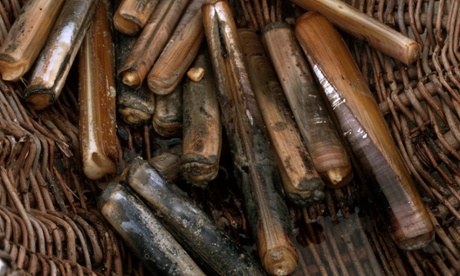
Another sand dweller prized by island and coastal communities is the razor clam or spoot, but in terms of collecting difficulty, razor clams are a different kettle of shellfish altogether, requiring more guile and considerably more technique.
Stealth is required, for they are sensitive both to vibration and pressure changes in the sand and, sensing approaching footsteps, are capable of burrowing deeper with surprising rapidity.
The sight of a small jet of water erupting from the sand indicates a razor clam on the move. From a couple of inches to one side of the jet, a sideways slice into the sand with a long-bladed knife will, with a bit of luck, connect with the creature’s shell and pin it against the densely packed sand. Then it’s mankind against mollusc, as the free hand is used to burrow into the sand to extract the spoot, which uses its muscular foot to attempt to remain just where it is.
Both in Shetland and North Uist I’ve seen other gatherers forgo the use of the knife and with quiet and skilful hand alone magically extract a razor clam from beneath the sand. But for those of us whose spoot-collecting talents are not yet so developed, there is an easier way which, while certainly effective, somehow carries less satisfaction than more traditional methods.
A liberal application of household salt poured on to the clam’s keyhole-shaped breathing hole will, in short order, cause it to rise up through the sand and emerge far enough to be easily wiggled free.