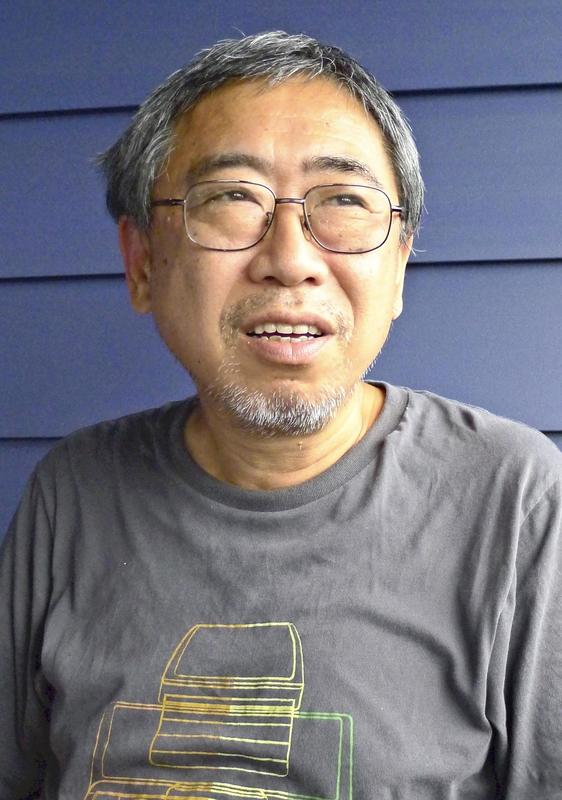
"Red," a manga trilogy about the most horrific incident caused by Rengo Sekigun (the United Red Army), has been completed. The author, Naoki Yamamoto, did his best to avoid including anything that wasn't real in the 13-volume epic published by Kodansha Ltd. It took him 12 years to conclude the series.
At age 58, Yamamoto belongs to a generation free of student protests. What did he feel about the case that happened 46 years ago?
"What prompted me first was the Aum Supreme Truth Cult case [in 1995]," Yamamoto said. "They [Aum members] were supposed to have had at least some kind of ideals, but before anyone knew it, they had become mass murderers. I wondered why."
It reminded him of a similar case that happened when he was a sixth-year student at elementary school -- the Asama Sanso incident in 1972. A group of youths who were aiming for a revolution killed 12 fellow members in an internal purge on a mountain. In the end, they exchanged fire with the anti-riot police.
Yamamoto read writings by the culprits and paid visits to the site of the killing. Then he realized there were indeed similarities between the group, the United Red Army, and the Aum cult.
"An extremely closed group always goes wrong. Perhaps it applies to today's society, too," he said.
He was convinced it would make an interesting manga. On the other hand, he also felt that it would be wrong to turn them into some kind of heroes or, conversely, villains.
"I wanted to draw them completely with no frills," he said.
The trilogy's first part, "Red" (eight volumes), ran in the Evening manga magazine from Kodansha from 2006 and won the Excellence Award at the Japan Media Arts Festival by the Cultural Affairs Agency in fiscal 2010. The second part, "Red: Saigo no Rokujunichi, soshite Asama Sanso e" (Red: The final 60 days, and on to the Asama Sanso lodge) is four volumes and started its run in the magazine in 2014. The third part, "Red: Saishusho; Asama Sanso no Tokakan" (Red: Final chapter; The 10 days at the Asama Sanso lodge), is one volume and ran in the magazine from 2017. Digital versions of the manga are available as well.
The first half of "Red" is a happy story about a group of young people who could be found anywhere. They have amateurish arguments, get drunk, sing, laugh and fall in love. Some of the characters are always drawn with a number from 1 to 15 on their heads. These are doomed numbers that denote the order of their deaths. Apparently, Yamamoto got the inspiration for the idea from a play directed by Suzuki Matsuo and other works of art. It gives off an inexplicably irrational air throughout the work.
Yamamoto met as many people concerned as possible and obtained permission from them to quote from their writings.
"I drew what actually happened, mostly without any changes. It's only about 5 percent fiction," he said.
Amid matter-of-fact descriptions, dramatic scenes appear from nowhere. Particularly effective is the scene in which the feeling of a runaway member is juxtaposed with a phrase from "Kowareshi mono toshiteno Ningen" (A human being as a fragile article), a collection of essays by Kenzaburo Oe in 1970.
Yamamoto made his professional debut in 1984. He is known as an extremely talented manga artist who led the erotic manga scene from the 1980s with his detached yet graphic depiction of sex. His most famous work, "Blue" (1991), sparked an argument over the regulation of "harmful manga" that involved the whole manga community.
His works are constantly well received by readers outside the manga scene as well because of their literary quality -- the works seem to pursue true human nature through sexual desire.
Therefore, "Red" surprised many fans because he took on a social, nonfiction subject, sealing off the erotic manga he once publicly declared was his lifetime work.
"Words and fiction are the biggest weapons for us creators, but nothing matters more than someone's life," he said. "Rengo Sekigun placed a vain word -- revolution -- above people's lives. What they did left an air of it not being cool to talk about politics, which still continues today."
The 1980s saw the arrival of the age of "introvert" erotic manga, and cults gained power. These are not unrelated to the downfall of the power of words. In that sense, "History is continuous," Yamamoto said. "I think it's about putting an end to the climate of denying serious words."
In 1999, Yamamoto drew an allegorical manga called "Believers" that featured the Aum cult and the United Red Army as motifs. Shohei Chujo, a Gakushuin University professor in French cultural studies, highly praised this work as well as "Red," which he called "a masterpiece that depicted the peer pressure of a typically Japanese group."
"Revolution is supposed to have power that explodes outwardly, but in Japan it somehow explodes inwardly," Chujo said. "Victims are always fellow members of the same group as the offenders. I think it's a contemporary issue that is also linked to the Japanese Imperial Army during the war [World War II] and bullying."
"I wanted to get through this just once. Now I can return to my job of drawing erotic manga," Yamamoto said.
He is still in touch with the people involved in the incident. "They all say they hope people won't forget the case," Yamamoto said.
Read more from The Japan News at https://japannews.yomiuri.co.jp/