The first trophy of the year has been won, José Mourinho is in business again as a collector of silverware, and all 91 of the teams behind Chelsea know that the business end of the season starts here. It certainly does for Manchester United, whose indifferent displays against unremarkable opponents in recent weeks must now be put out of mind for the real thing. Arsenal, Tottenham and Liverpool are the challenges March brings, with Manchester City and Chelsea to come in early April.
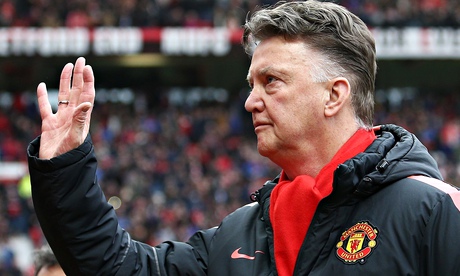
In terms of the club’s quest for a top-four finish that daunting fixture list is slightly misleading – Monday’s encounter with Arsenal is an FA Cup quarter-final – though Louis van Gaal sees the sequence of tests as a top-four continuum. “Every match is just as important as the next, and every result can influence the next,” he explained. “We are in a rat race in the Premier League and the Arsenal game is separate from that, but if we do well we would take the good feeling and confidence into our next games. That is usually how football works.”
The “if” in that theory is a fairly large one, given the way United have been playing of late, though in fairness they have maintained a top-four position throughout their struggles and the 2-1 victory at the Emirates in November was not only Van Gaal’s first away success but a rare instance of his side playing with a clinical efficiency. Arsenal slipped to eighth place as a consequence of that result, but have improved since. United climbed to fourth, where they have more or less remained, though whether there is any detectable sign of improvement under Van Gaal has been one of the debates of the season.
United’s last home win against Sunderland reflected most of the nagging doubts that observers have been harbouring in spite of the lofty league position. How unimpressive were the victors? Let us count the ways. There were the back passes to David de Gea from the halfway line that drew boos from the Stretford End. The slow, sideways passing that brought chants of “attack, attack, attack”. There was the miserable sight of Ángel Di María utterly failing to live up to his former glories, let alone his £60m transfer fee, before being withdrawn at half-time. Radamel Falcao was not much better, though United hardly played to his strengths, and Van Gaal was about to haul him off for Marouane Fellaini when he won the all-important second-half penalty. Juan Mata only came on for the last five minutes, so there was no cleverness through the middle. Adnan Januzaj played the second half and Ashley Young had one of his better games, so there was ability on the wings but no real exploitation of width or success at finding space behind the opposing defence. And United were only playing Sunderland, visitors that looked pallid and unimaginative after Burnley the previous week.
Yet Van Gaal was able to come out afterwards and argue that a team in third place in the Premier League (they subsequently dropped back to fourth) could not be playing all that badly, and he had a point. The point now is that the phoney war is over. Van Gaal displayed irritation last week when television reporters tried to make a story out of Ryan Giggs’ apparent non-reaction to United’s last-gasp winner at Newcastle, and he was entitled to do so. The Dutchman is probably wondering why people keep looking for fault lines when his side are winning, but for the next few weeks he will get a break from over-imaginative questioning because the results will tell the story. Van Gaal says he only likes to deal in facts, not speculation, and when United play against top-four rivals some facts are bound to emerge.
The winner of Monday’s quarter-final clearly have an outstanding chance of success in the FA Cup, not least because Arsenal come to Old Trafford as holders and most of the other Premier League heavyweights have already been eliminated. Some would argue the FA Cup came to Arsène Wenger’s rescue last season, it certainly seemed to take the Arsenal manager a long time to value the competition as representing a successful achievement in its own right.
Wenger always seemed to prefer the invisible silverware of Champions League qualification, financially desirable though not such a great day out for supporters when European campaigns invariably fizzled out in the knockout stages. Wenger has been in England for almost 20 years, Van Gaal not yet one, so how does the United manager see his first season panning out? Would success be something to wave from an open-top bus, or a quiet satisfaction in putting United back into the European elite at the first time of asking? If not indeed both?
“A title would be fantastic in my first season,” he said, meaning the FA Cup rather than the improbable dream of overhauling Chelsea in the Premier League. “Everywhere I have been I have always managed to win something in my first season, but the most important thing is the goal we have set, and that is the top four. The aim is to reach the top four in our first year together, and if we do not achieve that you can write that we have failed. Of course the top four and the FA Cup would be the ideal result, but for a top club the Champions League always represents the highest level.”
That puts Van Gaal in the Wenger camp then. Sir Alex Ferguson always used to maintain that any silverware was better than nothing, and Van Gaal may yet come round to that point of view should the season end in disappointment on all fronts, but for the moment he is sticking to the stated plan. “Anyone would like to win the FA Cup, but it does not put you into the Champions League,” he said.
Wenger once described a top-four finish as a fourth trophy, with the clear implication that it was more important than a couple of the others. “Yes, I think that is right,” Van Gaal said after taking a moment to consider the suggestion. “I think Arsène Wenger is always saying the right thing.”