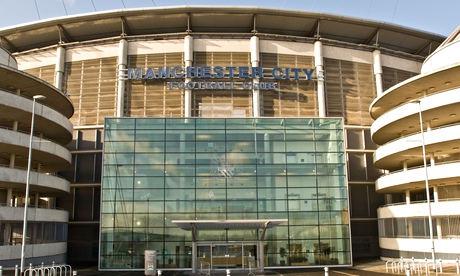
Manchester City and Arsenal supporters have jointly written to the two clubs before Sunday’s Premier League match at the Etihad Stadium calling on them to pay all staff a living wage. The letter, signed by the Arsenal Independent Supporters Association, Man City Fans Living Wage Campaign, Canal Street Blues, the GMB and Unison unions and Islington politicians, focuses on the hundreds of the clubs’ matchday staff still on low pay.
Arsenal and City say the people they directly employ are paid at least the £7.85 an hour (£9.15 per hour in London) which is assessed by Loughborough University’s Centre for Research in Social Policy, for the campaign body Citizens UK, to be the minimum a person can decently live on and provide for a family. However, those working as stewards and in clubs’ large catering operations on matchdays are employed by contracted companies or agencies and many are understood to be on the legal minimum wage, which is £6.50 per hour for adults, £5.13 per hour for 18-20 year olds.
The letter delivered to both clubs this week states: “As Arsenal and City fans, we are proud of the fantastic work being done by both clubs in our local communities. Surely it’s not too much to ask that the [thousands of] staff who keep our stadiums safe and clean, serve us food and refreshments, sell club programmes and merchandise and carry out many other roles should earn enough to live on?
“We call on our two clubs, that play the most attractive football in the Premiership, to lead the way and name an early date to become living wage employers.”
Last month Chelsea became England’s first fully professional football club to be accredited by Citizens UK as a living wage employer, which involves ensuring that the wage is paid to employees of all contracting companies. Chelsea have committed to incorporating this in all their contracts by 2017. Hearts have been accredited in Scotland, Luton Town have committed to gaining accreditation, and the semi-professional, supporter-owned FC United of Manchester became the first British football club to be accredited, in October.
Campaigners have focused on football partly because of the vast inequality between thousands of workers on the minimum wage and top players who can be paid £15m a year, and chief executives – Arsenal’s Ivan Gazidis was paid £2.2m last year; City’s, Ferran Soriano, is not a director so his salary is not disclosed.
Arsenal’s position is that while they pay their employees more than the living wage in London, they exercise no influence over the wages paid to staff by their suppliers. City’s stance is that they pay their employees a living wage and require the same of contractors for capital works, such as the building of the new academy and stadium expansion.
City say they now ask suppliers of other services such as matchday catering to tell them if they pay the living wage, and if they do, City score them more highly when contracts are being awarded. City also stressed the emphasis in the club’s major projects on employing local people and suppliers and buying locally sourced materials.
No Premier League or Football League club besides Chelsea has yet committed to paying the living wage to all staff, and the leagues centrally do not have a policy on it, leaving it to the individual clubs.