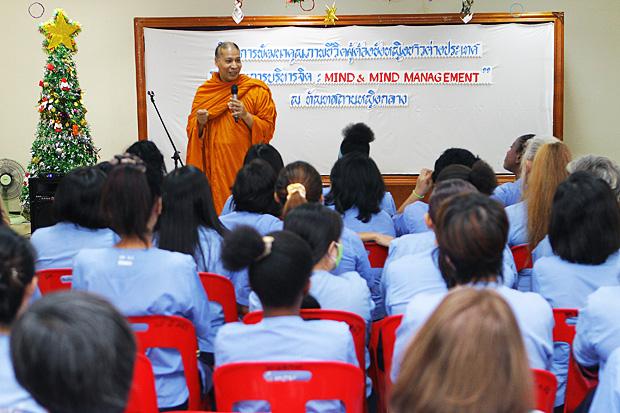
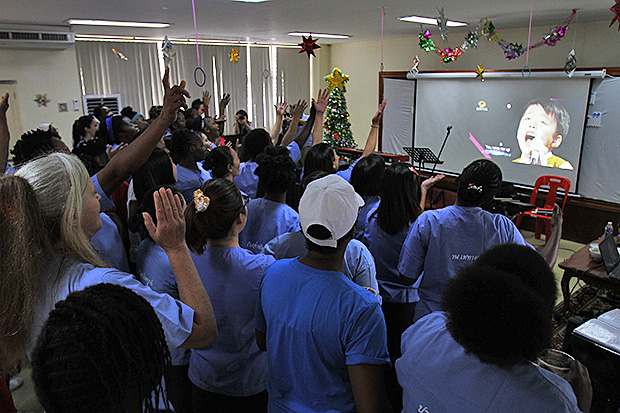
A cosy room with some festive decorations was full of cupcakes and pizzas. It looked like a party. Women dressed in blue sang, danced and even rapped. At the front of the room, a man in his saffron robe was smiling and clapping. Such a lively and joyous atmosphere made it hard to believe that all this was actually happening in a prison. Now even some of the guards were dancing along.
It's a mind management programme organised recently within the Central Women Correctional Institute (CWCI) in Bangkok, where those dressing in blue were foreign women inmates detained in the facility. There are currently over 400 of them here from Asia, Europe, Africa, the Middle East and more, with the majority being prosecuted for drug-related charges. Being held in a country not their own far from friends and families, in a place of unfamiliar language and culture, can cause stress for the foreign inmates. The programme intends to help them adjust to their living conditions by having a positive outlook in life.
Revered monk
This mind management programme is run by a revered Buddhist monk and lecturer Venerable Anil Sakya. Beginning in September last year, his weekly lesson is joined by 100 women inmates from 30 countries. The monk has been giving lessons to inmates in Thailand for over eight years at different facilities around the country. He called his lessons cognitive transformation therapy, which is not about religion but rather self-transformation through self-reflection.
His lessons are comprised of lectures and counselling, with topics revolving around how our minds work, changing mindsets and value, and give inspiration and motivation that participants can ponder on and look inward into their own thoughts. Lessons are conducted in English.

"Being a monk myself and teaching all those things, everyone thought that I was propagating Buddhism. I said no. I'm not here to propagate Buddhism. I'm doing this to improve their humanity," he said. Some Buddhist teaching was in the lesson, he added, but in a sense of it being a universal issue. Otherwise, he hardly mentions Buddha.
During the time of our visit, the Venerable -- who's beloved and well received by inmates of diverse religious backgrounds -- gave his talk about a sense of here and now in quite a light-hearted manner. Don't wallow in the past. No one can control the future. Be in the present. He spoke to his attentive listeners sometimes in parable with teachings behind it, while many inmates jotted notes down.
In captivity and beyond
"Awesome!" exclaimed Mary*, an inmate from South Africa who has been at CWCI for over five years, when asked about her opinion towards Anil's lesson. During our conversation, she often referred to the class as a "privilege" and that she's changed a lot after joining it.
"Our minds are blocked. It's like a brain torture for us, and by having this activity, it opens our mind a little bit. It makes us realise that we can learn something and be something. We made mistakes and are learning from this. The Venerable really taught us how to not blame ourselves," said Mary, adding that she used to be an aggressive person who let her mouth run wild. But attending this lesson has calmed her.
Mary's sentence is over 30 years for drug trafficking. "I've made peace with that," she said, though tearing up a little as the subject came up. Being in a Thai prison has its challenges. She said she had a hard time adjusting to the overcrowding, and general human drama of prison and the competitive nature between women. She said there were times she was so stressed she didn't even want to wake up. But through lessons in mind management, she's handling things better now, and this includes her outlook for the future.
Mary has lost her job, and she foresees that it will be mostly impossible to get it back due to her criminal record. But despite everything a silver lining exists in the form of her family and children who are waiting for her back home.

Since her incarceration, her family has yet to visit her due to the cost and time it takes to fly to Thailand. Their mode of communication was thus strictly through letters. Mary said an online video system was recently put in place so that inmates can communicate with their family abroad, something she said she is looking forward to using.
When she gets out, Mary hopes to help others, especially women and men being used for drug trafficking and other crimes.
"Many people don't realise what they're falling into, especially young teens. There are some girls in here that are 18-19 years old and it's very sad to see them here. It can be my baby, my child, who is in prison," she said. "They say the children are our future. If we don't work with them, then there's no future."
While Mary still has quite a long way to go with her sentence, another inmate like Connie* has just over a year left in her time. Also from South Africa, Connie has been at CWCI for seven years for drug trafficking.
The mind management lesson is one of the things that makes prison more bearable, said Connie. She decided to join the class because of anxiety that stemmed from her imminent release and integration into society. Her future plans are not concrete yet as she confessed she has no idea what the outside world is like and how much it has changed. While the future remains hazy, Connie said she is making the best out of her time in prison. She made sure to have certain skills and qualifications to fall back on once she's out. So far, she has completed a certified massage course from Wat Pho, and also finished a degree through correspondence courses in her home country.
One of the things she has taken from the mind managing lesson is to appreciate the present, and to not worry too much about the past and future.
"Teacher said you have to make a home for yourself no matter where you are. And sometimes, you have fear that is not real but it's just something that we bring into our own mind," she said. "I'm scared. That is true. But I'm sure I'll be able to make it out there."
Visible changes
The transformative changes among participating inmates were obvious, said Chadaporn Ruksasup, director of CWCI who governs over 4,800 inmates she called her daughters. She and her team work closely with respective embassies in caring for the well-being and rights of foreign inmates.
The mind management programme had been ongoing for 14 weeks by the time we visited. It was planned for 25 weeks, or around six months in duration. It is considered one of the few English-language activities that foreign inmates can join and really understand what is going on.
"This programme adds to what we already have and help things work more efficiently," said Chadaporn.
Over half-way through the programme, the institute's director reported an improvement in several inmates' behaviour and attitude. Before, there used to be complaints over their unwillingness to eat rice, and other living conditions. The inmates didn't want to listen to staff and even fought among themselves. Now, they have learned to abide by the rules and better accept Thai conduct and culture.
"We barely have any trouble nowadays. We live like friends and help out one another. It's quite visible from their smiles. If you go into any prison and see smiles, it means people aren't stressed out there."
Normally, each foreign inmate is given an orientation in English or other languages they can understand. There are also different activities they can join while inside, such as life skills and even projects initiated by the royal family such as the Kamlangjai Project by HRH Princess Bajrakitiyabha and To Be Number One project by Princess Ubolratana. Still, most of the activities organised are conducted in Thai, which limits the participation of foreigners who don't understand the language.
Chadaporn said the institute welcomes outside parties who come in and help inmates through social responsibility projects.
"The Department of Corrections can't improve the situation for inmates all on our own. We do have to rely on outside communities, networks and organisations for help. It's a national matter," said Chadaporn. "We are open for improvement. Any organisation is welcomed to join us, as long as they fit within our regulations. We want our inmates to go out and not revert to wrongdoing again."
*Not their real names