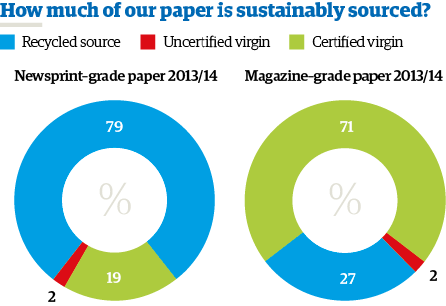
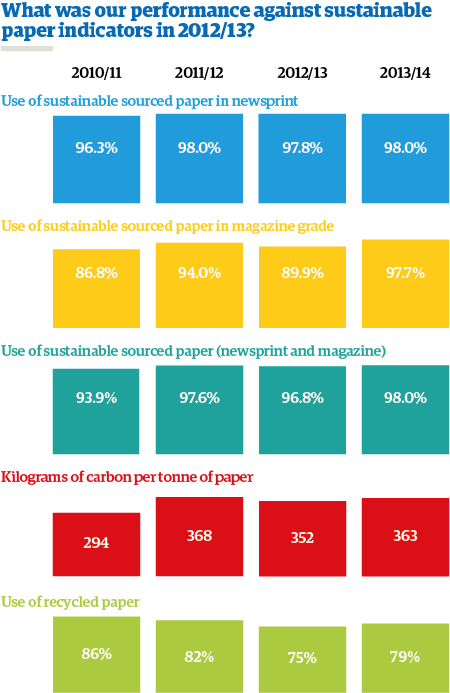
Guardian News & Media (GNM) is committed to sourcing sustainable paper; in the last financial year, 98% of the newsprint and magazine-grade paper used for the Guardian and Observer was sustainably sourced (either recycled or using certified virgin fibre). For magazine grade paper, we were able to cut uncertified source by 8% by switching to British recycled paper while maintaining the percentage of certified virgin source at 72%. Compared to last year, our newsprint contained increased recycled fibre, back up to 79%. This was achieved by moving from certified virgin and uncertified sources to British recycled fibre.
As we are using less paper than we did in the past, we reviewed our supplier arrangements to make sure we were getting best value for money and upholding our commitment to our sustainable paper policy. As a result, we decided to switch from uncertified stock to recycled. This decision has helped to support British recycling mills and increased recycled content to just under 80%. Consequently, our carbon per tonnes of news print increased to 363kg, but it is still below the KPI of 369kg.
The reduction in uncertified virgin source for magazine grade by almost 8% follows an increase in our target from 90% to 95% in the GNM paper policy. Data sheets from mills were updated and they highlight the need for companies to supply paper that is certified through schemes such as FSC, PEFC and CFA if they want to sell into all markets.
The print centres in London and Manchester reduced water usage by 4%. Ink consumption was down by 5% across all print sites, including contractors. The water saving of 220,000 litres is equivalent to the average amount of water used every day by 1,490 UK citizens. These savings are part of the centres' on-going efficiency programme aimed at reducing water and ink usage; last year the focus was on how the ink is applied to the printing plates.
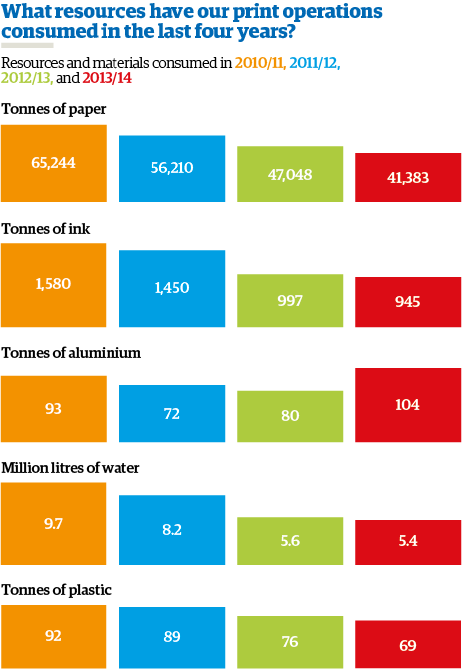
The use of aluminium plates increased by 30% because of the amount of work done for third party organisations: new plates are created every time a new product is printed.
Digital resources footprint
The new data centres were built using large capacity machines with virtualized servers running on them. This allowed GNM to reduce the size of the data centre by going from 500 to 80 physical machines. Each physical machine (running multiple virtualized servers) is also more efficient per unit of space used, in terms of power and capacity, and has a very high energy efficiency rating.