
PRINCETON, N.J. -- Upon winning the Nobel Prize in Physics on Tuesday, Syukuro Manabe, a senior meteorologist at Princeton University, said the award was a "big surprise."
The 90-year-old Japanese-born U.S. citizen was recognized for his pioneering research that helps predict the impact of greenhouse gases such as carbon dioxide on global climate change using computers.
Manabe won a quarter-share of the prize of 10 million Swedish kronor (about 127 million yen), with another quarter going to Klaus Hasselmann, 89, a professor at the Max Planck Institute for Meteorology in Hamburg, and half for Giorgio Parisi, 73, a professor at Sapienza University of Rome.
The award was announced in what was the early morning hours of Tuesday for Manabe, who lives in New Jersey. About eight hours later he was in a Princeton University auditorium in suit and tie, greeted with rapturous applause from faculty members, students and others who assembled for a press conference.
"I never imagined that this thing I was beginning to study [would have] such huge consequences," Manabe said.
Referring later to an increase in the number of natural disasters that are believed to be partly caused by global warming, Manabe said, "Climate [policy] involves not only environment, but also energy, agriculture, water and just about everything you can imagine."
He underpinned the importance of accurate predictions on a global scale in order to combat climate change.
"It's very difficult to sort out what is going on," he said. "The best way I did was we carried out many numerical experiments."
He added, "Curiosity is the thing which drives all my research activity," which he said is "great fun."
-- Pioneering climate research
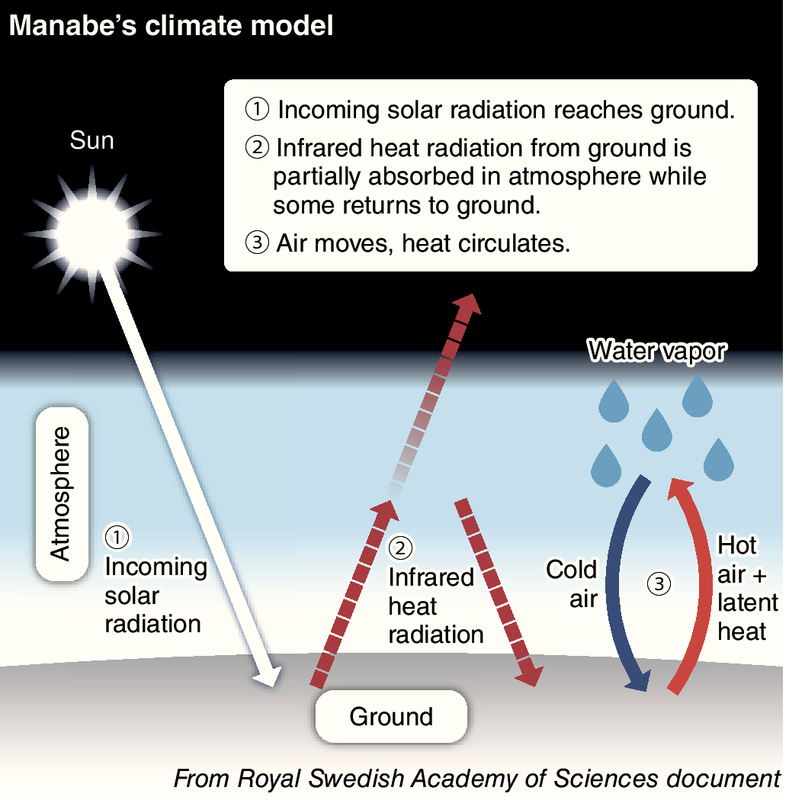
In 1958, Manabe arrived in the United States to work as a research meteorologist at the U.S. Weather Bureau, which is now the National Oceanic and Atmospheric Administration. In 1967, he led the development of physical models to determine the relationship between the atmosphere and temperatures using a high-speed computer. His model predicted that if the level of carbon dioxide in Earth's atmosphere doubles, the global surface temperature increases by 2.36 C.
In 1989, he also succeeded in developing a more enhanced global warming prediction model involving the weather conditions of the atmosphere, ocean and land. Such research results were included in the first assessment reports released in 1990 by the Intergovernmental Panel on Climate Change (IPCC), a U.N. panel consisting of scientists and others from around the world. The IPCC, which clarified the relationship between human activities and global warming, was awarded the Nobel Peace Prize in 2007.
Manabe also led a research team on global warming in Japan for four years from 1997.
After being informed of winning the Nobel Prize, Manabe said during an interview that he couldn't believe it was happening, but added that the theme of climate change has never drawn more attention than today.
This is the first Nobel Prize for a Japanese-born person since 2019. Manabe became the 12th person from Japan to win the physics prize, and the first since Takaaki Kajita, distinguished professor at the University of Tokyo, won in 2015.
At 90, Manabe is also the oldest Japanese-born winner of a Nobel Prize.
The award ceremony is scheduled to be held in Stockholm on Dec. 10, but this year's winners will receive their medals and diplomas in their country of residence due to the novel coronavirus pandemic.
-- Profile
Born in Ehime Prefecture in 1931, Manabe graduated from the University of Tokyo's School of Science, then obtained his doctorate from the university. After moving to the United States, he held posts such as senior research meteorologist at the U.S. National Oceanic and Atmospheric Administration and visiting research collaborator at Princeton University. He was awarded the Benjamin Franklin Medal of the United States in 2015 and the Crafoord Prize of Sweden in 2018.
Read more from The Japan News at https://japannews.yomiuri.co.jp/




.png?w=600)








