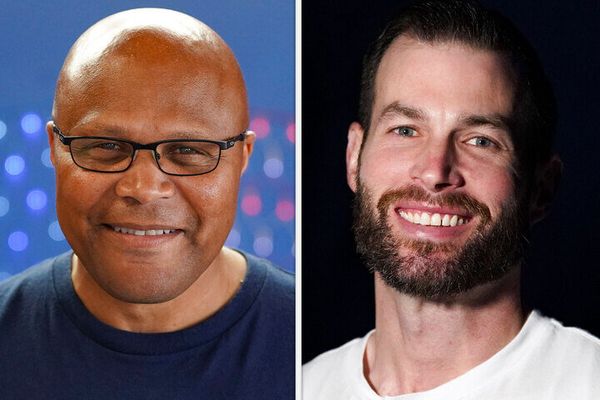
LAS VEGAS _ A man who sold ammunition to Stephen Paddock, the gunman who carried out the massacre in Las Vegas, has been charged with manufacturing armor-piercing bullets, according to court documents.
The charges against Douglas Haig were filed in federal court Friday. The documents said that unfired armor-piercing bullets found inside the hotel room where Paddock staged his attack carried Haig's fingerprints.
The charges were filed the same day Haig held a news conference to address his contact with Paddock before the shooting. Neither armor-piercing bullets nor the charges came up during the news conference. Instead, Haig discussed how his life had changed after it was revealed this week that he had sold tracer rounds to Paddock.
Recounting events from Friday, Haig said the last doorbell ring at his house came at 2 a.m. Up until that point, it had been a steady stream of rings and knocks at his home. One woman shouted through his door that he should die.
There have been death threats too, Haig said.
"I don't know who they are or what they want," Haig said. "I'd just keep the lights off and stay quiet."
The 55-year-old Arizona man's life has been upended over the last four days after his name was mistakenly released Tuesday as a "person of interest" amid hundreds of pages of unsealed search warrants connected to the mass shooting in Las Vegas in October.
He said he learned about his name being made public while he was at work Tuesday.
"My cellphone started to explode with calls," Haig said.
On Friday, he stood before the media _ hands folded in front _ dressed in tan pants, dark blazer and tie, and tried to explain how little linkage he had to Paddock, who killed 58 and wounded hundreds from his room on the 32nd floor of the Mandalay Bay Resort and Casino.
Haig is an aerospace engineer who got into selling ammunition as a part-time hobby in 1991. He sold 720 rounds of tracer ammunition to Paddock a month before the shooting. Police found a box with Haig's name on it in the room, but it was unused.
Police still do not have a motive for the killings, and for months, little was known about the investigation until more than 600 pages of search warrants were unsealed last month and Clark County Sheriff Joe Lombardo released a preliminary investigative report. The absence of information in the previous months allowed conspiracy theories to bloom, among them that the attack was inspired by Islamic State.
Up until Haig's name emerged, the only other person of interest named in the Vegas shooting was Paddock's girlfriend, Marilou Danley. She last issued a public comment three days after the shooting and has kept a low profile since then. She said she had been "devastated" by Paddock's crime, and she has cooperated with authorities during the investigation. Authorities have said that Paddock, who killed himself, was the only gunman to fire on the crowd.
Haig said he didn't even know the shooting had occurred until he was called by federal authorities 11 hours after the massacre. Haig said that he starts his days early at 6 a.m. and that, when told what happened, he felt "revulsion."
But he also thought that, as the months passed, his sale of ammunition to Paddock would be a footnote that would eventually fade away. When his name came out, the spotlight burned bright on a man who, according to his LinkedIn page, had developed ammunition and weapons for defense contractors. He is currently listed as a senior engineer at Honeywell Aerospace.
Then on Tuesday, his name was published, then broadcast nationwide.
"It's not been a lot of fun, quite frankly," he said.
He did an interview with "CBS This Morning" the day after his name was made public, saying he sold Paddock the tracer ammunition. "He said he was going to go put on a light show," Haig said in the interview. " And I can't remember whether he said for or with his friends, but that's what he did say." His attorney said Haig hoped that holding a news conference would help him restore his reputation.
Haig said after the 2 a.m. doorbell ring on Friday, he was able to get some sleep and arrived at his attorney's office around 8:30 a.m. He said, however, he had to first escape his house. But this took planning. Haig said he waited for a garbage truck to pull up and used it as cover to leave.
Haig drove by himself to the law firm in an office park in Chandler, a Phoenix suburb. He said he saw the television crews setting up tripods outside the law office and suddenly realized he was unsure what to expect.
"Yeah, I was nervous," he said.
When he stepped out in front of the lectern, his attorney, Marc Victor, introduced him. Victor, a high-profile attorney in Arizona who served as a legal analyst for media during the Jodi Arias murder trial, helped prepare Haig.
Haig was direct with his answers _ though he had to be reminded at several points during the 20-minute news conference to lean into the microphones clustered atop the lectern.
He said he spoke with law enforcement on four separate occasions for at least six _ and maybe eight _ hours. He met Paddock at a gun show in Phoenix and later sold Paddock the ammunition at his house. Nothing aroused suspicion, he said. Haig said he usually ships ammunition or sells it at the gun show, but occasionally lets people come by his house to make a purchase.
"I have to trust them," he said.
Haig said Paddock got lost on the way but eventually pulled up appearing "very well-dressed, very well-groomed, very polite, very respectful."
Haig said he put Paddock's order in a box. "He paid me and put it in his car and drove away. At no time did I see anything suspicious or odd or any kind of a tell _ anything that would set off an alarm."
Victor said he hasn't been told whether his client is still being considered a person of interest, and the FBI didn't return a request for comment. Las Vegas Metropolitan Police Department referred all questions to the FBI.
But Haig's attorney said he wasn't expecting to get a call from law enforcement saying Haig was no longer a person of interest.
"They could keep him as a person of interest for the rest of his life," Victor said.
Haig said he isn't selling ammunition anymore, and he wasn't sure if he'd ever get back into it again.
"I don't know," he said. "I truly don't know."