Sometimes being someone’s friend means telling them openly and honestly that their idea is downright terrible. It can be hard, it might mean some conflict, but ultimately, it’s often for the best. At the same time, not every disagreement has a clear right answer.
A netizen asked the internet if they were wrong to tell their friend that his plan to propose to his girlfriend in lieu of getting her any gifts was a bad idea. Turns out, he was not particularly receptive towards constructive feedback. We reached out to the person who made the post via private message and will update the article when they get back to us.
Most people are pretty excited about getting things over Christmas

Image credits: Anna Pou / Pexels (not the actual photo)
So one man was told that his plan to propose instead of buying anything was perhaps flawed
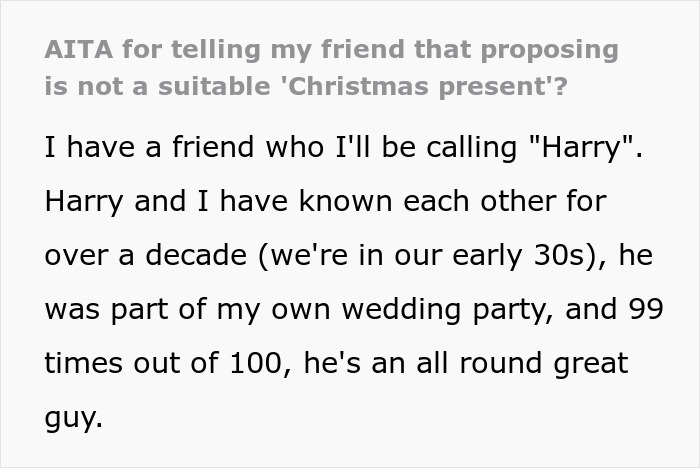


Image credits: Antoni Shkraba Studio / Pexels (not the actual photo)

Image credits: Gui Spinardi / Pexels (not the actual photo)
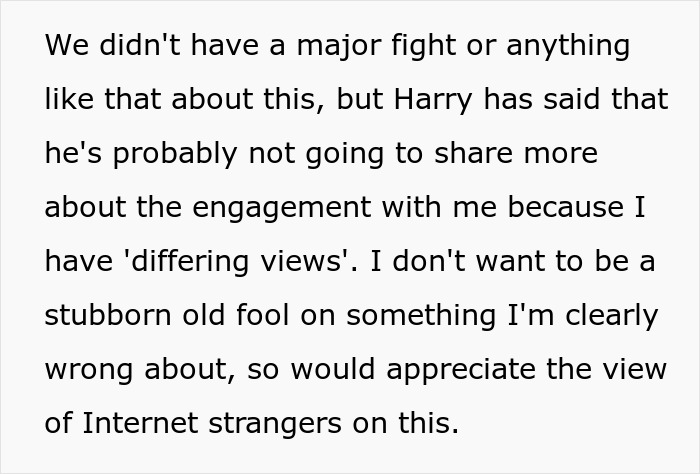
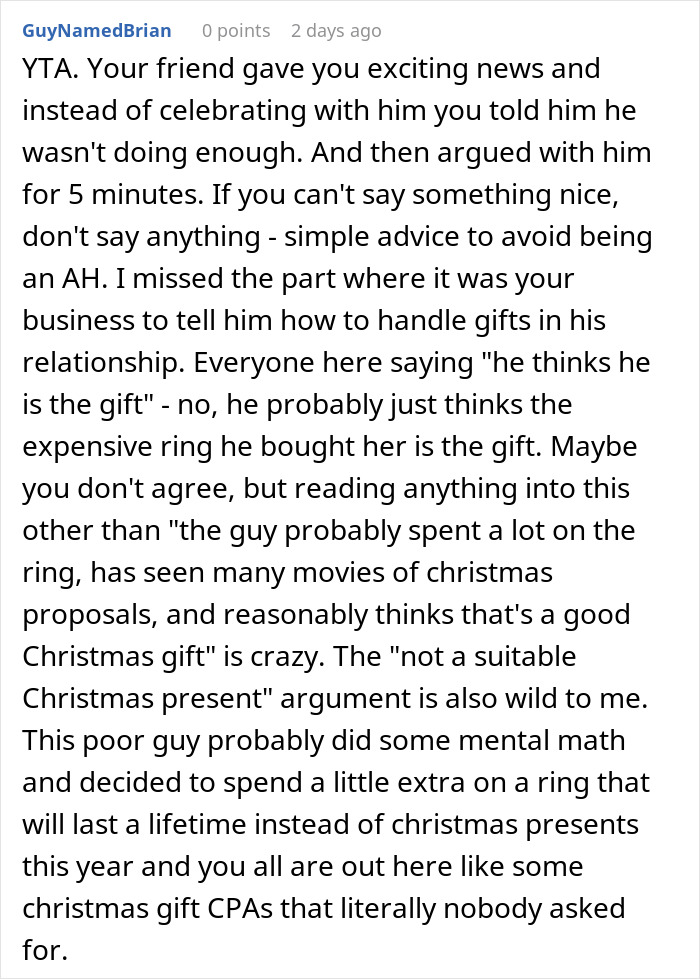
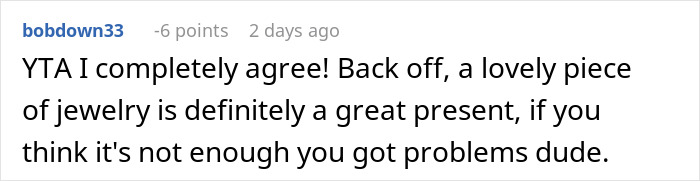
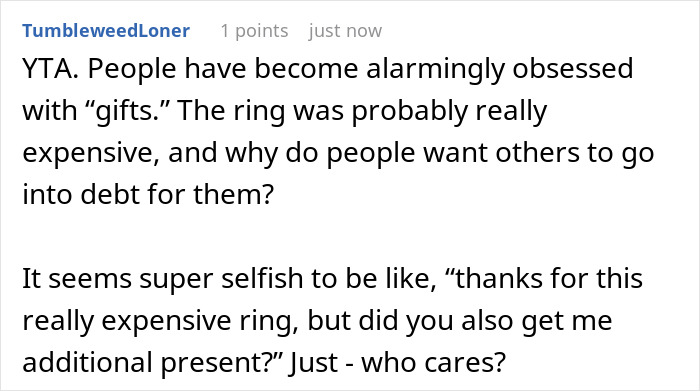
The netizen responded to a few reader comments as well

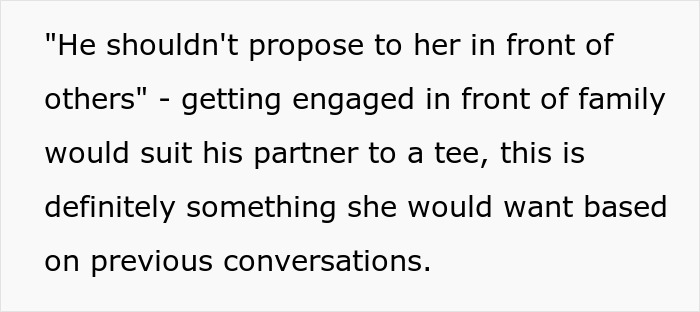
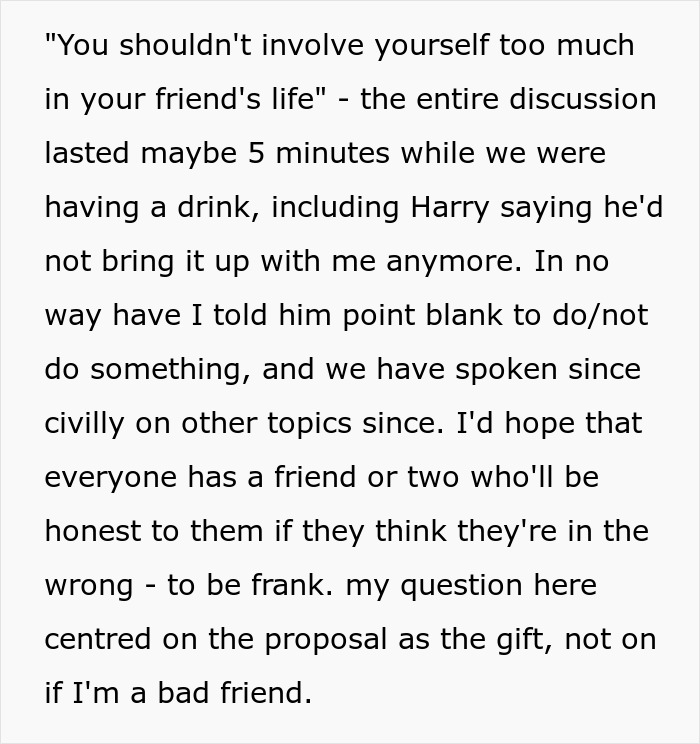
Image credits: jamaicanmescream

Image credits: Antoni Shkraba Studio / Pexels (not the actual photo)
People tend to side with whoever is telling the story
The internet has given us an unprecedented window into other people’s conflicts, and nowhere is this more apparent than in the eternal debate over whether an engagement ring counts as a Christmas present. Consider a scenario where someone plans to propose to their girlfriend on Christmas morning without wrapping up any additional gifts. When a friend suggested this might be a mistake, thousands of internet commenters eagerly rushed to judgment, overwhelmingly agreeing that the proposer was in the wrong. But why are we so quick to pick sides when we know almost nothing about the actual people involved?
This phenomenon reveals something fascinating about how we consume conflict online. Research in social psychology has consistently demonstrated that people possess a remarkable ability to align themselves with a narrator’s perspective, especially when that narrator presents information in a seemingly reasonable way. When we encounter a story from a single viewpoint, we tend to accept its framing as objective truth rather than one person’s interpretation of events. The engagement ring debate is a perfect case study. Commenters confidently declared that showing up without wrapped presents on Christmas morning would be a relationship disaster, that the girlfriend would feel hurt and disappointed, and that the proposer was being cheap or thoughtless. But here’s the thing: none of these commenters know the girlfriend. They don’t know whether she’s the type of person who would be genuinely thrilled by a surprise proposal and couldn’t care less about a few wrapped boxes, or whether she’d feel slighted by the absence of traditional gifts. They’re filling in blanks with their own experiences, values, and assumptions.
Studies on narrative persuasion indicate that when people encounter a story, they unconsciously insert themselves into it, projecting their own feelings and reactions onto the characters involved. Someone who would feel disappointed without Christmas presents assumes everyone would feel that way. Someone who sees engagement rings as profoundly romantic gestures might have the opposite reaction. We’re not actually judging Harry’s situation so much as we’re revealing our own values and expectations. What makes this mass judgment particularly interesting is how confident people become despite having minimal information. The story provides a few data points: the relationship is four years old, the girlfriend is family-focused, the ring is expensive, and Harry believes an engagement counts as a gift. From this sparse framework, commenters constructed elaborate narratives about what the girlfriend wants, what she deserves, and what will happen Christmas morning. This reflects what psychologists call the illusion of explanatory depth, our tendency to believe we understand complex situations far better than we actually do.

Image credits: fauxels / Pexels (not the actual photo)
It’s hard to pass judgment on multiple people you’ve never met
The framing of the original story also did significant work in shaping opinions. By establishing that the girlfriend “appreciates the give and take of mutual present exchanges” while being “in no way materialistic,” the narrator created a sympathetic character who cares about thoughtfulness rather than money. It’s a careful construction that makes Harry’s position seem thoughtless without making the girlfriend seem greedy. Few commenters stopped to question whether this characterization was complete or accurate.
Research on moral judgment shows that people are remarkably quick to make ethical evaluations based on limited information, particularly when a story involves perceived unfairness or someone being treated poorly. The idea of a woman receiving no Christmas presents while her partner receives several triggers an immediate sense of inequity, regardless of whether that woman would actually care. We’re responding to an abstract principle of fairness rather than the specific needs and desires of real individuals in a real relationship.
Perhaps Harry knows something about his partner that the internet doesn’t. Maybe she’s told him repeatedly that she finds excessive gift-giving wasteful. Maybe they’ve discussed keeping Christmas low-key this year. Maybe she’s been dropping hints about wanting to get engaged and would genuinely prefer the ring over anything else. Or maybe Harry is making a mistake and his friend’s advice is sound. The point is that we simply don’t know, yet thousands of people felt qualified to render judgment anyway.
The real gift here isn’t the ring or the hypothetical Christmas presents. It’s a reminder that every story we encounter online is filtered through someone’s perspective, and our rush to judge reveals more about our own biases than about the people we’re judging. Before picking sides in someone else’s relationship drama, we might ask ourselves what we’re really responding to: the actual situation, or our own projection of how we’d feel in similar circumstances.
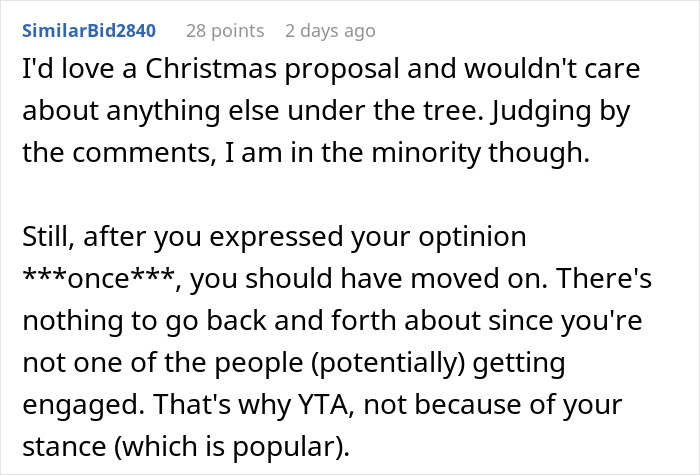
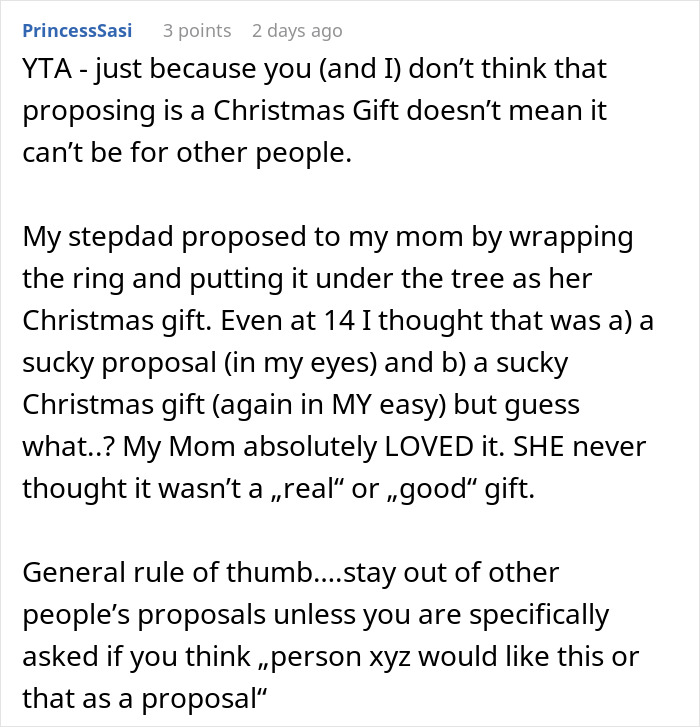
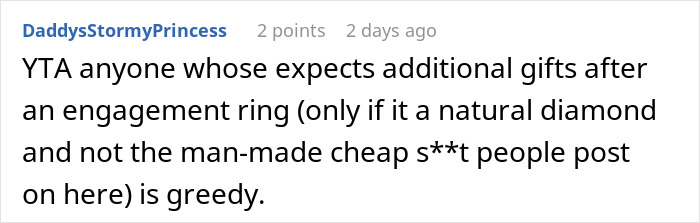
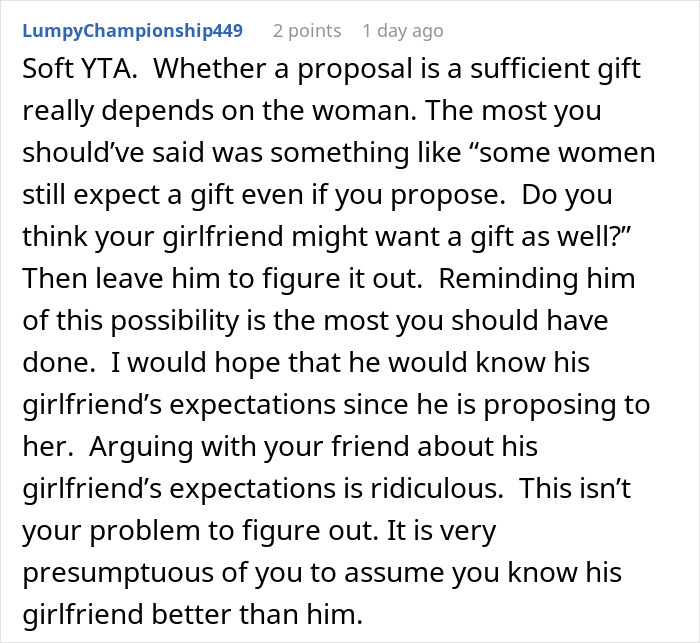
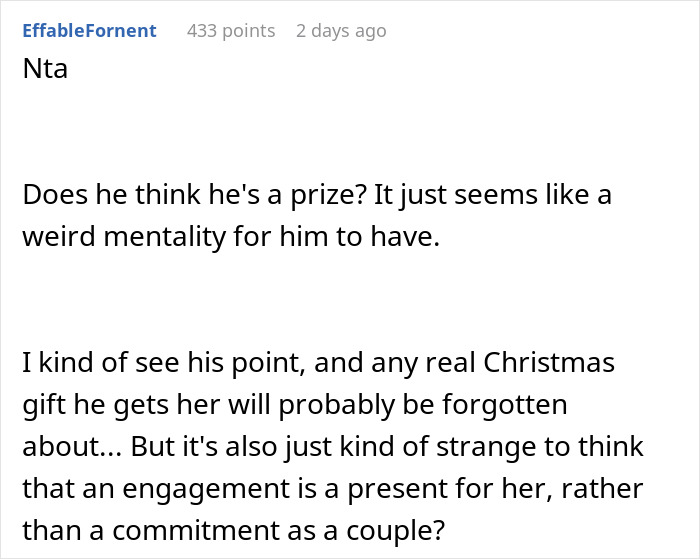
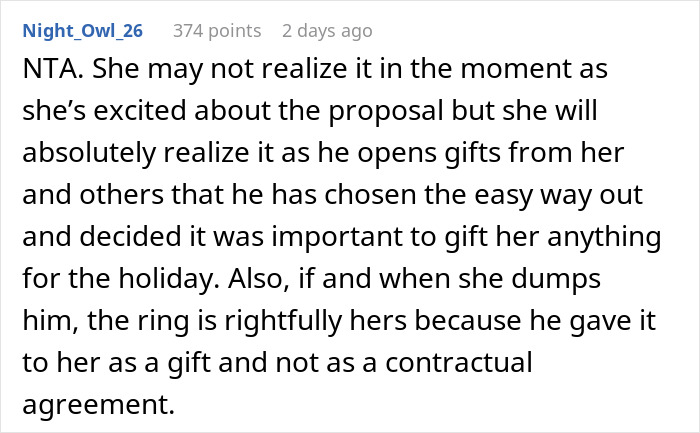
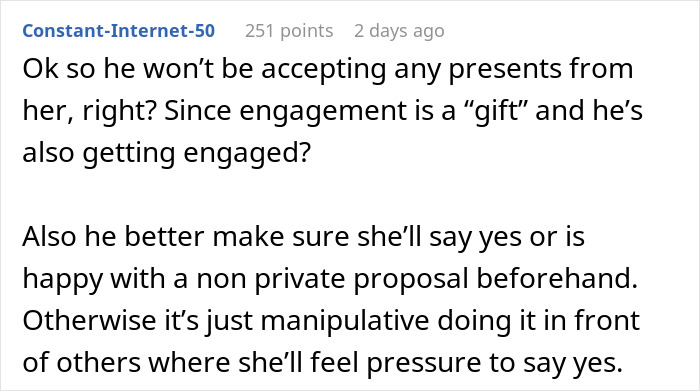
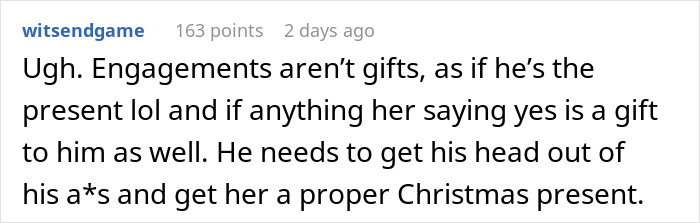
Some thought they were right to call out “harry”
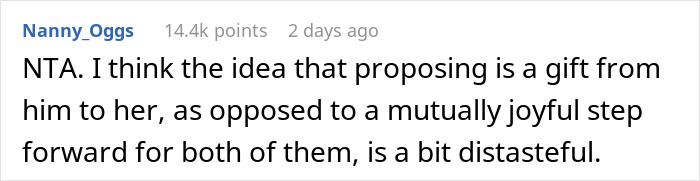

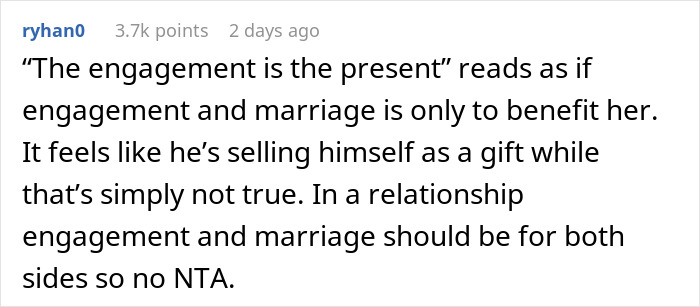
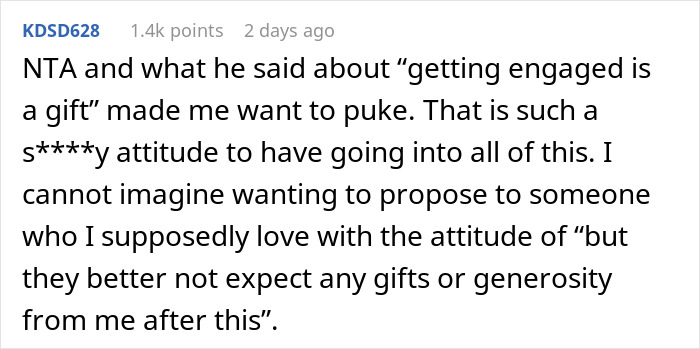

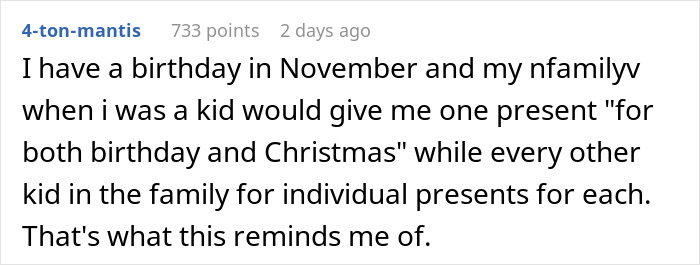
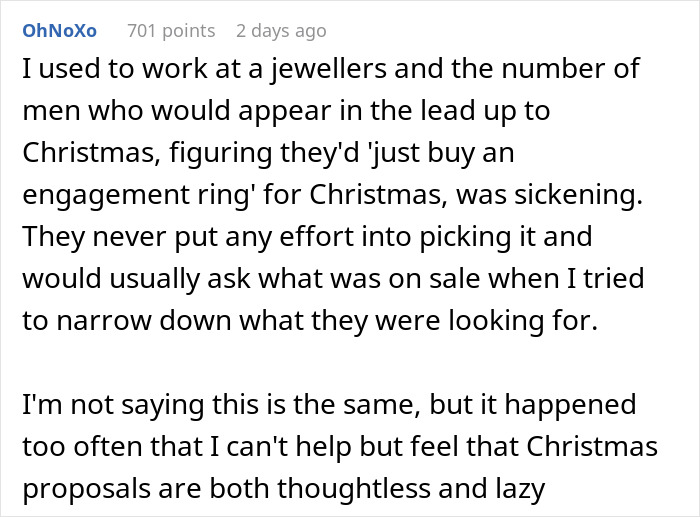







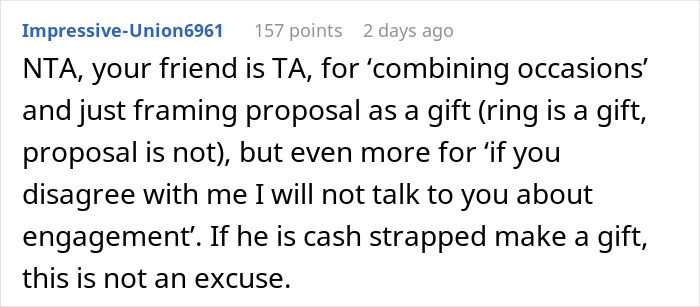
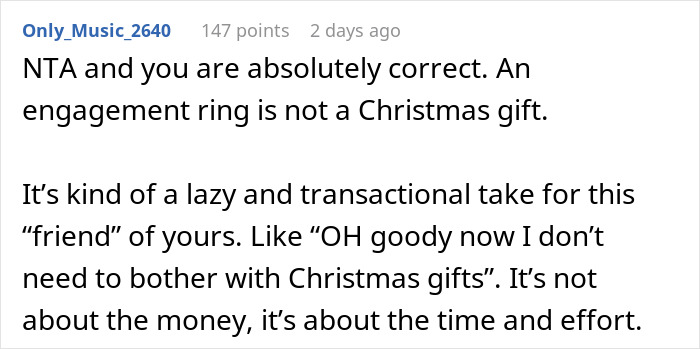
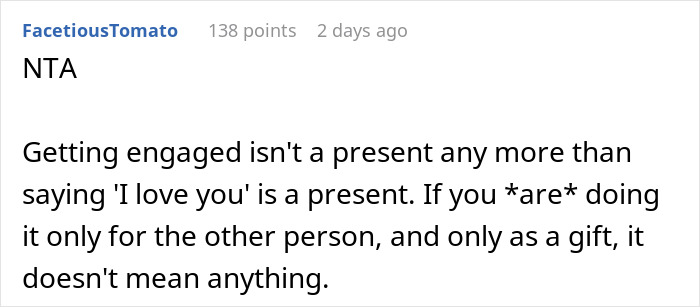
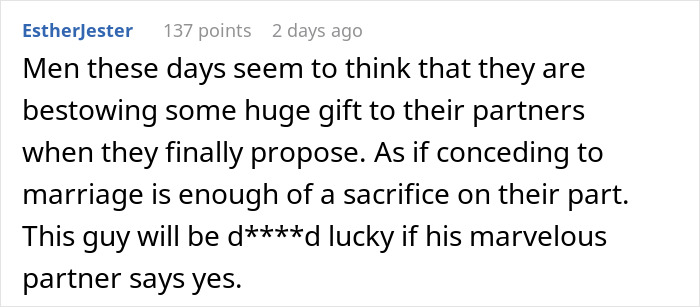
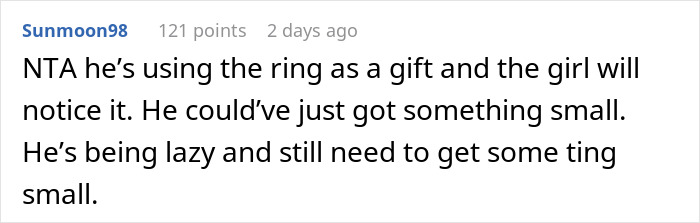

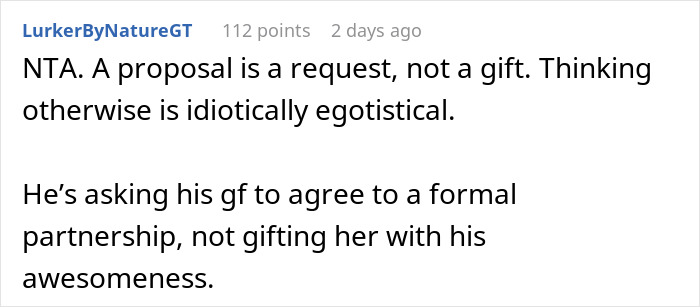

Others thought “Harry’s” idea was fine