Whenever a refereeing controversy dominates the weekend’s football – identifying the difference between Craig Dawson and Gareth McAuley, and missing Martin Skrtel’s stamp on David de Gea made for some lively debate during the last set of Premier League matches – and within the discussion the role of the referees’ assessor makes an appearance. What would they make of these incidents? And what are the consequences?
There is something slightly mysterious about these unnamed men who do the marking and their systems. To the referees themselves, assessment becomes as much a part of their job as making sure they have their whistle, cards and little black book, getting them acclimatised to the business of being constantly appraised and challenged.
“You know the degree of scrutiny referees are under,” explains Mike Riley, the manager of Professional Game Match Officials Limited (PGMOL). “You know we are judged by the clubs, by spectators, by ourselves on how well we have done on the pitch. So from the first time you pick up a whistle you are being judged. It’s about putting the right mechanisms in place – this is how we evaluate performances, this is how we judge you, this is how we help you deal with judgment from the outside world.”
At Premier League level, there are two people responsible for these evaluations, one of whom is a delegate representing the Premier League (usually a former player or manager who keeps an eye on major decisions and man management) and the other from PGMOL (typically a former referee who analyses the technical performance).
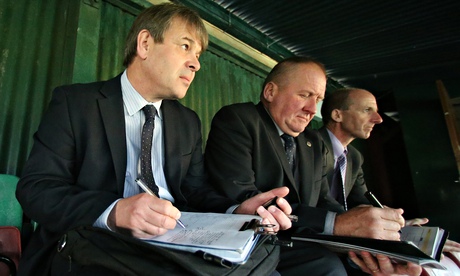
To get an idea of what they are looking for, the Observer spent an afternoon with John Norbury and observed him assessing the performance of Lee Swabey and his assistants for a Conference game. Norbury’s notes took the form of a handy chart so he could mark down everything noteworthy to the minute, with appropriate ticks and question marks. After the game he popped into the referee’s room to ask Swabey and his assistants to clarify one or two issues. It was a pretty straightforward match. A flare was thrown on to the pitch in the first half. Swabey stopped the game to make sure it was dealt with safely. He made a good impression in the second half for dealing with the one minor altercation with calm authority and a few firm words. “Settled with a handshake,” noted Norbury.
A big skill is learning when to raise your profile in a game and when to be invisible. The amount of talking to players needs to be just right and clear communication is vital, including the little things – sometimes you need to explain why a free-kick was given so the players understand the decisions. Equally, a referee’s positioning is monitored to assess whether he is in the best position to see as much as possible.
Later Norbury watched the DVD of the game to check against his notes, so that he had all the information to fill in the online report. All the facts are duly noted – teams, goals, cards – then all the officials get a mark, and the difficulty of the game is rated, along with a brief description of the match.
Marks are handed out according to an evaluation scale which ranges in small increments from five “Very Poor Performance (unacceptable)” to 9.0 – 10.0 “Excellent performance (outstanding)”. A critical element is how referees rate in what is known as KMI – a key match incident. The number of KMI errors is a significant part of the calculation – each one is worth roughly half a mark.
These marks form merit tables, which are one of the major resources when PGMOL sits down and works out which referees get to officiate at the different levels. Swabey, for example, is one of 33 officiating this season in Panel 2A (the Conference). Roughly 10 of them will be vying for promotion to the National Referees List (Football League). The aim is for the best of today’s Panel 2A officials to be in the Football League or Premier League within five to 10 years. Those earmarked for promotion usually get the experience of a few try-out games in the level above, dropped in to see how they can handle bigger crowds, increased pressure, and faster, more technical players.
Four members of the management team headed by Riley make their promotion choices, and occasionally have to consider demotion if someone suffers a prolonged period of poor form. “We look at the assessments that have been compiled throughout the year, the reports from the coaches who have been with them all year, the reports from Liam Slack [the sports psychologist] to build up a complete picture of what that official is like compared to everyone else,” explains Riley. Then there is a selection day, which includes five exercises designed to test various skills plus a formal interview.
“There is an element of competitiveness in refereeing that is necessary. There are 33 referees at this level who all want the opportunity to referee in the Football League, so they are competing against each other all the time.”
Those considered the most talented and consistent will be refereeing in the Premier League in a few years’ time.