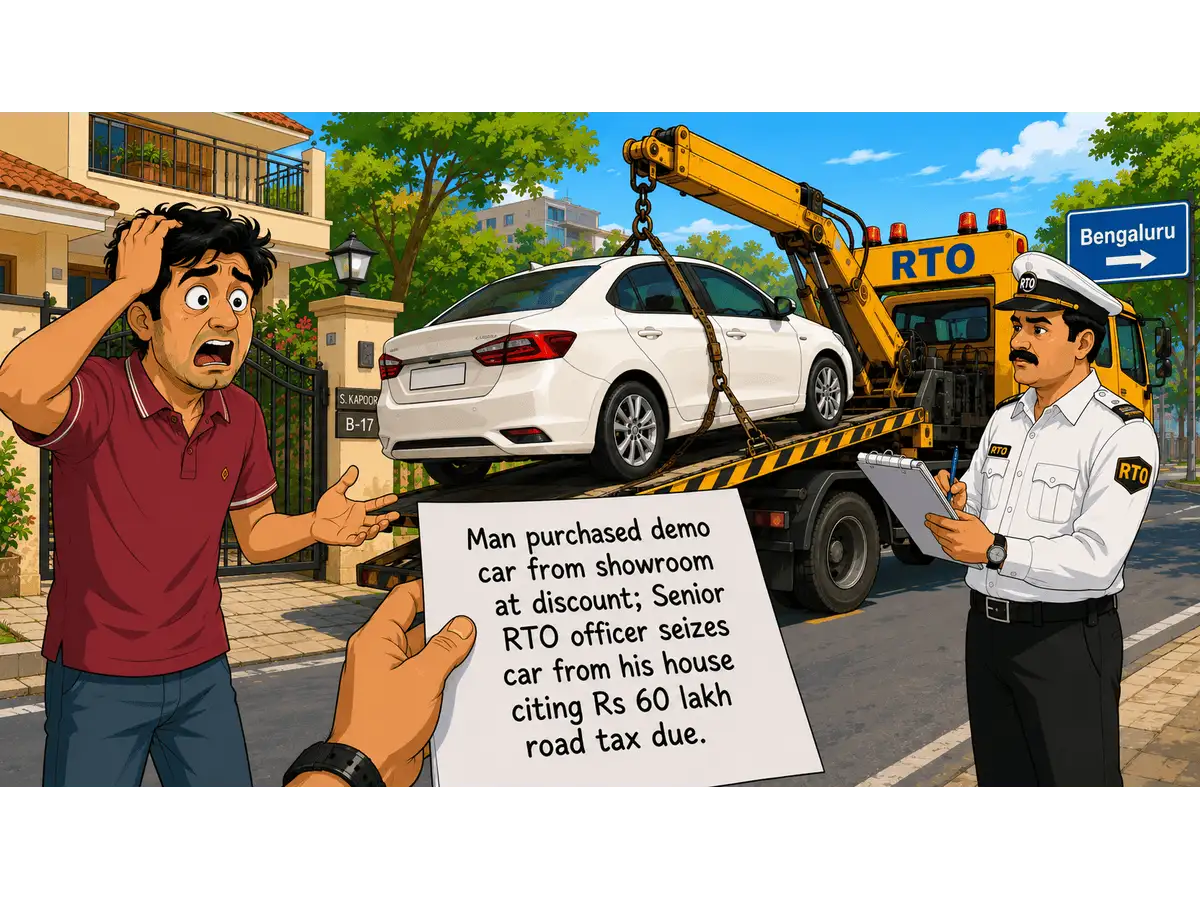
When Mr Rama bought a demo car on September 1, 2025 which had been manufactured in 2021 he had no idea of the troubles which will haunt him later. In the interest of full honesty, the dealer told him that this was a demo car that had been briefly registered in 2022 but was returned by the first buyer.
However, after buying the car, Mr Rama soon ran into trouble with the RTO when a senior Bengaluru RTO officer barged into his home and seized his vehicle and took it to the Yelahanka new town police station on Allalasandra main road.
This seizure took place on February 7, 2026 when Rama was away. The senior motor vehicle inspector from Bengaluru RTO along with other officers forcibly entered his premises and seized the vehicle without any prior notice or investigation. The senior RTO officer personally transported the car to the Yelahanka New Town Police Station.
When Rama returned, he came to know that a zero FIR and criminal case had been registered in his name. He faced charges related to fraud, forgery and fabrication of documents in connection with the vehicle’s registration. The case was registered under Sections 318(4), Section 336(3) r/w Section 3(5) of the BNS, which corresponds to offence under Section 420 and 468 of the earlier regime, the IPC ( offence of cheating and forgery).
The Karnataka State Public Prosecutor argued strongly that the owners of the vehicle have forged and caused financial loss to the Karnataka state, in addition to forging the invoices. Therefore, the crime was registered for both forgery and cheating with forgery related to the fraudulent registration and cheating concerning the loss to the state exchequer.
Rama’s advocate Venkatesh S. Arbatti, said that after the senior motor vehicle inspector from RTO towed the vehicle away, Rama was not informed where his car was being taken. Arbatti told the court that Rama was made to run from pillar to post, being told the vehicle is not in this jurisdiction or that one. So, he decided to file an application under Sections 497 and 503 of the BNSS to get the vehicle released.
According to the Karnataka State Public Prosecutor, this vehicle was manufactured in 2021, was not registered for 4 years and without registration or temporary registration, it was sold to someone else (Rama) in 2025.
The public prosecutor also pointed out that records of the car in the office of the Regional Transport Office (RTO) have been erased or altered, as if the vehicle was newly manufactured and registered for the first time.
Thus the prosecutor noted and told the court that the manner in which RTO records have been manipulated needed to be investigated, but he argued that the search and seizure action itself wasn’t illegal as the senior RTO officer was empowered to seize the vehicle.
The Karnataka High Court rejected the public prosecutor’s search and seizure angle but ordered that investigation be carried out about how the RTO records were manipulated.
On March 25, 2026, the Karnataka High Court ruled in favour of the vehicle owner. The high court quashed the FIR and took a strong exception to the conduct of the senior RTO officer who seized the vehicle unlawfully.
After pronouncing the order, when the counsel for the inspector sought the court's indulgence, Justice M. Nagaprasanna disapproved of the conduct of the officer vocally, as reported by LiveLaw.
“…You had no mandate to enter someone's house and take away the vehicle. You may be the best officer. But the best officer should also act in accordance with the law. There is no answer from SPP too about who gave you that power…This should not be repeated”, the court orally remarked.
As reported by LiveLaw, The Karnataka High Court pointed out that the inspector had seized the vehicle from the garage long before the registration of the crime against the petitioner (Rama). Hearing this, the state also acceded that the senior RTO inspector, who was also the complainant, had made an error. Citing the same, the court mandated that the inspector would undergo the rigours of departmental enquiry.
“I don't care about the vehicle, be it a Maruti or any other vehicle... you yourself, being the complainant, barged into someone's house and seized the vehicle unlawfully”, the court orally remarked, as reported by LiveLaw.
Though the motor vehicles inspector submitted that he was due for a promotion and the court's order for departmental enquiry would adversely affect him, the court clarified that it was necessary for him 'to feel the pinch'.
Karnataka High Court order
The Karnataka High Court said that if, at any point in time, it is discovered that the tax remitted for a given period, falls short of what is lawfully payable under the Taxation Act, the Competent Authority is empowered, but only after issuing due notice to the registered owner or the person in possession or control of the vehicle and affording such person, a reasonable opportunity of being heard, to recover the differential amount of tax from such owner.
The Karnataka High Court said that Section 11A in turn, confers the power to seize, detain, and even sell a vehicle where tax remains due and unpaid in respect of a vehicle falling within the ambit of Section 4, provided the procedure for determination of tax evasion has been scrupulously complied with. Thus, seizure is not an unbridled power; it is a conditional one, hedged in, by procedural safeguards and to be exercised only upon due determination.
In the case at hand, the high court said that the chronology of events reveals a startling inversion of statutory scheme.
The crime was registered on February 7, 2026, and in the hottest haste, the very next day, the senior RTO officer entered his residence and took away the vehicle. It is only thereafter that a demand notice was sought to be issued.
The sequence of actions by the senior officer left the procedure stipulated in law topsy-turvy. What emerged is a situation where no lawful demand was determined, no notice served upon him calling upon him to make good the alleged deficit in tax and yet the most drastic measure, seizure of the vehicle, was resorted to, at the very threshold. A remedy that the statute contemplates, as a last resort, has, in the case at hand, been deployed as the first.
Compounding this irregularity, the Karnataka High Court said, was the manner in which the proceedings have unfolded. The crime is registered, initially as a zero FIR and subsequently, transmitted to the jurisdictional police. The senior officer who is the complainant, proceeded to personally seize the vehicle from within the premises.
The high court expressed concern that a complainant would, in this manner, cross the line between accusation and action, taking on powers the law neither envisions or confers on him.
Karnataka High Court said: “Such conduct betrays a manifest and egregious abuse of authority, the departure from established procedure is not merely technical; it is fundamental, striking at the very root of due process. The safeguards enshrined in law, have not merely been overlooked, they have been rendered illusory, all acts attributable to the 2nd respondent (Senior RTO officer).”
Karnataka High Court order
The high court said that the broader considerations that have emerged in the case at hand, cannot salvage the patent illegality connected to the seizure of the vehicle. On the face of it, seizure is unsustainable and the only inescapable conclusion is that the vehicle must be restored to its lawful owner.
The high court said that the gravity of the misconduct on the part of the senior RTO officer cannot be ignored. A direction must necessarily issue for initiation of a departmental enquiry against the respondent for having acted in flagrant disregard of law and for overstepping the bounds of his authority.
Equally, the high court said that the undertaking furnished by the state public prosecutor that those responsible for deletion of the records in the Regional Transport Officer, shall be brought to books, must be given full effect.
The question that remains is, whether investigation against the petitioner ought to be quashed entirely. In the light of the foregoing analysis and considering the cloud of uncertainty that still shrouds certain aspects of the matter, the Karnataka High Court is of the considered view that the FIR cannot be sustained.
The high court said that however, while the crime is liable to be obliterated, it would not be prudent to foreclose the state’s authority to act in accordance with law. If, upon proper enquiry and strict adherence to statutory procedure, it is found that the petitioner has indeed evaded tax, the law must take its course.
The high court said that it must, therefore be held that although the 2nd respondent (senior RTO officer), has in effect, committed a legal hara-kiri by disregarding the governing provisions, the quashing of the crime will not operate as a licence to the petitioner to escape liability, if any, under law. Liberty is thus reserved to the state, to proceed afresh, strictly in accordance with law and with due observance to the procedural safeguards.
Order:
- FIR in Crime No.117 of 2026 registered before Ramamurthy Nagar Police Station stands quashed, reserving liberty to the state to act in accordance with law, bearing in mind the observations made in the course of the order.
- The vehicle that is seized and now in the custody of Police shall be released to the custody of the owner/ petitioner within one week from today.
- Departmental enquiry must ensue against the 2nd respondent for having acted in flagrant disregard of law, in the light of the observation made in the course of the order.
- The undertaking of the learned state public prosecutor that officers of the Regional Transport Office would be brought to books by initiating proceedings for having deleted the data of the vehicle from its devices shall be executed and a report to that effect be placed before the Court within two months from the date of receipt of a copy of the order, so as the result of enquiry against the 2nd respondent.