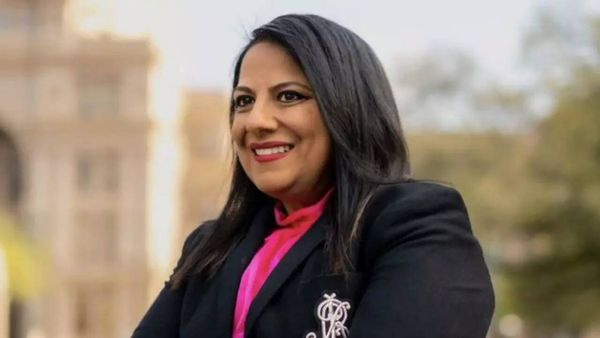
WASHINGTON _ Malika Bilal sometimes is thrust into the role of Muslim explainer _ even to fellow Muslims who incorrectly assume that she's a member of the Nation of Islam.
"People don't always understand the African American experience," Bilal said. "First thing they'll think is 'OK, she's Muslim, but she's probably Sudanese, she's probably Somali, she's from East Africa.'
"When I have to explain, 'No, actually my parents were born here, my grandparents were born here, my great-grandparents were born here,' they don't get it. You get a lot of 'No, no, but where are their parents from. Where are you really from?' "
Millions of eyes worldwide are on Bilal daily as she co-hosts "The Stream," a half-hour show on Al-Jazeera English. The Chicago-born Bilal is a trailblazer as one of the first American anchors to wear a hijab on a news show.
For Bilal, the hijab and the broadcast carry the responsibility of being a role model to Muslim girls and an informal educator to people she encounters on assignments in America who may have never met a Muslim.
"The questions were about Islam. Some (people) wanted to know about Saudi foreign policy, which I have no idea," she said.
Bilal discussed the challenges of being a cultural ambassador of sorts and what it's like growing up Muslim in a post-9/11 America in last week's episode of "Majority Minority."
"To be honest, the amount of hate I've gotten is like a drop in the bucket to the amount of love and the amount of support I've gotten from people," she said. "I remember when I was first starting out _ there was a young girl on Twitter and she said, 'I just wish I could open my eyes and see you in front of me and talk to you, you're such an inspiration.' At the time, it made me embarrassed. Sometimes it doesn't dawn on me until I hear those messages and I think, 'Yes, this is a responsibility.'"
She half-jokingly said that one of the toughest jobs in this country is being a black hijabi woman.
"You don't really think about all the things you are until you're forced to think about all those things," she said. "We all remember very vividly the election campaign that led to last year's election.
"That was a time when all three of those things were at the forefront," she said, referring to being a black Muslim woman. "So I was kind of forced to think about them more on a day-to-day basis than I had been at any other time."
Bilal gravitated to journalism school at Northwestern University in Evanston, Ill., where she initially envisioned a career as a print journalist "because I saw what the broadcast kids looked like and they don't look like me."
"I just kind of knew that wasn't the place that I would find my comfort and that I would be the most welcome," she said. "I wore a scarf and I didn't think that was a battle that I was ready to fight or that it was even worth fighting because I was happy in print journalism."
She never thought about abandoning the scarf, something she's worn since she was 13.
"I wanted it to be a part of me," she said. "I've lived more than half my life with it. It's a part of me, it's a part of my identity. It makes me who I am."