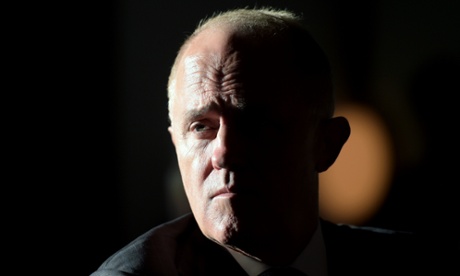
Malcolm Turnbull has condemned Joe Hockey’s proposal that first-home buyers be able to dip into their superannuation as a “thoroughly bad idea”, contradicting Tony Abbott, who called it a “perfectly good and respectable” one.
In an address to the Brisbane Club, Turnbull also declared that the 2014 budget had been the Abbott government’s “biggest misstep”, that the time for political “spin and slogans” or “exaggeration and oversimplification” was over and that governments got voted out if they were not seen as competent economic managers.
Turnbull’s panning of the superannuation plan aligns him with former Liberal treasurer Peter Costello and former Labor prime minister Paul Keating.
“My own view is that would be a thoroughly bad idea,” Turnbull said, in response to questions after the address.
“It’s not what the superannuation system is designed to achieve. Housing affordability is a big issue in Australia but as we’ve demonstrated over many studies over many years, this is a supply side problem.”
Costello said on Tuesday night governments needed to remember the main aims of the superannuation system: to give people a reasonable retirement income and to save themselves the cost of paying everyone the full pension.
He said those goals would lead the current government to decide against allowing people to take money out of their superannuation fund for a house deposit, just as he had decided against it when he considered the idea.
“Well look, this idea has been around for a long time. Every generation thinks it invented the wheel. We went through all of this back in the mid 90s. We had a look at it, we decided, because we thought superannuation should be for retirement savings, we decided not to allow superannuation to be available for housing,” Costello said.
“This government’s going to look at it again, fair enough, things may have changed. But I think they will come to the same conclusion as we did, that if you wanted to top up people’s retirement, if you wanted to save the government money, and it has that dual purpose, then you probably won’t allow people to draw down on it for housing,” he said.
Keating has argued it would destroy Australia’s system of universal retirement savings.
Hockey played down Turnbull’s intervention. “We wanted a debate about this,” the treasurer told the ABC’s Lateline program on Wednesday. “There’s a difference of views – of course there is.”
He said there were “lots of arguments both ways” on the impact on the housing market of allowing people to access super funds to purchase property.
“You’ve also got the argument that [buyers] get capital gain [from home ownership] and the capital gain may well be far greater than anything they get on their return in existing superannuation funds,” Hockey said.
He said Turnbull was “absolutely right” to advocate increased supply of housing.
As the prime minister retreats from a series of key budget and economic policies without obvious alternatives – including reinstating previously axed industry assistance schemes – the remarks about governments seen as bad economic managers, from the man seen as his strongest leadership rival, seemed pointed.
Australia now needed an “evidence-based, spin-free, fair-dinkum debate about the budget position and what we should do to fix it”, Turnbull said in Brisbane, saying this put the spotlight on Abbott and his treasurer, Hockey, as well as on the Labor leader Bill Shorten and the shadow treasurer, Chris Bowen.
“The more fundamental problem the 2014-15 budget faced was that the public was not persuaded tough measures were necessary in the first place,” the communications minister said.
“We – and I include myself and every member of the government in this criticism – did not do a good enough job in explaining the scale of the fiscal problem the nation faces, and the urgency of taking corrective action. In addition there was a deeply felt sense in much of the community that our proposed budget measures were unfair to people on lower incomes when taken as a whole.
“In my view the failure to effectively make the case for budget repair was our biggest misstep, because it was a threshold we never crossed,” he said. “The failure meant the government had been unable to make its case and the opposition had been able to avoid pressure to come up with viable alternatives.”
Turnbull said Australian governments “delivering good economic and fiscal outcomes are very rarely ejected” whereas “governments judged to be inept economic managers or presiding over recessions (even recessions caused by global events) on the other hand seldom survive the next election”.
As the prime minister comes under fire for announcing the reversal in policy on car industry assistance without any public consultation or reference to his own cabinet or party room, and for exaggerating its monetary benefits, Turnbull said the key to economic management was “that the public have confidence economic management is in safe and competent hands. That means policies need to be carefully thought through, painstakingly explained and be robust enough to withstand rigorous policy debate.
“As I have said many times, the time for spin and slogans is over. The Australian people want all of us in public life to respect them, by laying out the challenges we face clearly and accurately, not insulting them with exaggeration or oversimplification. They expect us to debate the options for dealing with problems honestly, transparently and with open minds.”
Turnbull said it was “in no way correct to say that the 2014-15 budget was a failure. Many measures, amounting to a net saving over the forward estimates of $16bn, have been passed. But we clearly haven’t been able to achieve the degree of fiscal repair and reform that was and is needed.
“A number of its most important measures, which would have generated savings over the forward estimates of more than $25bn, have been unable to secure support from the Senate crossbenches and have been abandoned or modified.”




.jpg?w=600)