Here’s the Australian Council of Trade Unions’ message of condolence.
“The Australian Union movement today pays its respects to former Prime Minister Malcolm Fraser,” ACTU President Ged Kearney said.
“Malcolm Fraser will always be remembered for his strong opposition to apartheid and his commitment to multiculturalism through his work with Vietnamese and Cambodian migrants.
“In recent years Malcolm Fraser has been a strong, powerful and socially progressive advocate for human rights in particular the rights of refugees and his support for more humane and compassionate immigration policies.
“Our thoughts are with his family today.”
And with that, we might wrap up our rolling coverage of reactions to the passing of Australia’s 22nd prime minister, Malcolm Fraser. Thanks for sticking with us.
Abbott has discussed some of Fraser’s achievements in government, of which we’ve heard much about today. He goes on:
I made it my business to renew my contact with him on becoming party leader back in 2009. Although his politics had changed over the years, he led us triumphantly into government and deserved the continuing respect of all Australian Liberals. I had quite a number of long talks with him since then, most recently late last year. I didn’t always agree with all of his positions. In fact, I often disagreed with his positions. But I always appreciated his insights and the wisdom born of long experience.
Updated
The prime minister, Tony Abbott, is now speaking in Sydney about the passing of Malcolm Fraser.
It is a sad moment for all Australians. It’s a particularly sad day for all who cheered Malcolm Fraser on in those stirring days when he led the fight against what many of us thought was a bad government, the days of 1975. As our nation’s leader between 1975 and 1983, Malcolm Fraser restored economically responsible government while recognising social change. In a long and active retirement, he maintained a keen interest in our country’s direction. Of course, the constitutional crisis of 1975 was one of the defining political events in our country’s history. Malcolm Fraser held true to the belief that his actions were in the best interests of Australia. He was, as he put it, determined to turn on the lights and to restore Australia’s economic fortunes. It was the greatest win in Australian political history. And it confirmed that he had correctly read the public mood.
Updated
At the risk of sullying a day of tribute, AAP’s Paul Osborne notes that Malcolm Fraser was a Blues fan, and was at one stage the club’s number 1 ticket holder.
Malcolm Fraser was a former No1 ticketholder at @CarltonFC #auspol #AFLFootyShow #afl pic.twitter.com/i9nWZc7XIF
— Paul Osborne (@osbornep) March 20, 2015
Updated
The Canberra Times notes a flurry of activity at the National Portrait Gallery, where staff have hastily mounted a portrait of the late Malcolm Fraser. Naturally, it’s been placed next to Gough Whitlam’s portrait. Read the full story here:
MT @jpmoloney Fraser already hung in Portrait Gallery alongside Whitlam http://t.co/EDdkUSXPhu via @canberratimes pic.twitter.com/XyeoW7EzKP
— Tom McIlroy (@TomMcIlroy) March 20, 2015
Updated
Greenpeace has also paid tribute to Fraser today as a champion of the Great Barrier Reef.
“Malcolm Fraser was a powerful advocate for a more humane and independent Australia.” said Greenpeace CEO David Ritter. “We celebrate his achievements as Australia’s prime minister, in particular his protection of the Great Barrier Reef.”
In June 1979, the Fraser government prohibited exploration and drilling for petroleum on the Great Barrier Reef and, in October, declared the Capricornia section of the reef the first stage of a protected Great Barrier Reef marine park.
“We thank him for his vision and love of Australia’s incredible natural heritage,” said Ritter.
“I’m personally very grateful to Mr Fraser for being generous with his time and advice,” he said.
“We extend our deepest condolences to his wife, Tamie, and their children and grandchildren.”
Updated
Here’s the deputy leader of the federal Labor party, Tanya Plibersek.
Farewell Malcolm Fraser.
Mr Fraser never retired from public life.
Especially in his later decades, he was a great champion of human rights in Australia and around the world. Mr Fraser’s efforts to help end Apartheid in South Africa, his support for immigration from Asia, and his promotion of a multicultural Australia will always be remembered.
I particularly admired his advocacy for an independent Australian foreign policy.
History will forever record the controversy of the dismissal. But so too it will record Mr Fraser’s enduring contributions to our national life.
My thoughts are with his family and friends at this sad time.
Labor’s Jason Clare has posted this tribute:
Two titans. Both now lost to the ages pic.twitter.com/YERUvEuYYf
— Jason Clare MP (@JasonClareMP) March 20, 2015
Updated
Riffing on an earlier post, here’s Fraser with his nemesis-cum-mate the late Gough Whitlam.
Great AAP pic. #auspol pic.twitter.com/rDpjHPpzWr
— Paul Osborne (@osbornep) March 20, 2015
The West Australian former deputy leader of the Liberal party, Fred Chaney, spoke on Sky News earlier. He offered this pithy summary:
The way I would summarise Malcolm is that he stood for the idea of mateship but mateship included everyone, it wasn’t just the old white Anglo-Saxon group.
I think he has been one of the great moral compass that we have had as a country.
Gough, then Fraser: reminds me of those old couples who die in quick succession, unable to break for long the ties that bound them in life.
— Sean Kelly (@mrseankelly) March 19, 2015
Bit of truth in this wry observation by Sean Kelly.
The prime minister, Tony Abbott, will make some remarks about Fraser in Sydney in about 30 minutes.
Meanwhile here’s a possibly apocryphal but charming story about the former PM recounted in Bob Hawke’s memoirs.
Great Malcolm Fraser anecdote told by Bob Hawke - included in Mark Latham's book pic.twitter.com/vWd1dS9Cz8
— Tom McIlroy (@TomMcIlroy) March 20, 2015
Updated
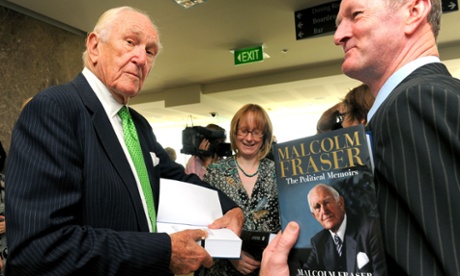
Greens senator Sarah Hanson-Young tweeted her condolences earlier and has followed up with this short statement dedicated to her erstwhile mentor.
Mr Fraser was a politician of principle and a leader of genuine compassion. He was a true gentleman with a heart full of empathy.
He made a remarkable contribution to this country and, especially in recent years, gave a voice to those of us who want our nation to be both fair and decent.
He was one of the greatest mentors I have had and he will be greatly missed.
My thoughts are with his wife Tamie and his family at this difficult time.
Updated
Fraser was a fierce critic of John Howard’s government, particularly its treatment of boat-borne asylum seekers. Howard has addressed the mens’ personal relationship in his tribute in Sydney.
Can I just say something about my own personal relations with him. Malcolm Fraser was somebody that I was attracted to in the early 1970s because I thought he put the case for Australia’s commitment in Vietnam rather better than most of his other colleagues. And when I entered parliament in 1974, I saw him as a future leader of the Liberal party. I supported him in both of his leadership bids. Culminating of course in his becoming leader in 1975. He was very generous to me in promoting me very early and giving me the opportunity in politics. I always valued that and was always grateful for it. We worked together very closely, particularly when I became treasurer at the end of1977 and remained in very close professional harmony and cooperation until the defeat of his government in March of 1983.
He goes on, revealing he had two discussions with Fraser last year:
I won’t pretend that after we left government we didn’t have areas of disagreement and he was critical of some of the policies of my government. I acknowledge that. That was his right and the public will make its own judgment about the validity of different points of view taken. But it’s fair to say that last year I had the opportunity of two discussions with him. I interviewed him in relation to the compilation of my book on Menzies and they were discussions that I enjoyed, and I’m sure he did, and it was an opportunity to talk about somebody who meant a great deal to both of us, the founder of the party that both Malcolm Fraser and I had the privilege of leading. Anybody who achieves what Malcolm Fraser achieved in his life deserves respect as a quite extraordinary Australian. He brought to the government of this country, he brought great integrity.
Updated
I’ll keep adding highlights from former PM John Howard’s tribute to Malcolm Fraser, but in the meantime, my colleague Nick Evershed has produced this nifty timeline of Fraser’s achievements in office. See the full thing here.
Updated
John Howard has also addressed the controversial circumstances in which Fraser become prime minister in 1975.
Numerous words, books and countless speeches have been written or made about the events leading to the dismissal of the Whitlam government. The only two points I would add is to pay tribute to the remarkable strength and capacity Malcolm Fraser displayed in holding the Coalition together and in the process of doing that to make the point that the decision to defer supply was not a decision rammed down the throats of a quavering and reluctant Coalition party room, but was a consequence amongst other things of Malcolm Fraser consulting every member of his shadow ministry and all of them raising their hands in favour of the deferral of supply.
The other observation I’d make for those who continue to dispute the wisdom of what Malcolm Fraser did is to remind people that in 1975 and 1977 that he won two emphatic majorities, in 1975, the biggest majority in Australian electoral history and that was almost matched by his re-election in the end of 1977. He restored tranquillity to the affairs of government in the nation. The last 12 months of the Whitlam government, even in the eyes of those who revere Gough Whitlam, were months of chaos and confusion and disorder and there was a sense of stability and calm and reassurance restored to the nation’s affairs.
Updated
Former prime minister John Howard is now speaking about Fraser in Sydney. Here are some of his remarks:
Malcolm Fraser was of course prime minister of Australia between December of 1975 and March of 1983 and he’s the fourth longest-serving prime minister of Australia. In political terms he achieved the significant feat of winning three elections. He dominated the political scene on the centre-right side of politics from the time he assumed the leadership of the Liberal party in March of 1975.
He goes on to quote Australian political journalist Paul Kelly.
It’s fair at a time like this to make an observation about Fraser’s prime ministership. At the time of his relinquishing his position in March of 1983 and in his book ‘The Hawke Ascendancy’, Paul Kelly who has by most measures become a very significant chronicler of Australian political events had this to say, “Fraser was a very good prime minister, much better than people would have suspected in 1975. He ran a government of above average competence by Australian standards with acumen, dedication and professionalism”.
Updated
We’ve just posted a gallery of Malcolm Fraser’s life in pictures here. A couple of the images:
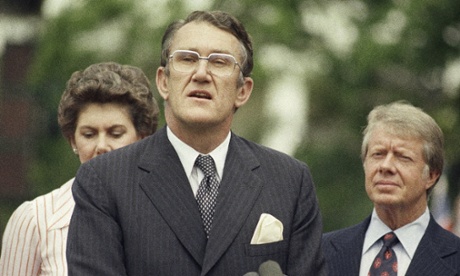
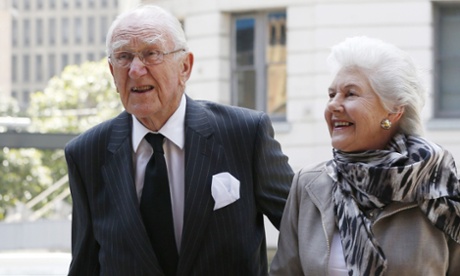
Updated
Had the honour of interviewing Malcolm Fraser about this iconic photograph taken in #Bunbury for the @swtimes #auspol pic.twitter.com/Actna1m0vk
— Usman Azad (@uazadnews) March 20, 2015
The fierce commitment of the Melbourne patrician Fraser to a multicultural Australia has been highlighted in a number of tributes to the man. Fraser’s commitment to diversity was well-reasoned, as this 1981 speech shows:
The key elements of multiculturalism can be simply stated. They are based both on realism and idealism. The starting point is the recognition and appreciation of the fact that the Australian population is derived from a wide variety of ethnic and cultural back-grounds, and that these backgrounds are important to the way Australians see themselves. The sheer duration and magnitude of immigration into this country, the plain facts of the composition of Australia’s population mean that even if we wished otherwise ethnic and cultural diversity can neither be ignored nor readily extinguished.
We know that the attempt to enforce conformity holds high costs both for the individual and the society. It denies people their identity and self-esteem. It drives a wedge between children and their parents. Ultimately it poses a real threat of alienation and division. We cannot demand of people that they renounce the heritage they value, and yet expert them to feel welcome as full members of our society. Realism alone dictates that cultural differences must be responded to in a positive way.
But multiculturalism is concerned with far more than the passive toleration of diversity. It sees diversity as a quality to be actively embraced, a source of social wealth and dynamism. It encourages groups to be open and to interact, so that all Australians may learn and benefit from each other’s heritages. Multiculturalism is about diversity, not division – it is about interaction not isolation. It is about cultural and ethnic differences set within a framework of shared fundamental values which enables them to coexist on a complementary rather than competitive basis. It involves respect for the law and for our democratic institutions and processes. Insisting upon a core area of common values is no threat to multiculturalism but its guarantee, for it provides the minimal conditions on which the wellbeing of all is secured.
Updated
Tributes to Australia’s 22nd prime minister continue to roll in, including just now from the employment minister, Senator Eric Abetz. He describes Fraser as “a strong friend to Tasmania”.
I express my sincere sympathies to Mrs Tamie Fraser and her family on the news of the death of the right honourable Malcolm Fraser, AC, CH, prime minister of Australia from 1975 to 1983.
Malcolm Fraser was a strong friend to Tasmania throughout his prime ministership.
Immediately on election he recognised the need for special treatment to take account of the additional cost of Tasmanian freight travelling interstate, and so the Tasmanian Freight Equalisation Scheme was born in 1976.
In 1980 Malcolm Fraser established the Australian Maritime College in Launceston as a world-class centre for maritime studies and expertise.
He also moved the Australian Antarctic Division from Melbourne to Kingston in southern Tasmania in 1981 and expanded it, recognising Tasmania’s strong scientific and practical links with Antarctica and Macquarie Island.
I had the particular pleasure of getting to know the then prime minister in my role as the federal president of the Australian Liberal students’ federation. The prime minister was our patron.
Mr Fraser will be remembered for bringing the dysfunctional Whitlam government to an end. In 1975 Tasmania’s five House of Representative seats swung from Labor to Liberal. Those seats remained with the Liberals even after the defeat of his government.
On a personal level, Malcolm and Tamie Fraser loved holidaying in Tasmania and maintained a fishing shack in the Central Highlands where he could indulge his passion for fly-fishing.
He was a towering figure, both physically and in our nation’s political history, and led a government which made a significant improvement to our economic development and infrastructure.
Updated
Summary
I’m handing over our continuing coverage following news of the death of Malcolm Fraser this morning to my colleague Michael Safi. Here’s a short summary:
- The former prime minister of Australia, Malcolm Fraser, died aged 84 in the early hours of Friday 20 March.
- Tributes have flooded in from around the country from political leaders past and present, including prime minister Tony Abbott, opposition leader Bill Shorten, communication minister Malcolm Turnbull and former prime ministers Paul Keating, Kevin Rudd and Julia Gillard.
Fraser felt strongly about ending the subservience of Australia to the United States, and developing stronger ties with nations across the Asia-Pacific, including China.
Here’s a video where he outlines some of his thoughts on this:
Updated
The managing director of SBS, Michael Ebeid, has also paid tribute to Fraser:
For @SBS @MalcolmFraser12 was a founding father having establish @SBS TV. May he rest in peace and always be remembered. #RIP
— Michael Ebeid (@michaelebeid) March 19, 2015
Governor general expresses condolences
The governor general, Sir Peter Cosgrove, has issued a statement following the news of Fraser’s death. Here’s the statement in full:
On behalf of all Australians, I offer my deepest sympathies on the passing of former prime minister, the right honourable Malcolm Fraser AC.
Mr Fraser made an indelible contribution to Australia during his many years in public life, most particularly during his eight years as prime minister. He will be long remembered for his tireless service to our nation.
On this sad day, Lynne and I extend our personal heartfelt condolences to Tamie Fraser AO on the loss of her husband, and to Mark, Angela, Hugh and Phoebe on the loss of their father. May they find some comfort in the knowledge that many Australians are sharing their grief today.
Updated
Fraser’s opposition to Apartheid in South Africa remains one of his most significant legacies from his time as prime minister. He was one of the first international leader to visit Nelson Mandela while he was incarcerated, and he lobbied hard – particularly for trade sanctions – and spoke out at length about the abuses that were occurring.
Here’s an excerpt from a speech he gave in the House of Representatives in 1982 on the topic:
Qantas is operating to Mauritius and it is hoped that it will extend such operation to routes in southern Africa and further on. I know that Qantas has been examining the matter. The government was concerned that Qantas should not re-establish its direct link with South Africa. I think the reasons for that are well-known. We do not wish to, and do not encourage, trade with South Africa. Although there is no prohibition of it, there is no active promotion of trade with South Africa.
We believe that maximum pressure should be exerted against South Africa, to seek to break down the system of apartheid. I think we all know that there is a degree of racial intolerance amongst all countries, but most countries around the world, by law, practice or custom, seek to diminish and eradicate racial intolerance. That is certainly the approach of the States and the commonwealth of Australia.
It is certainly the approach of the overwhelming majority of Australian citizens of all political complexions. The difference in South Africa is simply that racial intolerance, bigotry and discrimination are enshrined in the law in a multitude of ways. People cannot move without a police pass. People of the wrong colour cannot live in certain areas. People of the wrong colour might be allowed to get a job in an area, but their wives and families have to stay 300 miles behind, in the hills.
Updated
The opposition leader, Bill Shorten, said Labor salutes the life of Fraser and his great integrity in government:
Labor salutes the life of former prime minister Malcolm Fraser, who passed peacefully today at the age of 84.
As the member for Wannon, a minister, prime minister and elder statesmen, Malcolm Fraser gave six decades of tireless service to our nation.
As prime minister, Malcolm Fraser showed international leadership of great integrity in condemning the evil of Apartheid.
He immeasurably enriched Australia’s multicultural society, offering refuge to tens of thousands of vulnerable people driven from Vietnam by the horror of war.
He maintained the Whitlam government’s commitment to the cause of reconciliation and recognising the land rights of Aboriginal and Torres Strait Islander people.
In the long third act of his public life, Malcolm won many new admirers as a powerful voice for human rights and reconciliation and a deep thinker regarding Australia’s place in the world.
Updated
The communications minister, Malcolm Turnbull, has delivered a tribute that outlines Fraser’s achievements:
Lucy and I were very sad to learn of the death of our friend Malcolm Fraser and we send our condolences to his wife Tamie and their children.
Malcolm Fraser came to the parliament as a young farmer from the Western Districts of Victoria. He grew into a great leader of the Liberal party and a reforming, visionary prime minister who laid so many of the foundations for the diverse, multicultural nation we are today.
Malcolm was rather shy and often appeared somewhat aloof (not least because of his great height). But those who knew him well saw a warm, droll and often very exuberant man.
In office and out of it he showed himself to have a big and compassionate heart. He introduced the Aboriginal Land Rights Act in 1976 and was a strong campaigner against racism around the world leading the commonwealth’s campaign against white minority rule in Rhodesia and apartheid in South Africa.
Updated
Fraser was a prolific presence on Twitter in Australia, and never held back in his views.
Below are a few of the last tweets he wrote. They illustrate – in that most truncated way that Twitter tends to be – the breadth of his views on the world and Australia’s place in it:
Time for a new China vision - Asia and the Pacific - ANU http://t.co/vbSJiGDcmW
— Malcolm Fraser (@MalcolmFraser12) March 18, 2015
Sri Lanka put up a great fight , played brilliant cricket . Congratulations .
— Malcolm Fraser (@MalcolmFraser12) March 8, 2015
Anti-Netanyahu rally draws huge crowd in Israeli city. Not all Israeli's are as dangerous as Netanahyu http://t.co/1rG6BcO5Rt
— Malcolm Fraser (@MalcolmFraser12) March 8, 2015
Qantas passenger banned after asylum seeker walkout http://t.co/AP7UcPBrXe. Heavy handed Qantas, was it under Gov instruction, where is ALP
— Malcolm Fraser (@MalcolmFraser12) March 8, 2015
US and Iran ignore Netanyahu and press on with talks - Al Jazeera English. Showing good sense http://t.co/ndcPmymPVx
— Malcolm Fraser (@MalcolmFraser12) March 8, 2015
Updated
The former Labor prime minister Paul Keating has also offered his condolences and thoughts following Fraser’s death:
The death of Malcolm Fraser underwrites a great loss to Australia.
Notwithstanding a controversial prime ministership, in later years he harboured one abiding and important idea about Australia – its need and its right to be a strategically independent country.
He detested what he saw as our strategic subservience to the United States and our willingness to be easily led from the path of a truly independent foreign policy.
... I always thought Malcolm would be around a lot longer. I must say, I wished he had been.
Updated
Prime minister Tony Abbott pays tribute to Malcolm Fraser
The prime minister, Tony Abbott, has issued a statement on the death of Fraser. He has applauded Fraser’s contribution to Australia:
Our country has lost its 22nd prime minister, the right honourable Malcolm Fraser.
As our nation’s leader between 1975 and 1983, he restored economically responsible government while recognising social change.
In a long and active retirement, he maintained a keen interest in our country’s direction.
The constitutional crisis of 1975 was one of the defining political events of our nation.
Malcolm Fraser held true to the belief that his actions were in the best interests of Australia. He was determined to ‘turn on the lights’ and restore Australia’s economic fortunes.
The greatest win in Australian political history confirms that he had correctly read the mood of the public.
The friendship he built in later life with Gough Whitlam spoke volumes about the character of both men at the centre of the crisis: in their own different ways, they were both fierce Australian patriots.
Under Malcolm Fraser’s leadership, self-government was conferred on the Northern Territory, the commonwealth ombudsman was established and our first freedom of information laws were enacted.
Following the Hilton bombing, he established the Australian federal police. Later, he introduced legislation to establish a crimes commission following the Costigan royal commission.
Updated
Former Labor prime minister Kevin Rudd has also released a statement on passing of Fraser. He has emphasised Fraser’s contributions to foreign policy and recognition of Indigenous Australians:
Prime minster Fraser, both during his time in office and after, championed the cause of ending apartheid in South Africa; the advancement of the interests of Indigenous Australians; and the passage of the Human Rights Act in 1981.
On the moral imperative of eliminating apartheid in South Africa, Malcolm Fraser stood in absolute contrast to Margaret Thatcher.
I well remember Malcolm attending the National Apology in February 2008 together with prime ministers Whitlam, Hawke and Keating as we celebrated another milestone in reconciliation between Indigenous and non-Indigenous Australians.
All Australians will recall Mr Fraser’s role in the controversy surrounding the dismissal in 1975. This cannot be erased from history. Prime minister Fraser will be remembered as a compassionate Australian, who cared for people at home or abroad, who had little or nothing to protect them.
Fraser should be honoured as PM in tradition of Alfred Deakin. He championed end of apartheid in South Africa. http://t.co/X8RN064wnv
— Kevin Rudd (@MrKRudd) March 20, 2015
Updated
The flag at federal parliament is at half mast. Here’s a picture from my colleague Shalailah Medhora:
Flag at federal parliament at half-mast to mark the passing of former PM Malcolm Fraser. pic.twitter.com/v2CzMvS2Yd
— Shalailah Medhora (@shalailah) March 20, 2015
The Liberal Party has released a statement on some of the achievements of the Fraser government:
- Introduction of family allowance providing direct help for mothers and families
- Family income supplement introduced
- Lone fathers’ benefit introduced
- Means test on pensions replaced by simpler income test
- Automatic indexation of pensions
- New pensioner housing scheme introduced
- Abolition of estate and gift duties
- Establishment of Office of Child Care
- Progressive legal reforms with introduction of ombudsman, National Companies and Securities Commission, Human Rights Commission, freedom of information legislation
- Ratification of International Covenant on Civil and Political Rights
- Prohibition of sand mining on Fraser Island
- Whaling banned in Australian waters
Updated
My colleague Calla Wahlquist has just sent me this update with some reaction from human rights lawyer Julian Burnside:
Human rights lawyer Julian Burnside said Fraser was a person of “the greatest decency”.
Burnside met Fraser in 2003 and the two have frequently appeared alongside each other criticising Australia’s treatment of asylum seekers. He told Guardian Australia he considered the former prime minister a friend.
“It’s easily overlooked, because of his political ascendancy in 1975, but Malcolm Fraser always was a person of the greatest decency,” Burnside said. “He really hadn’t shifted his position in politics or in dedication to human rights since 1975.”
“He was a person who took a position for which he was reviled by many and, uniquely in Australian politics, was later embraced by those same people because his vision was so enduring.”
Burnside said it was one of the “greatest tributes” to Fraser that he will be as much – if not more – missed by people on the left side of politics as those from the Liberal party. He said Fraser was good-humoured about the shift in his public image.
“I had a funny experience with him, I think it was about 2004 or 2005, when we were on the same panel of a writers panel,” he said.
“At the end of my lecture I ad-libbed that it was my most fervent wish that the next Labor prime minister of Australia would be Malcolm Fraser.
“And he laughed and thanked me, and said, ‘it will never happen, I am much too far to the left for them’.”
Updated
Timeline of Fraser's ascension to prime minister
Here are some of the key points from the early years of Fraser’s time in politics. These key points are outlined, along with many more, on this useful timeline from the University of Melbourne:
-
10 December 1955: Wins the seat of Wannon and enters the House of Representatives in federal parliament.
-
28 February 1968: appointed the minister for education and science under the Gorton government.
-
12 November 1969: Appointed minister for defence.
-
21 March 1975: Elected leader of the Liberal party.
-
15 October 1975: Announces the opposition will block supply of the Whitlam government.
-
11 November 1975: Fraser becomes prime minister after Whitlam is dismissed by the governor general.
-
13 December 1975: Fraser wins the federal election against Whitlam.
Updated
Former Labor prime minister Julia Gillard has also posted a tribute to Fraser:
I honour Malcolm Fraser’s service to our country as prime minister.
Malcolm Fraser in and beyond politics was a leader in the fight for racial equality. His brave stance against the evil of South Africa’s apartheid helped change the world for the better.
Malcolm will always be remembered kindly for his commitment to multiculturalism and his specific actions to resettle Vietnamese boat people in Australia. Many will also recall with admiration his compassionate work internationally through his leadership post politics of CARE Australia and then CARE International and its citizens.
Updated
The legislative agenda of the Fraser government was quite extraordinary.
One of Fraser’s particular interests was public accountability and due process. He has spoken at length about his commitment to government as an open process that should be transparent and subject to oversight.
His government passed the first freedom of information laws in Australia, appointed the first ombudsman and established the Human Rights Commission.
Each of these measures had an enormous impact on how government operates in Australia. We can see – quite recently – how important some of these mechanism are in making government accountable, such as with the Human Rights Commission’s recent report into children in detention.
Here are some of the key legislative measures passed by the Fraser government from the Malcolm Fraser Collection:
Social Services Amendment Act 1976
Aboriginal Land Rights (Northern Territory) Act 1976
Constitution Alteration (Senate Casual Vacancies) Act 1977
Federal Court of Australia Act 1976
Crimes (Taxation Offences) Act 1980
Taxation (Unpaid Company Tax) Assessment Act 1982
Aboriginal Development Commission Act 1980
Human Rights Commission Act 1981
Updated
My colleague Katharine Murphy has filed this story on the death of Fraser:
Former Australian prime minister Malcolm Fraser has died at the age 84, after a brief illness.
Fraser’s passing was confirmed by a brief statement from his office on Friday.
“It is with deep sadness that we inform you that after a brief illness John Malcolm Fraser died peacefully in the early hours of the morning of 20 March 2015,” the statement said.
Just returning to Fraser’s views on immigration – this was his last piece, published in the Sydney Morning Herald. It is a strident defence of the president of the Australian Human Rights Commission, Gillian Triggs, and an indictment of the government’s attacks on her:
The Australian Human Rights Commission and its president, Professor Gillian Triggs, a most distinguished and highly respected lawyer, have been under significant attack from the government and some elements of the media.
In accordance with its charter, the commission undertook an Inquiry into Children in Detention early in 2014. The Attorney-General received a copy of the final report on November 11, 2014. The government must publish the report within 15 sitting days of that date. It is expected from everything we have heard about children in detention that the report will be highly critical. Are the attempts to diminish the reputation of the commission designed to make it easier for the government to ignore its report?
Because of the increase of arbitrary powers, not subject to appeal or review, that the government has granted its own ministers, the work of the commission is more necessary than it has ever been.
The expansion of the ministers’ powers, without any judicial review, without any possibility of appeal, indicates the government is not concerned about the separation of powers between the executive and the judiciary. The government is concerned to make sure the law and the courts cannot restrain it in the exercise of its harsh policies.
Updated
The education minister Christopher Pyne has also offered his condolences to the Fraser family.
Vale Malcolm Fraser. A life dedicated to the service of our country. We will be poorer without him. Thoughts are with his family. #auspol
— Christopher Pyne (@cpyne) March 19, 2015
One of Fraser’s most significant legacies is his contribution to developing Australia’s immigration policies. He was a substantial supporter of adopting a humanitarian policy and allowing refugees to seek asylum in Australia during his time as prime minister.
More recently, his views on this issue have seen him very publicly depart from recent Liberal governments. He has been an outspoken critic against both Labor and Liberal government policies around immigration detention and treatment of refugees.
In this 2013 video he described the policy as a “total reversal of some of the values Australia had”.
Updated
The treasurer, Joe Hockey, has offered his condolences to the Fraser family:
I do want to pass my condolences on to Tamie Fraser and the Fraser family … quite obviously these events just indicate how in one way or another we all stand on the shoulders of those that were before us.
Updated
Here is the Guardian’s report from 13 November 1975 describing the moment Whitlam was dismissed, when Fraser was first appointed prime minister:
In a move that has stunned Australia, the prime Mminister, Mr Gough Whitlam was dismissed from office today and parliament prorogued by the governor general, Sir John Kerr.
Sir John, who until now has refrained from intervening in the five-week-old constitutional crisis, appointed the opposition leader, Mr Malcolm Fraser, as caretaker prime minister. A general election is expected to be held on December 13, although no formal announcement has yet been made.
The governor general’s action – unprecedented in Australian history – came after Mr Whitlam told parliament that he would hold an election for half the Senate. However, when he formally advised Sir John of his intention, the governor general refused to issue the necessary writs, and according to Mr Whitlam, dismissed him without any further explanation.
Today’s announcement produced extraordinary scenes throughout the country. Thousands of civil servants in Canberra stopped work in protest. Later, there was a huge and spontaneous demonstration in support of the Labour administration outside parliament house.
Updated
The Liberal MP Philip Ruddock has posted this tribute:
Those who recall the manner of his election discouragingly should remember Malcolm as a liberal on issues of race and human rights. #auspol
— Philip Ruddock (@philipruddockmp) March 19, 2015
Updated
Fraser entered politics at a young age. When he became a member of the House of Representatives in 1956 he was the youngest member of the house.
Here is an excerpt from his maiden speech:
As the youngest member of this House — in passing I should like to say that if I remain a member it will take me 33 years to reach the average age of members of the cabinet — I appreciate the honour that the electors of Wannon have shown me by returning me as their representative. We have just heard a clever, learned and academic speech from the honorable member for Yarra (Mr Cairns). However, I feel that he has oversimplified an extremely difficult and intricate problem. One of the major factors which he has neglected in his argument is that over the last few years the government has pursued a vigorous policy of development which has placed great stress upon our available supplies of labour, capital and materials, and this, I believe, is one of the principal causes of the inflation which we are at present experiencing.
... There is one final thing that I should like to say. I was too young to fight in the last war, and I owe a debt of gratitude to those who fought in World War I, as well as in World War II. But I am not too young now to fight for my faith and belief in the future of this great nation, in which the individual is, and always shall remain, supreme. I have spoken tonight of power and the prosecution of state and federal works. I have spoken of increased population; again I believe we shall achieve a population of 25,000,000 people in this country. But all these things will mean nothing if one thing is ever forgotten – that the individual happiness of each citizen is, and must remain forever, the first thought of our national leaders.
Updated
Fraser has become a towering figure in Australian politics, but not just for his time as prime minister. What is remarkable about his legacy is the evolution of his views, and how universally admired he is across politics.
The Greens senator Sarah Hanson-Young has posted this response to the news.
Mr Fraser a politician of principle and leader of compassion. A true gentleman with a heart full of empathy. I am devastated.
— sarah hanson-young (@sarahinthesen8) March 19, 2015
Updated
The first of many tributes and reactions are beginning to come through. My colleague Daniel Hurst has just sent me these reactions from the Victorian Liberal party:
The Victorian Liberal leader, Matthew Guy, described Fraser as “a leader and a statesman” who would “always be of the Liberal party”.
The incoming Victorian Liberal party president, Michael Kroger, mourned Fraser as “a very fine Australian who gave much to this country”.
Speaking to Sky News, Kroger said Fraser had moved away from the Liberal party in recent years, but “never left the stage” and the country was richer for it.
Updated
Fraser was prime minister of Australia between 1975 and 1983.
His appointment came at a tumultuous time in Australian politics; it followed the dismissal of then prime mininster Gough Whitlam by the governor general, Sir John Kerr, amid a constitutional crisis.
Fraser went on to win the subsequent election that resulted in a landslide win for the Liberal party. He won two further elections in 1977 and in 1980.
In 1983 he was defeated by Bob Hawke, and retired from federal politics shortly after the election.

Updated
Here is the full statement from Fraser’s office:
It is with deep sadness that we inform you that after a brief illness John Malcolm Fraser died peacefully in the early hours of the morning of 20 March 2015.
We appreciate that this will be a shock to all who knew and loved him, but ask that the family be left in peace at this difficult time.
Updated
Good morning. The former prime minister of Australia, Malcolm Fraser, died in the early hours of 20 March 2015 aged 84.
Fraser was prime minister between 1975 and 1983. He leaves an enormous legacy in shaping the nation.
We will be providing rolling coverage and updates throughout the day.