It has been an open secret in southern Thailand, especially in Yala, Narathiwat and Pattani provinces, that Malaysia has long served as a second home for many insurgents seeking refuge when they face military crackdowns.
Among these fugitives are several leaders of the Barisan Revolusi Nasional (BRN), an armed separatist group fighting for the independence of the southernmost provinces.
They feel safer living openly in Malaysia, particularly in Kelantan, because many hold dual citizenship and can remain there unless Thai authorities formally seek their return.
Thai security officials are also aware of this dilemma, but rarely speak out for fear of damaging the good-neighbourly relationship between the two countries.
The same can be said of senior government figures, who appear more concerned with diplomatic niceties than with speaking the truth openly.
So when National Security Council secretary-general Chatchai Bangchuad recently said Malaysia holds the key to peace in the Deep South, it was indeed praiseworthy that he had the courage to tell the truth.
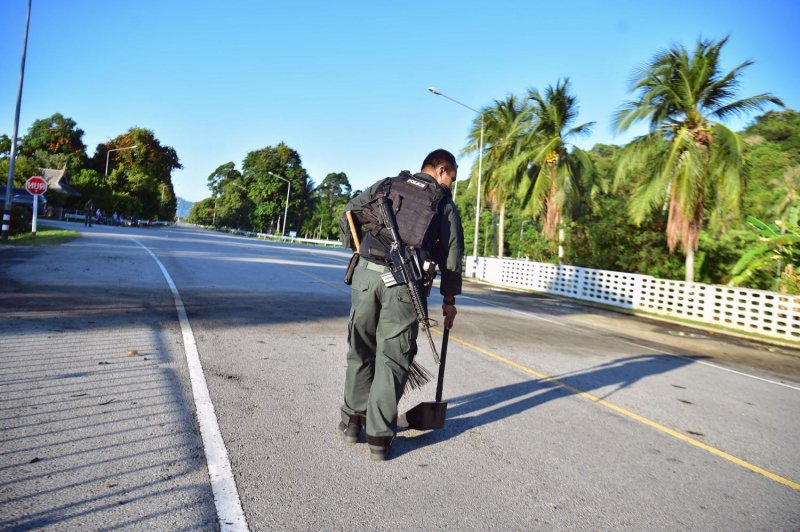
Army chief of staff Gen Chaiyapruek Duangprapt was even more forthright when he said the perpetrators of last Wednesday's attack in Ra-ngae district of Narathiwat, which left five paramilitary rangers dead, must be hunted down no matter where they are hiding, even in a neighbouring country.
Although he did not name the country, it was widely understood to be Malaysia.
Defence Minister Lt Gen Adul Boonthamcharoen, however, sought to play down Gen Chaiyapruek's remark about "hunting down", saying he would prefer the media not to repeat the wording.
Obviously, the defence minister was more concerned about maintaining good relations with Malaysia.
But the Thai media are in no mood to play the "good guy" after the loss of five rangers and a string of violent incidents in recent weeks, including a car bomb in Narathiwat, the killing of a construction foreman in Yala, and bomb and arson attacks on several petrol stations.
Malaysia has facilitated peace talks between the Thai government and the BRN for years, and we are grateful for that good-neighbourly gesture.
But it can do more by not turning a blind eye to the fact that several insurgents wanted in Thailand for crimes committed in the southern provinces are taking shelter there.
Malaysia can, at the very least, restrain these criminal elements, if not arrest and return them to Thailand to face justice.
It should demonstrate greater sincerity and cooperation in helping resolve the unrest through peaceful means.
Thailand showed the same commitment several decades ago when it persuaded Chin Peng, leader of the Communist Party of Malaya, based mainly in Betong district of Yala province, to cease hostilities against Malaysia in 1989 during the government of the late prime minister Gen Prem Tinsulanonda. A peace agreement was signed in Hat Yai and witnessed by then-prime minister Chatichai Choonhavan.
Successive governments have been reluctant to label the insurgent groups in the Deep South as "terrorists", even though many of their violent acts, including roadside bombings targeting officials, civilians and public property, qualify as acts of terrorism.
Instead, the perpetrators have been described as "ill-intentioned people" or, more recently, "instigators of unrest", apparently out of concern that the terms "terrorism" or "terrorists" might elevate their status and invite international intervention.
For now, the government is pursuing the so-called "talk-talk, fight-fight" approach in dealing with the insurgent groups.
Prime Minister Anutin Charnvirakul has instructed security forces to deal harshly and decisively with the insurgents while, at the same time, continuing peace talks with the BRN.
The Deep South insurgency has dragged on for more than two decades since 2004. More than 7,800 people, mostly civilians, have been killed and over 13,000 injured. About 500 billion baht has been spent from the budget, while financial losses and property damage are estimated to be in the billions of baht. Yet peace remains elusive.
Hopefully, this dual-track policy may offer a chance of success. But without sincere cooperation from Malaysia, that chance remains slim.
There is no denying that Malaysia holds the key to peace in the Deep South.
The big question is: when will Malaysia use that key?