

SEATTLE _ When Alyssa Johnston and members of her tribe speak to one another in Quinault, they are often moved to tears by the knowledge that, at the turn of the century, the language was all but dead.
The last person who spoke fluent Quinault passed away in 1996. By using recordings of those who spoke the language in the 1960s, a handful of people in the Olympic Peninsula tribe are slowly and painstakingly piecing it back together _ and teaching it to a new generation.
Last year, Johnston was the first person in recent memory to earn a world language credit at the University of Washington by showing she had achieved "intermediate low-level proficiency" in that language.
"It's everything to me," Johnston said of the importance of reviving her tribe's native tongue. "Language is culture," she said, and the tribe "right now is literally making history" by bringing it back.
That history is also being written on the UW's Seattle campus.
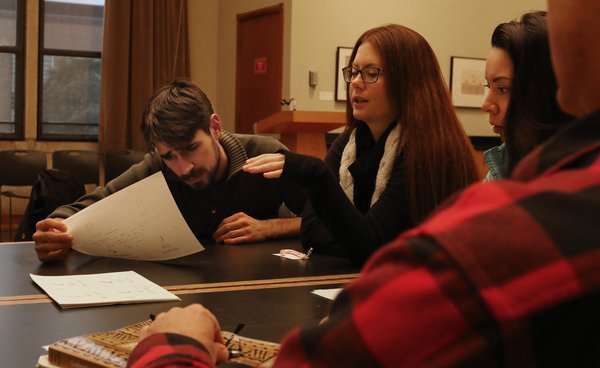
Every two weeks, two separate groups gather around a table in one building or another to practice one of two indigenous languages: Southern Lushootseed, the common tongue of the Native American tribes that lived in this region, and Hawaiian, the native language of the indigenous people of Hawaii.
Chris Teuton, chair of American Indian Studies at the UW, hopes students eventually will be able to learn both those languages in for-credit courses, joining the 55 other languages already taught by the university.
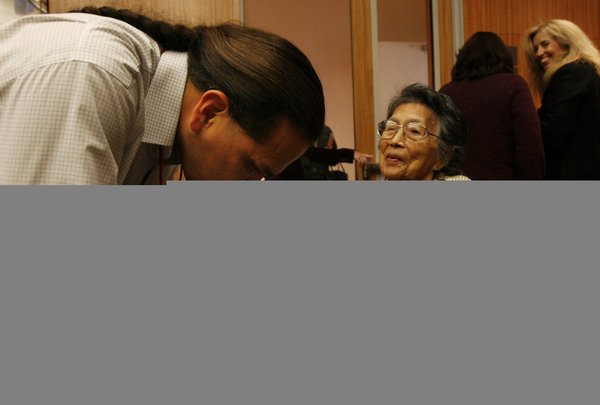
In the meantime, the informal classes are a labor of love for the volunteers who teach them. Nancy Jo Bob, a member of the Lummi Nation, and Tami Kay Hohn, of the Puyallup Tribe, both drive up from Auburn every month to offer several hours of language instruction, using a system they devised that helps students think and speak in complete sentences from the outset.
Lushootseed was revived by Upper Skagit author, teacher and linguist Vi Hilbert, who died in 2008 at the age of 90. Hilbert taught Lushootseed for credit at the UW until her retirement in 1988, and it has been taught intermittently at the university since then, along with Navajo and Yakama.
Lushootseed's sentence structure is different from English, and includes sounds that don't exist in English.
"It's like my tongue is tap-dancing," one speaker marveled during a recent language table session.
Sentences start with a verb, rather than a subject, and the form the verb takes, gives information about the manner and time of action, said UW English Professor Colette Moore, who is taking part in the language table.
"By the time a speaker gets to the subject in a Lushootseed sentence," she said, "he or she has already given a lot of other information."
The language's history in the Puget Sound area dates back thousands of years. English, in contrast, has been spoken around here for fewer than 250.
"Sometimes it can be a perspective shift for students to see English as an immigrant language," Moore added, "but, of course, it is."













