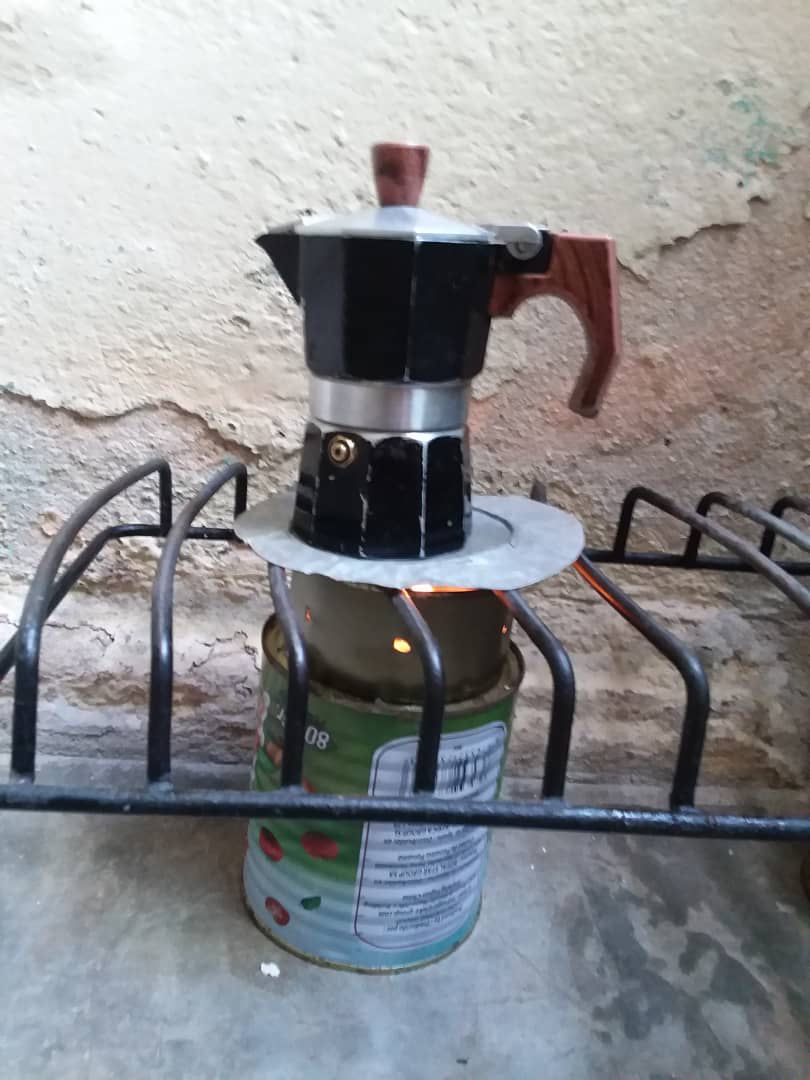
My grandmother sent me a photo last week. In it, a white candle burns inside a metal bucket.
Balanced on the bucket’s rim are the cast-iron grates from the gas stove—the stove that no longer has gas. And, on top of the grates, sits the coffee maker. The idea is that the candle’s small, dying flame will heat the stovetop espresso maker just enough for the coffee to brew. The whole contraption looks like something a child would build at a survival camp. My grandmother is over 80 years old, and she built it because in Cuba right now she has no gas to cook with, virtually no electricity at any hour of any day, and her morning coffee is non-negotiable.
I stared at that photo for a long time. I was sitting in my apartment in Houston. Outside the window, Texas was still Texas.
Cuba is in the dark. Literally—for most of the day, most of the country has no electricity. The national power grid, known by its Spanish acronym, SEN, has collapsed seven times in the past eighteen months. The last two collapses happened within a week. The government’s energy ministry admitted that 2025 was one of the nation’s worst years for fuel scarcity and promised that 2026 would be only “slightly better.”
My homeland generates roughly half the electricity its people need. The main thermal plant, Antonio Guiteras, breaks down constantly. Its boilers, designed to last only 25 years, are over four decades old and run only through faith and improvisation. More than a hundred diesel generators sit idle across the island for lack of fuel.
The result: In many provinces, people get about two hours of electricity a day. Sometimes none.
Houstonians know what it’s like to lose power. In February 2021, Winter Storm Uri left millions of Texans without electricity for days in the dead of winter. In Cuba, such blackouts are common. The refrigerator shuts off. The food rots. The water pump cuts out. Bread goes unmade because the bakeries can’t run their ovens. People walk or bike kilometers to work because the buses lack fuel. They do laundry at three in the morning when the power sometimes flickers on without warning. They set their phones on windowsills to catch a signal, because even the cell towers fail.
A friend in Havana recently wrote: “We’ve been without power for 48 hours and I can’t connect.” Another: “They gave us two hours of electricity. Not even enough time to breathe. The fridges didn’t cool down. The battery packs didn’t charge. This system is diabolical.” Another, commenting after a rare hour of power: “I woke up scrambling. Just in case the SEN goes down again.” This is the grammar of daily life in Cuba now—“just in case”—every sentence conjugated in contingency, every plan built on the assumption that everything could collapse before you finish thinking it through.
A few weeks ago, a fake government communiqué circulated on WhatsApp. It announced the imminent activation of “Option Zero” due to the country’s imminent total paralysis: no transportation, no electricity, no water, no food distribution, no internet. People were told to immediately fill every available container with water. To organize their block, their building, their neighborhood. That “revolutionary discipline and resolve” would be needed in the days ahead. Millions of people received it and thought, That sounds right.
The bogus notice was shared so many times that the government had to issue a denial in the newspapers. The fake communiqué was indistinguishable from reality because reality resembles apocalyptic fiction.
The United States—the country that gave me refuge and where I pay taxes—has spent several months now making it nearly impossible for Cuba to import petroleum.
One friend, a 33-year-old who has never left Cuba, sent me a voice message from Havana. He was eating a pizza at one of the rare street cafes that still runs on its own generator.
He told me that when Cubans talk about wanting freedom, they’re not really thinking about who specifically governs them. They’re thinking about survival. “What we want is food. What we want is opportunity. What we want is an economy, a salary, openness, prosperity. After that, we can think about other things,” he told me. Then he laughed a little. “The Cuban has never been about the future. The Cuban lives in the present. Give it to me now, I’ll enjoy it, and we’ll see.”
I left Cuba in 2022. Before that, state security had detained me many times for doing journalism. The first time, in 2018, I was covering hurricane damage in the province of Pinar del Río when two officers on motorcycles stopped me and my photographer, confiscated our phones, held us for 12 hours, and asked—over and over—what we were doing there, who was funding us, what kind of organization was “independent.”
An “independent journalist,” for them, was synonymous with a counterrevolutionary. In Cuba, everything that cannot be directly controlled by the government—including the press—is prohibited.
Another time, in 2019, they held me for seven hours at a police station in the province of Holguín, where I had traveled to cover the closure of a sugar mill. They erased the files from my laptop and camera and made me sign a warning letter. A lieutenant colonel told me: “Here, I am the law.” On my way out, an officer mentioned my son. He suggested I dedicate myself to him. My son was 5.
I did not want to leave Cuba. I loved my life there—my routine, my streets, my language, and even the specific weight of the air in August. I left because the alternative was to stop being a journalist, become a journalist who writes only what they’re told, or end up in prison. I left because staying required either submission or suffering, and I’d already had enough of both.
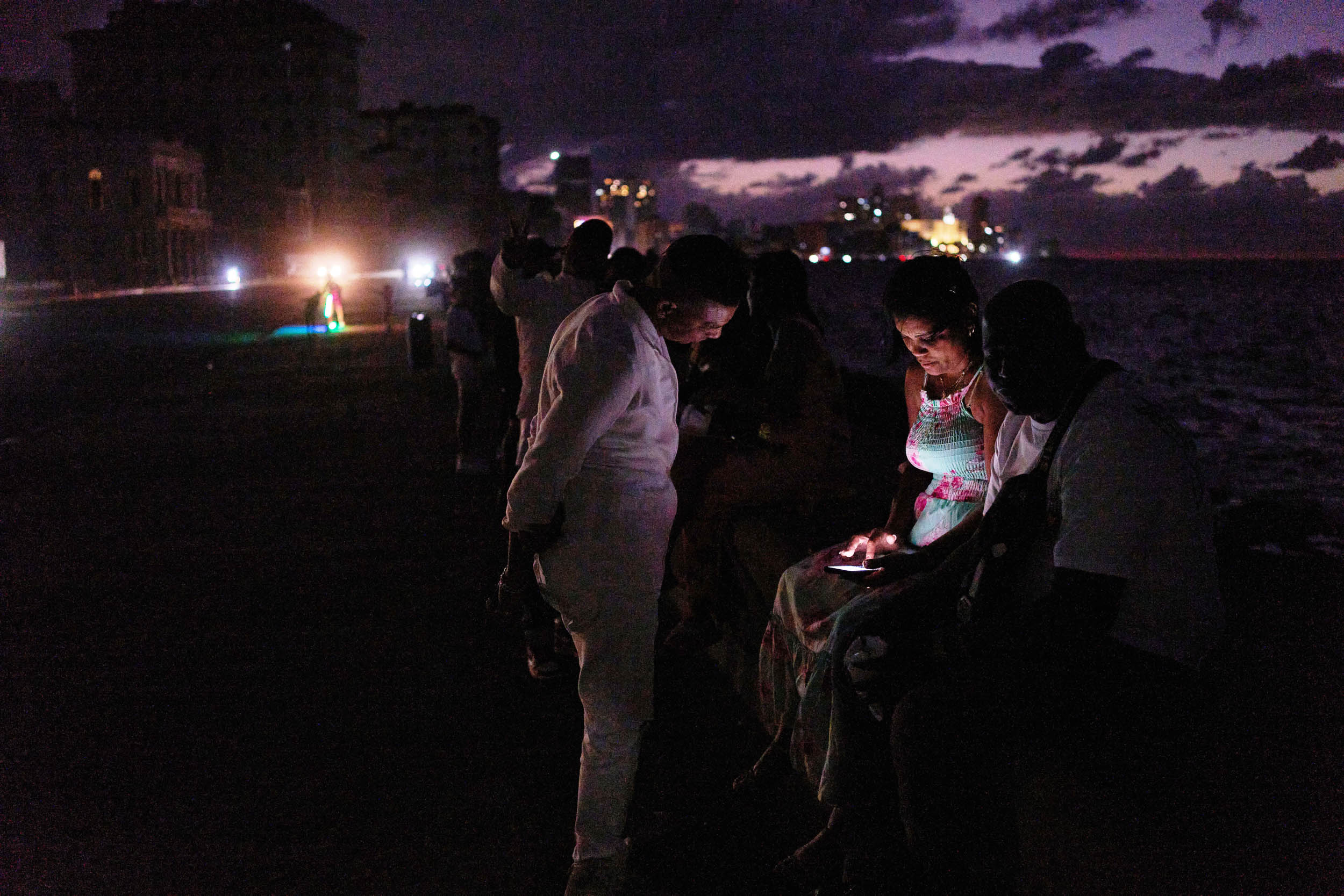
I left my son behind. He is now 12 years old. He lives in Havana with his mother and, like everyone in Havana, has two hours of electricity a day or less. The image I can’t get out of my head is his face in the dark, lit only by the phone screen. A 12-year-old illuminated by that small rectangle because there is no other light. He rations the phone’s battery because he doesn’t know when he’ll be able to charge it again. I send money when I can. Life in Houston is not cheap, and I am a freelance journalist who also drives Uber and does odd jobs. I know the money I send doesn’t really fix anything.
Nearly all of Cuba’s power plants run on fuel that the island cannot buy because the United States—the country that gave me refuge and where I pay taxes—has spent several months now making it nearly impossible for Cuba to import petroleum.
The Cuban government has been blaming the United States for its problems since 1959—sometimes rightly, sometimes not. At this point I am no longer interested in that argument. My only position on the Trump administration’s oil blockade comes from seeing a 12-year-old rationing his phone battery and a grandmother heating coffee with a candle. I care about the suffering of the people there, even as a Cuban forced to come to the United States for protection. And now the country that gave me that protection is tightening the screws on the place where my relatives live in the dark.
The coffee contraption my grandmother built—the candle, the metal bucket, the cast-iron grates, the espresso maker balanced on top—is the most Cuban thing I have ever seen. It is ingenious. It is absurd. And it is dignified—because dignity in Cuba has always been a form of resistance built from whatever materials desperate people can find.
She makes coffee every morning. The candle is small. It takes longer than it should. The coffee, I’m told, comes out fine.