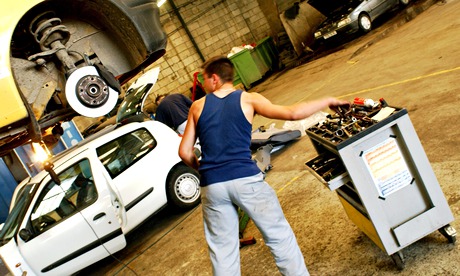
Under the trees, just down the road from the Dourdin housing estate, the signs are unmistakable, with a couple of cars jacked up and a litter of oily rags and toolboxes spilling all over the pavement. By Thursday evening the open-air mechanics have set up shop in this district of St Denis, north-east of Paris.
Sporting a singlet and a (fake) diamond stud in his ear, Eddie (name changed) has plenty on his hands. Customers are waiting in their cars. At the end of the day he pulls out a flask of bourbon and some plastic cups, and turns up the sound system. The scene turns into a boozy picnic.
You can find amateur mechanics like Eddie all over the Paris area and in the rundown estates of many French cities. With a strong economy lacking in recent years, a makeshift one has instead developed. Being unofficial, it is hard to pin down with figures. In Seine-St Denis most of this business is close to the big city. You only need to hop across the inner ring road to have your car repaired. At €20 ($22) for a change of brake pads or €30 for an exhaust pipe, they are unbeatable. It is a full service, with scope for bodywork and painting.
Between Aubervilliers and St Denis, despite hunks of concrete intended to keep people off the wasteland behind the site of the future Condorcet university campus, there are plenty of mechanics. Trade is well established and, in this case, mainly in Ivorian hands, drawing recruits from nearby suburbs. There is no lack of work, repairing engines, keeping watch, moving cars if police turn up. Lorries bring cars from Belgium or Germany every day.
Further east, along the old route nationale 2, near Fort d’Aubervilliers Metro station, undocumented migrants hail passing cars, offering their services. You can find similar deals at Stains, Rosny-sous-Bois and Drancy, among others. These black-market garages have taken over underground car parks, quiet back streets, the backyards of old factories and even supermarket forecourts.
Nor are they restricted to Paris. There are so many in the northern quarters of Marseille that Socialist party senator Samia Ghali has decided to make it a major issue. “With oil leaking all over the place and cars monopolising spaces for months, it’s become unbearable,” she says. The story is much the same on working-class housing estates in smaller towns such as St Etienne or Roubaix. In the latter case the mechanics have moved into warehouses abandoned by the garment trade.
This business has always existed in poor neighbourhoods. Odd jobs are part of a larger culture of mutual assistance. The banknotes that change hands between two car doors are often the only earnings of these occasional mechanics. “It helps the family to do a couple of jobs – on the side – outside your building,” says Nordine Moussa, at Marseille’s Collectif des Quartiers Populaires de Marseille, a residents’ group.
“It’s being going on a long time, but it’s gaining ground with the crisis. Most people here have a second- or third-hand car that’s always breaking down,” says Philippe Rio, the Communist council leader at Grigny, south of Paris.
“You have to distinguish between the odd bit of work to make ends meet and full-time unregistered work,” adds Stéphane Troussel, Socialist leader of the Seine-St Denis departmental council.
The authorities seem well aware of the illegal repair centres, but in no hurry to shut them down. “The top priority for us is violent theft,” an official says at the préfecture of Essonne, south of the capital. In Seine-St Denis they are more concerned. “We get a lot of reports, so from time to time we take action to contain the trade and respond to complaints by local residents,” says a spokesperson at the police headquarters in Bobigny. “For instance, on 15 April about 30 officers raided the car park on the Clos St Lazare estate, in Stains, to break up an illegal repair shop that had got out of hand. Six young men from various west African countries were arrested, then charged for unregistered labour, and three customers for using their services.” A tenants’ association representative appears less than reassured. “They’ve been taking over the car park every day for ages,” he says. “They’ll be back.”
Local councils are torn between action and laissez-faire. To discourage shade-tree car mechanics the most severely affected towns tighten up parking bans or install concrete blocks preventing access to pavements. Police patrols may be stepped up too. But the trade just moves elsewhere.
Some councils seem resigned. Undertakings of this sort are inevitable in a recession. “It caters for a specific demand and is not a source of crime as such,” says Pierre Quay-Thevenon, personal assistant to the leader of Aubervilliers town council. “It’s wiser to go along with it, to make sure it doesn’t get out of hand.” Here and in neighbouring St Denis the council is thinking about setting up a community garage, where residents could repair their car in exchange for a small subscription fee. This should help to clear up some of the slicks and wrecks that so bother local people.
This article appeared in Guardian Weekly, which incorporates material from Le Monde