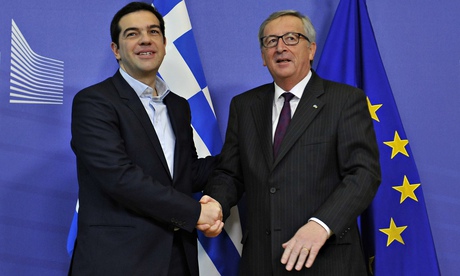
The founders of the EU wanted to ensure that through mutual dependency and support wars that led to so much devastation in the first part of the 20th century could no longer happen, while allowing Europe to continue as a force on the world stage with the rise of continental powers such as China and India. Such fundamental principles of common cause will be totally undermined if the eurozone powerhouses, as Nils Pratley terms them (5 February), continue to demand austerity from Greece, regardless of the economic and social consequences or the democratic will of its people.
The reason most of the British favour retaining EU membership is trade. Countries like the UK not in the eurozone already sit on the sidelines as the European economy stagnates. However, if the eurozone “powerhouses” continue to bully Greece and punish its electorate for daring to vote against austerity – or worse, force a Greek exit from the euro or even the EU – how long will it be before eurosceptic voices suggest that a simple free trade area such as Efta is the best way to ensure that national sovereignty and European democracy are sustained? The break up of the EU will follow. A monetary union without a fiscal union was always a step too far. Now eurozone countries should either make it work for all the countries or accept it is a failure and get rid of it.
JD Budden
Exmouth, Devon
• It is a commonplace that every German has memories of the hyperinflation of the 1920s embedded in their DNA. Unfortunately, the Germans appear to have forgotten that the hyperinflation was a direct result of the crushing burden of war reparations imposed on them by Britain and France. The German economy was crippled by the obligation to transfer real resources to the victorious countries on a massive scale – exactly the position Greece finds itself in today. They also seem to have forgotten that the burden of reparations and the ensuing hyperinflation created a fertile breeding ground for extremists and propelled Hitler into power.
Geoffrey Renshaw
Department of economics, University of Warwick