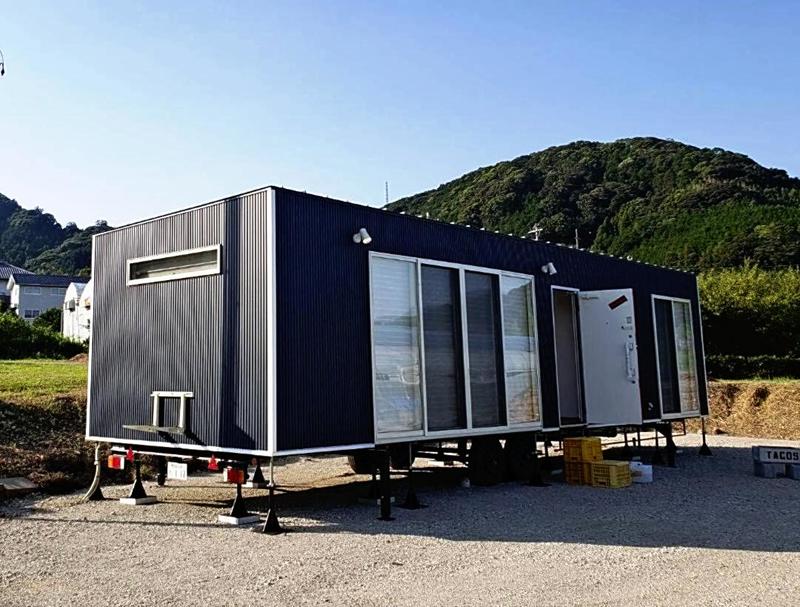
Trailer houses have been attracting attention for their stylish structure and convenience. Yet although these homes require no foundation work and present relatively low initial costs, they may have to be removed if they are not properly transported and installed.
Masafumi Oda, 39, and his wife Rima, 29, began building a trailer near their home as a second house in Gamagori, Aichi Prefecture. Featuring one room in addition to a living room, dining room and kitchen, the trailer is about 11 meters long and 3 meters wide. Overall the floor space is about 35 square meters.
There is also a bathroom and toilet inside, and the house looks very much like a regular small apartment.

"We usually live with my parents, but I want to spend more time here little by little. In the future I want to move with this and live in Okinawa," Rima said smiling.
The overall cost will be more than 8 million yen. The interior can be changed freely, so the couple designed it themselves, and they were particular about the wallpaper.
"I didn't know if I would live in the same place for a long time, so I wanted to live light. I was looking for a convenient place to live so I wouldn't have to burden my kid with a mortgage in the future," Masafumi said.
Trailers are pulled by cars along public roads. No ground improvement or foundation work is required, so the cost is low and there is basically no fixed property tax or real estate acquisition tax.
Trailer houses can also be resold like used cars.
However, they do pose issues different from housing. When traveling, for example, it is necessary to follow the Road Traffic Law and obtain permission from the Land, Infrastructure, Transport and Tourism Ministry in advance. Installation sites are also subject to the City Planning Law and the Building Standards Law.
"If such facilities are not established in accordance with the law, they may be subject to administrative guidance and ordered to be removed," said trailer house maker and retailer Lukura in Toyohashi, Aichi Prefecture, who built Oda's trailer house. "To use these homes with peace of mind, dealers need to confirm with local governments how to transport and place them."
American-born trailer houses first came to Japan in the 1990s and have been used for vacation homes, shops and temporary housing. Currently, there are several manufacturers in Japan. According to the general incorporated association Japan Trailer House Association in Tokyo, there was a conspicuous number of illegal installations because the homes' low price and ease of installation were emphasized. As a result these homes are said to be handled strictly these days.
Certain installation requirements must be met for trailer homes to be treated as vehicles. Specifically, the system of the trailer house must first be able to be connected to water and other lifelines without the use of tools. Second, it must be able to be moved at any time. Third, the owner must legally prove that it is a vehicle through inspections and other means.
"Accurate knowledge is required, so manufacturers and others need to choose carefully," said Kunihiko Ohara, representative director of the association. "It's better to presume you'll use it like a second house rather than a permanent home."
In some cases, a trailer house is installed as a child's room on the premises of a home, in others it is used to care for parents who need nursing care at home. "It's also possible to set up a trailer house on the premises of an adult child's household and use it as an unusual two-family house," Ohara said.
Read more from The Japan News at https://japannews.yomiuri.co.jp/