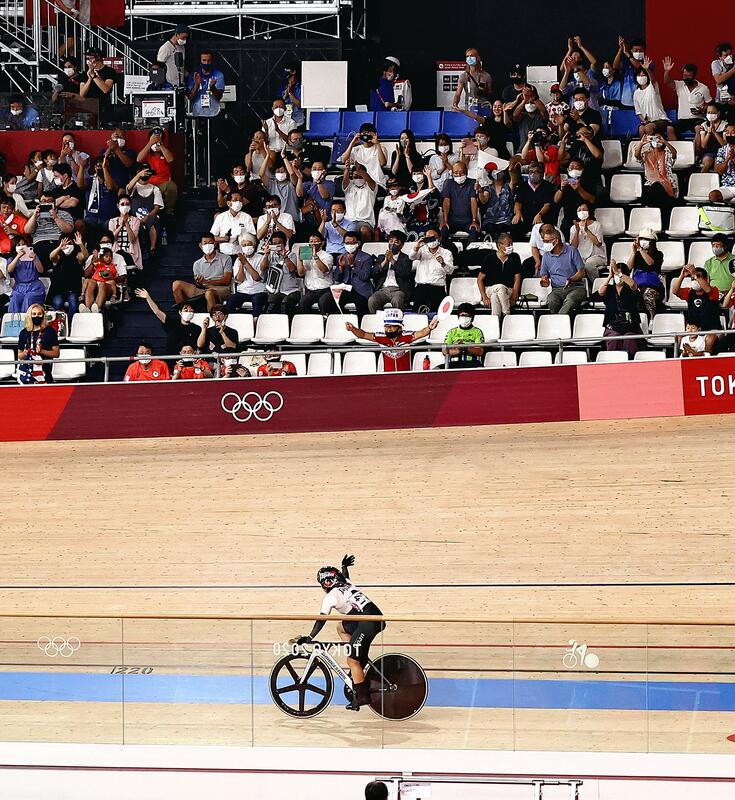
While the majority of stadiums and arenas sat empty, a total of about 43,300 spectators were
able to attend events live during the Tokyo Olympics at five venues in Miyagi, Ibaraki and Shizuoka prefectures.
Public opinion had been mixed about holding the Olympics in the middle of a global pandemic. What did those who went to the venues think?
A survey conducted by The Yomiuri Shimbun on spectators who were able to watch the action live addressed such matters as the worthiness of the Olympics and their thoughts on coronavirus countermeasures. It produced a variety of responses, from being inspired by the athletes' performances to feeling insecure about infection control measures.
The survey was conducted on a total of 155 people at five venues, including Miyagi Stadium, Ibaraki Kashima Stadium and Fuji International Speedway in Shizuoka Prefecture.
Asked if it was worth holding the Olympics during the pandemic, 109 people, or 70%, replied in the affirmative, while 34, or 22%, said it was not. The other 12 people, or 8%, said they were unsure or did not give an answer.
Toshihiko Shimizu, 67, of Kumagaya, Saitama Prefecture, attended the women's soccer match between China and Brazil at Miyagi Stadium on July 21 and other events. "I found myself naturally clapping for the players," he said.
During the 1964 Tokyo Games, Shimizu said he visited a home with a TV set so he could watch the competition. This time, some in his family opposed holding the Olympics and he also felt his own uneasiness.
"It is sad that everyone could not welcome the athletes," Shimizu said. "But I felt closer to the people of other races and countries by directly seeing them compete. There is value in conveying peace."
There were other positive responses. "I started feeling positive amid the coronavirus crisis," a 40-year-old woman said. "The Games could be held in Japan only because rules are respected here." A 47-year-old woman said the Olympics gave "hope to children."
Conversely, Masaichi Kakinuma, 61, of Sendai, saw no significance in holding the Games. "I thought I would feel something if I watched an event at the venue, but it didn't ease my anxiety. I felt as if the voices of the people were ignored."
A 69-year-old man commented, "It lacked excitement," while a 40-year-old man said: "It is meaningless if there is no interaction with foreign visitors. The events should have been held with as many spectators as possible."
-- Abiding the rules
Regarding the implementation of COVID-19 countermeasures, 95 respondents, or 61%, said it was "done sufficiently," while 54, or 35%, found it was "done adequately." Six respondents, or 4%, said it was "not done at all" or "not done very much."
The vast majority of respondents, 147 of the 155, or 95%, said they heeded the call to go straight to the stadium and return directly home without stopping anywhere along the way.
A 52-year-old company employee of Tokyo traveled with his junior high school-aged daughter to watch Nadeshiko Japan's women's soccer match at Miyagi Stadium. As instructed by venue staff, the two sat with an empty seat between them.
With constant reminders from staff to refrain from shouting or giving high-fives, the spectators around the two simply applauded without vocal cheering even when Japan scored a goal.
"I was able to enjoy the match with peace of mind," he said.
However, Masao Hino, a 51-year-old company employee of Tokyo, said he felt uneasy at a track cycling event at the Izu Velodrome in Shizuoka Prefecture on Aug. 4. A group of about 10 people connected to an overseas team, all with Olympic credentials hanging from their necks, took up seats nearby Hino, forcing him to move to another seat. Some of them had taken off their masks and cheered loudly.
The Playbook, specific guidelines for infection control given to all Olympic athletes and personnel, prohibited them from sitting in the spectators' areas.
"I felt uncomfortable, wondering if there was any problem in terms of infection control for foreign visitors related to the Games to come in contact with spectators," Hino said.
Read more from The Japan News at https://japannews.yomiuri.co.jp/