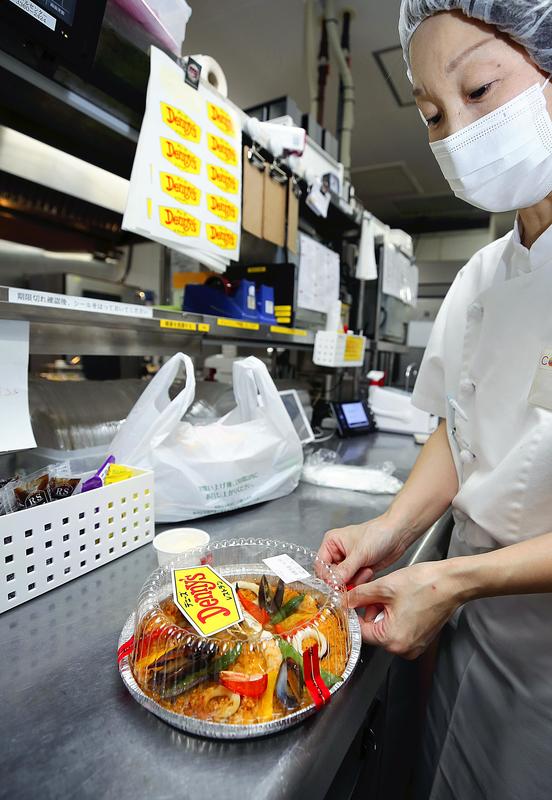
The staff at a Denny's family restaurant was in the kitchen steadily pumping out paella recently, although there was not one customer to be seen waiting for the food in the restaurant in Shinagawa Ward, Tokyo.
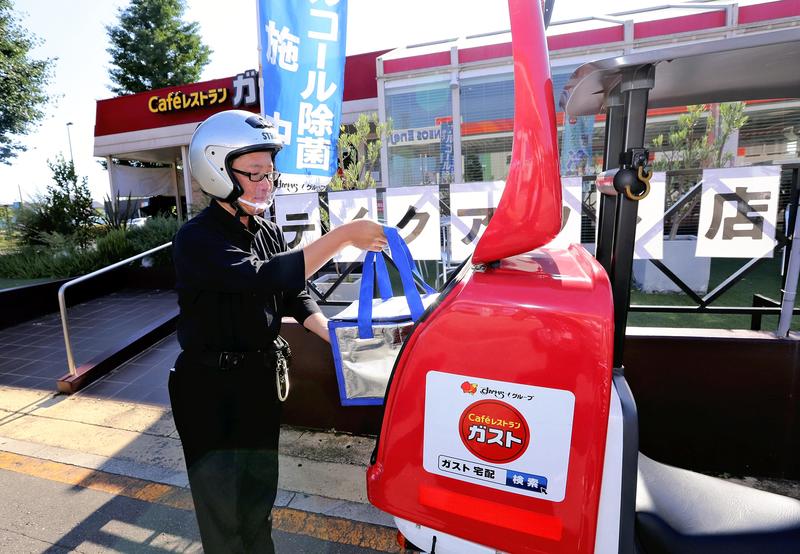
Cooked paella was carefully packed and transported to offices and homes within a 5-kilometer radius of the restaurant by outsourced delivery personnel. Kitchens that specialize in food preparation solely for delivery are called "ghost kitchens" in the United States and China.
Denny's has been using the facility as a base for its delivery services since May, using it for food preparation and cooking. Denny's initially planned to launch operations at the facility sometime before the end of the year, but significantly moved up the start.
"Some consumers don't want service at the restaurant [because of concerns about the new coronavirus]. Home delivery and takeout services will continue to grow without a dip," said a senior official of Seven & i Food Systems Co., which operates Denny's restaurants.
The company plans to set up five to six such kitchens in Tokyo and other areas before the year is out.
There had been efforts to respond to the demand for home delivery in the restaurant industry. However, it was difficult for restaurant operators to get those businesses off the ground amid difficulties in obtaining delivery staff and finding ways to deal with issues such as a high volume of orders.
The recent rapid expansion of the delivery business is largely because of the emergence of deliery operators such as Uber Eats and Demae-can.
According to sources close to the matter, restaurants pay a commission of about 30-40% of sales to delivery operators in many cases. Ghost kitchens are an idea created to generate profit even after paying such high commissions.
It doesn't take much startup time to open a ghost kitchen because there is no need to hire or train restaurant workers. It also doesn't require big space, since there is no customer seating. "Labor costs and rent for ghost kitchens amount to one-third of that of regular restaurants. The profit margin is higher than that of regular restaurants even after taking into account the commission," the official said.
--Fierce competition inevitable
Because of the spread of the new coronavirus, the number of customers is unlikely to return to normal soon. Fierce competition is inevitable in the industry with many competitors hoping to find a way into delivery services.
Saizeriya Co., which operates the namesake Italian restaurants, began experimenting with delivery services earlier this month. Like Denny's, it outsources delivery, paying a commission.
Saizeriya, which is popular because of its low prices, has grown because of a business model that cuts out middlemen as much as possible along each step, from procurement of goods to preparation and serving.
It even has its own factory in Australia to produce the white sauce for its signature dish, Milanese doria (300, yen including tax).
"Because of school closures [amid the novel coronavirus], shops and restaurants in student towns are deserted," Saizeriya President Issei Horino said. "The growth of teleworking prevented people from frequenting restaurants in business districts. I keenly felt that the traditional way of doing wouldn't work."
Skylark Group, which operates the Gusto restaurant chain as well as fast-food outlets, is also set to focus on home delivery services.
"Until now, we have only considered eating and drinking at our restaurants. Moving forward, it is necessary to always plan a menu taking into account delivery and takeout services," said Skylark Holdings Co. director Haruyoshi Sakita.
--Market growth
There are challenge in this area, too. Compared with freshly made dishes, the taste of delivery and takeout meals always deteriorates over time.
"When a hamburger is eaten at the restaurant, it gets a 100-point rating, but when eaten one hour later, that number falls to 50 or 30 points," said Ryuhei Fukushima, director of Mos Food Services Inc., which runs entities including Mos Burger restaurants.
Last year, the company introduced a system to improve the water retention of its buns. Fukushima said its burgers stay soft and easier to eat even after a period of time passes.
Udon restaurant chain Marugame Seimen started offering takeout service in May. To maintain the chewiness of the elastic noodles, the dashi broth and noodles are packed separately. Also, a three-layer container is used for the takeout orders to prevent spillage.
The market size of the nation's dining-out industry is about 26 trillion yen, while that of the deli food market, in which ready-cooked meals are delivered or offered as takeout items, is about 7 trillion yen.
The battle in the growing market is likely to further intensify.
Read more from The Japan News at https://japannews.yomiuri.co.jp/