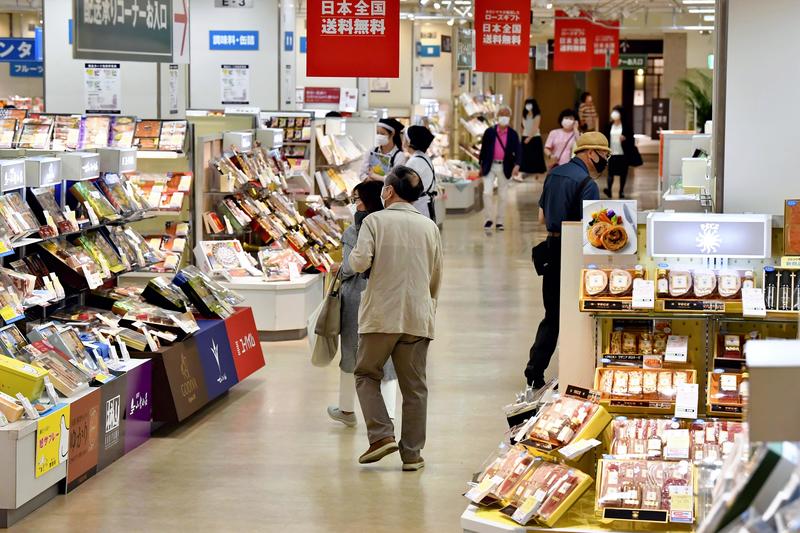
The nation's leading department stores, hit by temporary closures and reduced business hours amid the novel coronavirus pandemic, have posted huge net deficits for the six months ended Aug. 31, 2020, it was learned Tuesday.
As visits to Japan by foreign travelers, which underpinned department stores' performance until last year, are unlikely to pick up in the near future, major retailers across the country will aim at regaining their profitability by stepping up such business lines as online sales.
--Closing duty-free shop
"In a prime downtown [Tokyo] location in Shinjuku, we are producing a deficit to some degree every month. It would be difficult to ignore this from the standpoint of our business operation," Yoshio Murata, president of Takashimaya Co., explained in a recent telephone press conference in which he announced the closure of the Shinjuku store's duty-free shop at the end of this month.
This duty-free shop has been open since 2017, jointly run with the ANA Group, to appeal to foreign visitors to Japan. But Takashimaya has concluded that it would be difficult to get the shop out of the red.
Takashimaya posted a net deficit of 23.2 billion yen in its consolidated financial results for the half year ending on Aug. 31, compared to a net profit of 12.4 billion yen for the corresponding period last year. In its just-released forecast of consolidated results for the year ending on Feb. 28, 2021, Takashimaya expects to post a net deficit totaling 36.5 billion yen.
J. Front Retailing Co., which has Daimaru Matsuzakaya Department Stores Co. under its umbrella, registered a net deficit of 16.3 billion yen in its consolidated financial results for the half year ending on Aug. 31, compared to a net profit of 14.3 billion yen during the corresponding period last year.
However, when looking only at the figures for the three months from June to August, J. Front had moved back into the black.
Sogo & Seibu Co. also posted an operating deficit for the half year ending on Aug. 31.
--Beefing up online sales
Each department store aims at a recovery in profits by beefing up online sales.
Daimaru Matsuzakaya is stepping up efforts by having its buyers, who are in charge of getting goods in stock, introduce noted products from Hokkaido and elsewhere online to boost sales.
Meanwhile, Takashimaya hopes that expanding its lineup of gifts and food products will help it increase its online sales for the year ending on Feb. 28 next year by 40% compared with the previous year.
The stores will also advance their reviews of their sales floors. Takashimaya will reorganize its sales floors for clothing -- which used to account for much of its overall sales -- to emphasize clothing it stocks on its own, rather than items brought in by apparel makers. J. Front Retailing said it will accelerate its decisions as to what to do with loss-making stores and businesses.
Masayuki Kubota at the Economic Research Institute of Rakuten Securities, Inc. noted: "Consumption by foreign visitors to Japan cannot be expected for the time being. It is likely that [department store operators] will beef up their e-commerce while shifting further into such a business model as taking in specialty stores as tenants to earn rents."
--'Special losses'
With the nation's major department stores, such as Takashimaya, having plunged into a net deficit for the half year ending on Aug. 31, it is significant that they included "special losses" in their financial results for office rents and personnel expenses that accompanied temporary store closures amid the new coronavirus epidemic.
Special losses are usually included in financial results when a company suffers damage to its property and equipment due to a disaster or when it reduces the value of its stores and plants as a result of a greater than expected drop in profits. On the other hand, when certain gains are made, such as through the sale of real property or stock holdings, they will be incorporated as "special gains." In either case, the special loss or special gain is made for a temporary reason that has nothing to do with the company's core business functions.
When calculating "operating profit," which refers to the profits that a company generates from its core businesses, such costs as rents and personnel expenses are usually deducted from sales revenue.
But the Japanese Institute of Certified Public Accountants in April set forth its view that expenses related to the new coronavirus can be included as "special losses."
Takashimaya, for one, included 10.3 billion yen of those expenses, including personnel costs incurred during store closures, as "special losses."
On the other hand, the International Accounting Standards (IAS), which calculate a company's assets and liabilities by current market value as much as possible, do not recognize special gains or losses. J. Front Retailing, which uses the IAS, included the costs of 8 billion yen as personnel expenses and others that accompanied store closures, but in its financial results, there are no entries for special gains or losses.
Read more from The Japan News at https://japannews.yomiuri.co.jp/