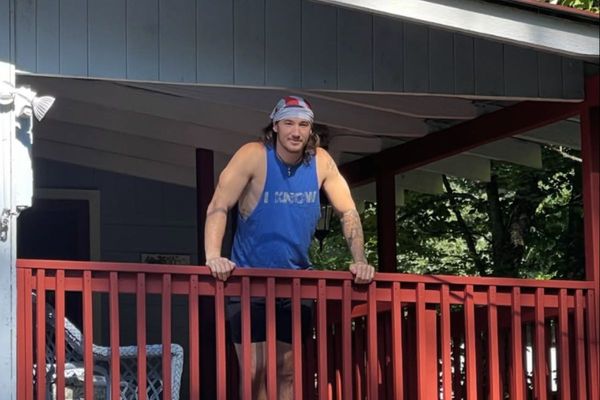
Majak Daw might well be the best-known 50-game player in the history of AFL football. Which is perfectly understandable. His is a remarkable story. But much of it has been about what he represents rather than the football he actually plays – even the narrative of the Sudanese refugee turned AFL professional is now only one of several significant chapters in his story.
Happily, at 29 and in his 11th season on North Melbourne’s senior list, he now has another chance to redress that imbalance. Selected to play for the Roos against Adelaide on Sunday, it will be Daw’s first senior game for more than 700 days, a year-and-a-half after sustaining horrific pelvic and hip injuries when he fell 25 metres into the Yarra River from Melbourne’s Bolte Bridge.
Daw’s recovery has involved not only a gruelling physical rehabilitation program, but dealing with significant mental health issues.
Even after they had been addressed, he encountered continued bad luck on the injury front. His planned round one return this season was delayed by a cold (and the accompanying nervousness about coronavirus). In May, during the long lay-off period, Daw badly tore a pectoral muscle during a gym session.
Finally, though, the last obstacles to a return have been cleared. Little wonder Daw was movingly enveloped by a huge throng of ecstatic teammates when North Melbourne skipper Jack Ziebell announced his imminent return before the whole playing group on Wednesday.
Here was an embodiment of resilience, of dedication to openly confronting and addressing issues of mental wellbeing, not to mention the time-honoured footy storyline of player finally beating the injury curse.
Daw may well be wondering just how many different causes he has now come to symbolise. But his spontaneous joy upon having the news delivered suggested he wasn’t too fussed. And relieved the hard work has paid off.
“It’s been pretty hard. There were times where I didn’t think it was going to come,” he told the North Melbourne website soon after the announcement. “There were times where I trained really well and felt really sharp and I’m like: ‘I’m not that far off’. But until the coaches tell you you’re playing, you just don’t know, really.”

Before December 2018, Daw had been primarily a poster boy for multiculturalism in Australian sport. The first Sudan-born player to make an AFL list, Daw was rookied by North Melbourne in 2010, something of a development project after having only played the sport for four years.
He, his parents and eight siblings had fled civil war in Sudan, arriving in Australia in 2003. Majak discovered the game only at secondary school. Even before he had played a senior game for the Roos, Daw had become a powerful figure for an entire migrant community in Melbourne, not to mention administrators eager to spread the indigenous game’s reach.
By the time he had played 25 games, he had been appointed an AFL multicultural ambassador, and was already well-known for his mentoring and welfare work within the Sudanese community.
Daw’s football battle meanwhile, was always about developing the nous and knowledge to go with his physical gifts, his incredibly athletic physique just one bit of the puzzle. His progress was at times halting. He showed glimpses of what could be in the ruck. He kicked six goals as a key forward in only his fourth senior game in 2013.
Yet it was not until the second half of the 2018 season, when Daw became a permanent key position defender, that the developmental curve began to shoot up rapidly. He became a valuable weapon, more than strong enough to handle the biggest opposition key forwards, and his judgement having improved his intercept marking.
Expectations for 2019 were high. They were shattered, along with much of Daw’s lower body, in the horrific incident on 17 December 2018. Daw, having parked his car on top of the Bolte Bridge, was subsequently plucked from the water below by rescuers after a 25-metre drop.
The injuries to his pelvis and hip were so severe that doctors expressed surprise they had not been even more extensive, Daw’s strength and fitness having helped absorbed the impact.
Thus began a concerted recovery campaign involving an army of not only medical and physical specialists both inside the club and out, but specialists of the mind, all of whom Daw went to some lengths to thank upon the news of his selection for Sunday.
In the midst of his recovery, Daw and his partner Emily McKay also had their first child, Hendrix, now 11 months old. That is a lot of major life events in a pretty short space of time.
And if Daw’s return, given the circumstances, seems remarkable enough even now, consider that he actually played VFL football with North’s reserves in the first week of July last year, barely six months after sustaining the shocking injuries.

Indeed, Daw had played four games and was on the brink of a senior return that long ago, before a torn hamstring prematurely ended his season. He played pre-season football for the Roos this campaign, too, before the untimely sniffle, the AFL lockdown and the pectoral injury all conspired to delay until this August what will inevitably be an emotional occasion.
It has been some journey. And the significance of it is not lost on anyone in the football world, let alone those who have been directly involved in Daw’s comeback to the game. Or indeed, those who have been down the same unfortunate path Daw was on 18 months or so ago. Sunday will be about them, too.
“I want to be able to help people in a way that gives them hope they can do things that they once thought were impossible or getting back to living the life they always imagined,” Daw said.
“Life’s pretty hard, there’s some obstacles that get in the way. There’s no better example than the current circumstances with Covid. A lot of people have lost their jobs, it’s impacted a lot of people financially, so there’s a lot of people struggling, but I think if you just have the belief that it’s going to turn as long as you just keep rocking up each day…
“I was just really determined to do it, the incentive being that I can actually help other people, even people that I don’t know. There’s so many people get in touch with me who have shared with me their battles with mental health, and I think for me that’s a pretty big responsibility.”
One, though, that he has become used to over the years. And now even Daw’s prospective opponents, you suspect, would love to see him also fulfil his responsibility to his own football talent.
There was genuine excitement about just how good Daw looked toward the back end of 2018. Finally fully fit again, and freer in mind as well as body, who knows just how good a backman he can become given a clear run at it.
Daw’s story is already amazing. Maybe what we are about to see from him on the field might end up making it one of the greatest football stories ever.
In Australia, the crisis support service Lifeline is 13 11 14. In the US, the National Suicide Prevention Lifeline is 1-800-273-8255. In the UK, Samaritans can be contacted on 116 123. Other international suicide helplines can be found at befrienders.org