This time last year Bryant Jennings was punching a clock as a maintenance man at the Federal Reserve Bank of Philadelphia, working five days a week from 7.30am to 4pm. The responsibilities of the job included carpentry, plumbing, welding and electrical work.
“We fixed things,” he explains.
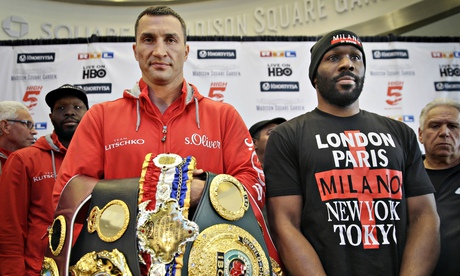
Now the 30-year-old from North Philadelphia will try to solve a far bigger problem, literally and otherwise. On Saturday night, Jennings will climb through the ropes at Madison Square Garden to fight Wladimir Klitschko for the world heavyweight championship before what is expected to be a sellout crowd. It will be his first bout as a full-time prizefighter.
The craft of boxing, at the elite level in particular, typically demands of its practitioners a lifetime commitment. There have been top professionals who took up the gloves later in life – Rocky Marciano, Sergio Martínez et al – but they have been extraordinarily rare.
Jennings, a three-sport athlete at Philadelphia’s Benjamin Franklin High School who had been playing local league basketball to keep fit, had already been working in the facilities department at the bank for three years when he first walked into the ABC Recreation Center in 2009. He was 24 and from his first session on the heavy bag, a light went on.
“Day one” he told the Guardian. “Literally. I say that humbly. My first day. Since then we knew, this was for me. I felt it. There was no turning back because I was good. I was that good. Just imagine what it would have been like if I’d been doing it all along. Look at what it has become.”
Before the month was out, he had his first amateur fight. He turned professional in 2010 after just 16 more. For the next few years, he trained at night and fought on smaller cards at the famed Blue Horizon on North Broad Street, The Arena in South Philadelphia and Atlantic City ballrooms, successfully balancing his nascent fighting career with a full-time day job – where he played the role of chilled-out entertainer.
“I was the life of the department!” he recalls fondly. “I was actually the only black guy on day shift and I was the youngest as well. I was really entertaining, real humorous. We were very diverse with a whole lot of different nationalities within the group, and I helped bring everybody together.”
As Jennings’ career progressed and he emerged as one of America’s most promising heavyweights, his co-workers steered him clear of some of the more dangerous tasks in the workplace. “My whole last year there it was like, ‘Yo, relax, we don’t need you getting hurt.’”
Last year, he scaled further up the heavyweight ladder with a pair of HBO-televised wins against unbeaten contenders Artur Szpilka and Mike Perez. The latter earned him a mandatory shot at the WBC titleholder Deontay Wilder, but Jennings passed on the opportunity for a chance to face Klitschko – and the career-high payday that comes with it. And in August, he clocked out for the last time. “I retired,” he said with a smile.
As his former co-workers know, Jennings is outgoing and gregarious by nature but those people skills will be of little use against Klitschko, who holds the IBF, WBA and WBO belts. The consensus among the boxing cognoscenti assembled here is Saturday’s fight will be a straightforward affair for the Ukrainian, who will enjoy advantages in height (three inches, at least) and weight (30lb). The bookmakers have installed Jennings as an 8-1 underdog. Even more glaring is the chasm in experience.
Klitschko, who won an Olympic gold medal in 1996 (when Jennings was 11), has more successful title defences than Jennings has paying fights. His nine-year title reign is second in boxing history only to Joe Louis. It has been more than 11 years since he lost.
Nearly all of his 17 consecutive title defences – second only to Louis (25) and Larry Holmes (19) – have followed a familiar pattern. Klitschko pumps his ramrod jab with mechanical efficiency, parries and picks off punches, saps the tenderised opponent’s will.
While Klitschko is 39, he’s shown little signs of decline. He’s coming off a one-sided destruction of Kubrat Pulev, who had been regarded as the best available contender, that saw him score four knockdowns en route to a fifth-round knockout.
“I admire his dedication,” Jennings says. “His clean living and stuff like that. Him being a very focused fighter. Never slacking.”
The key to the fight will be whether Jennings can negotiate a way inside the piston-like jab at the foundation of Klitschko’s success. It’s difficult to see how Jennings’ impressive athleticism alone will win the day.
Yet at Tuesday’s final press conference in the renovated lobby at Madison Square Garden, Jennings was loose and optimistic. If not for the promotional materials featuring his image festooned about the arena, you would have no idea he was days away from the biggest fight of his life. “Experience plays a part but not a big part because we’ve seen situations where the inexperienced guy comes out on top whether in sports or politics or in anything,” he says. “I understand that I’m a great underdog but that’s because people only look at the size and the inexperience but not the possibility.”
The sport’s flagship division has long served as a bellwether for boxing’s popularity at large. As the heavyweights go, they say, so does boxing. But as a bloc of Eastern European technicians like Klitschko emerged as the dominating force in the division, the sport’s status among American fans has diminished over the past decade.
The champion is a practitioner of risk management, a classic outside shooter who relies almost exclusively on jabs and hooks to wear down his opponent. Few uppercuts, body punches or combinations. Almost every offensive is directed upstairs, minimizing the risk of a counterpunch to his jaw. The distaste for his methodical style domestically is a major reason why Saturday’s fight represents Klitschko’s first bout on US soil since 2008.
Having been freed from the shackles of the workplace, Jennings trained for this fight in Houston. “You can’t be home, because home is too accessible,” he says. “Everybody knows exactly where you’re at. Everybody’s coming to the gym. Crowds around, unwanted guests, a mixture of energies. Throw you off your focus.”
As he walked from the Garden across Seventh Avenue to his hotel, fans called his name on the sidewalk. Hotel workers greeted him in the lobby: “Good afternoon, Mr Jennings.”
A long way from days consumed with construction and machinery. When asked of his life outside the ring, Jennings reveals a man fully committed.
“This is my every day. I work on making myself more efficient as a boxer, and I work on making myself better as a person,” he says. “This is my life now.”
An overmatched Philadelphia underdog against a bulletproof heavyweight champion. The parallels to Rocky are unavoidable. Now it’s up to Jennings to write a Hollywood ending.
.jpg?w=600)