Wendy Brennan agreed to participate in a study examining how arsenic exposure can affect children’s cognitive development primarily because her young daughter wanted the free T-shirt. It was 2009, and the family had lived on their property in the small Kennebec County town of Mount Vernon for eight years. Brennan said she had no reason to fear the results.
But when researchers came to test their drinking water, Brennan learned that her family’s well tested nearly six times above the Federal Environmental Protection Agency’s maximum exposure guidelines for arsenic.
“I pride myself on being a good mom,” she said. “One of the first things I thought was: ’I was giving my baby arsenic with her formula, and I was unaware.’”
Brennan is not alone: just 53 percent of Mainers on private well water had tested for arsenic as of 2023, the latest figures available. The number has not moved much since 2014, when around 48 percent of Mainers on well water reported having tested it for arsenic, and is far short of the goal set by the Maine Center for Disease Control and Prevention to have tested 65 percent of wells by 2020.
Low-income households making below $25,000 were least likely to have had their wells tested, according to the data collected by the Maine CDC.
For nearly the past decade, the state has maintained programs through MaineHousing to help lower-income homeowners test and treat their wells for arsenic and other contaminants. But the program has served fewer homes than anticipated because of rising costs and changing treatment criteria.
“The money we have is kind of a drop in the bucket right now, and it’s not permanent money — it’s not ongoing funding,” said Rep. Daniel Ankeles, D-Brunswick, whose bill to establish a $1 million contamination response fund to test and treat private wells died in the Legislature this spring.
Rising costs, unrealistic expectations
Over half of Maine homes get their daily water for drinking, cooking and bathing from private wells. Most of these are bedrock wells, which are drilled an average of 250 feet deep to access pockets of groundwater contained in the rock’s fractures.
Much of the bedrock in Maine contains minerals that house arsenic and radon, the byproduct of decaying uranium, said Jean MacRae, associate professor of civil and environmental engineering at the University of Maine. Soluble portions of these elements dissolve into the water in the bedrock. The Maine CDC estimates that 1 in 10 wells has too much arsenic.
People cannot taste, see or smell arsenic in water, but it can have serious health effects. A University of New Hampshire and Columbia University study found that drinking water with arsenic levels above five parts per billion — half of the Environmental Protection Agency’s limit— posed a threat to child development. Other research has found links between children’s prolonged exposure to high levels of arsenic and increased rates of certain cancers in later life.
While public drinking water systems are governed by state regulations, private wells do not fall under the same framework, meaning testing, treatment and upkeep is left to individual owners. Treatment costs for arsenic and other contaminants can be thousands of dollars, depending on the type of system that is installed; one 2015 study that surveyed homeowners in central Maine found that the cost of treatment was a barrier to treating arsenic contamination. The costs can continue for years, as systems require new filters and maintenance.
Brennan and her family moved into a new home on the same property soon after learning of her well’s test results. Her new home used the same contaminated well.
Brennan, who advocated in 2017 for the creation of Maine’s Private Well Safe Drinking Water Fund, said her family would not have been able to afford the filtration system they installed if the payments had not been included in their mortgage.
Maine formed its first dedicated program to help low-income homeowners treat their wells for arsenic in 2017, with $500,000 in one-time funding, administered through MaineHousing. Between 2017 and 2022, the program helped install 124 filters for eligible homeowners.
In 2022, the Legislature provided another $400,000 to the program, and expanded it to cover other contaminants that exceed health guidelines.
The Maine CDC said the following year that it expected the funding to help more than 500 homes install water filtration systems.
But three years later, the program has spent over $385,000 of its $400,000 and has helped just 57 homeowners install filtration systems.
Rising costs of water filters have been challenging, said Kim Ferenc, director of the abatement program. In 2022, the abatement program spent about $3,500 on average to treat a home’s well water system. Now, that treatment can cost between $4,000 and $5,000.
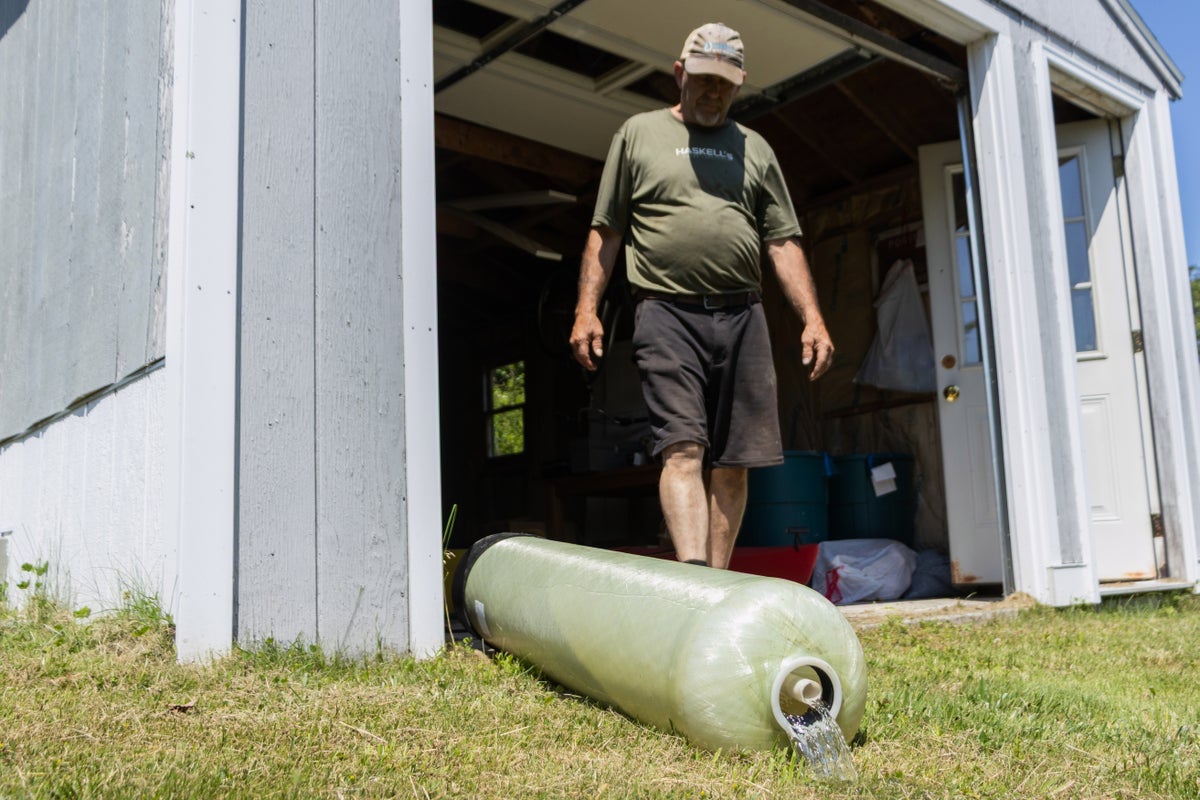
Installing a filtration system that treats all the water entering a home is even more expensive, costing up to $15,000, which is the highest grant amount offered by the program. Most grants it has offered have been for individual systems, such as a filter underneath a kitchen sink, Ferenc said, not the more expensive systems that serve a home’s entire water supply and are often stored in a garage or basement. The program does not provide financial aid for maintenance costs.
Companies that install these systems said prices are up for materials, much of which are imported, in part because of tariffs. Haskell’s Water Treatment, based in Rockland, imports much of its materials from outside the United States: ultraviolet lights from Canada meant to detect bacteria and water pumps from Italy or Germany.
Following the Trump administration’s tariff measures last year, the treatment company saw an eight percent price increase across all its materials, Haskell’s co-owner Jack Martin said.
“Pretty much everything that we are getting from our suppliers went up, even down to the fittings,” he said.
Spokespeople for Fontus Water Treatment and Air & Water Quality Inc., which handles many of the jobs funded by the state abatement program, said they have seen prices increase as well in the past four years.
Even without these cost increases, the idea that the program would be able to treat 500 homes was “not a realistic expectation,” MaineHousing spokesman Scott Thistle wrote in an email. At about $3,000 per house, excluding administrative and water-testing costs, the funding could be expected to provide grants for, at most, 134 homes, Thistle said.
The type of contamination and its severity can also lead to vast fluctuations in the price of treatment, he added.
The Maine CDC determined the abatement program could reach this goal after examining the average cost of “mid-level” treatment systems in 2023 detailed in MaineHousing’s reports at that time, said Maine Department of Health and Human Resources spokesperson Lindsay Hammes, but it was not a formal target.
A ‘generational story’
Inconsistent funding to treat well water contamination has been a “challenge,” Ferenc said. Lawmakers did not introduce any legislation to fund MaineHousing’s abatement program in their latest session earlier this year, and other bills to fund different well testing and treatment efforts failed to make it through.
Getting state funding to help private well owners test and treat contamination can be challenging. Lawmakers said it is not uncommon for a bill to be approved but die on the appropriations table.
That was the case for Rep. Ankeles’ bill, L.D. 2115, which would have established a $1 million contamination response fund through the Department of Environmental Protection to test and treat private water wells contaminated with PFAS chemicals and other hazardous substances.
Ankeles said he plans to reintroduce the bill next session and is open to expanding it to include funding for MaineHousing’s abatement program.
“We’re going to throw everything at the wall with respect to clean water because we can’t come away empty-handed,” Ankeles said. “It’s so bad for our state’s health if we come away empty-handed.”
Thistle, of MaineHousing, said he expected that lawmakers will continue funding MaineHousing’s abatement program for low-income homeowners.
“Advocates for this program consistently request funding for it, and so far, the Legislature has consistently provided funding,” Thistle said.
Brennan now lives in California, but her eldest daughter, Caitlyn, still lives in their old house in Mount Vernon, where she is raising her own children. Her family is using the same water well and continuing to treat the arsenic contamination they found when she was a teenager.
“It’s a generational story,” Brennan said. “It started with my daughter, and now it’s trickled down to her daughter.”
___
This story was originally published by The Maine Monitor and distributed through a partnership with The Associated Press.