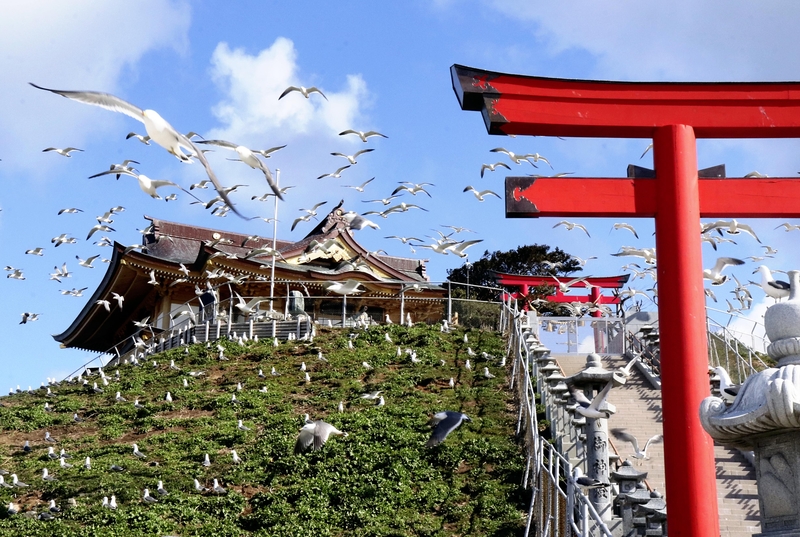
In the Kabushima area of Hachinohe, Aomori Prefecture, known as the nation's most prominent breeding ground for black-tailed gulls, the main building of the Kabushima Shrine that was completely destroyed in a fire in 2015 has been rebuilt and was reopened to the public on March. 26.
The construction was prolonged out of consideration for the gulls, but Kabushima Shrine's chief priest Toshio Nozawa said, "I want to make this shrine as beloved as the gulls."
It is said that Kabushima Shrine was established in the late half of the 13th century. It managed to avoid sustaining any damage during the 2011 Great East Japan Earthquake and subsequent tsunami. After the Kabushima area was made a part of the Sanriku Fukko National Park in 2013, the shrine became a symbol of reconstruction.
However, a fire broke out in November 2015 and the 240-square-meter main building, built in 1977, was completely destroyed. The ceiling that was painted by local children was also destroyed in the fire.
"This shrine steeped in tradition must not be left without the main building," Nozawa thought and sprang into action, but the road to reconstruction was a difficult one.
The construction was conducted only during the colder seasons, which was after the black-tailed gulls had left the breeding grounds at Kabushima -- officially designated as a national natural treasure.
Local residents supported Nozawa, who felt on the brink of giving up. The shrine received countless letters filled with messages of support such as, "I would often dash up and down the shrine stairs [to train] when I was in high school," and "Seeing the shrine stand undefeated against the tsunami always moved me." The local elementary school students also wrote messages praying for the shrine's reconstruction. Local residents and businesses raised a lot of money through donations, and the reconstruction plans began to come together.
The new main hall was made from locally sourced timber, such as a type of cypress called Aomori hiba, and its 487-square-meter area is roughly twice the size of the original building. Its curved roof was inspired by the image of a flock of black-tailed gulls taking flight.
The grounds of the shrine has become a tsunami evacuation area to show appreciation for the locals who supported the reconstruction.
The shrine opened for a festival on March. 26. "I want this to continue to be a shrine that never forgets the gratitude it owes to the people," Nozawa said.
Read more from The Japan News at https://japannews.yomiuri.co.jp/





.png?w=600)