PUNE: Districts those were severely impacted by the second Covid-19 wave may not see an equally intense third wave, an analysis by the Indian Council of Medical Research (ICMR) has said.
Experts from the top science body said states should now use district-level heterogeneity assessments — that include variations in spread and populations — to plan tailored public health measures for different regions. “All districts in Maharashtra did not experience the second wave uniformly,” said Samiran Panda, head of the ICMR’s Epidemiology and Communicable Diseases Division. “It is the need of the hour to examine the possibility of a third wave by considering key biological and behavioural parameters.”
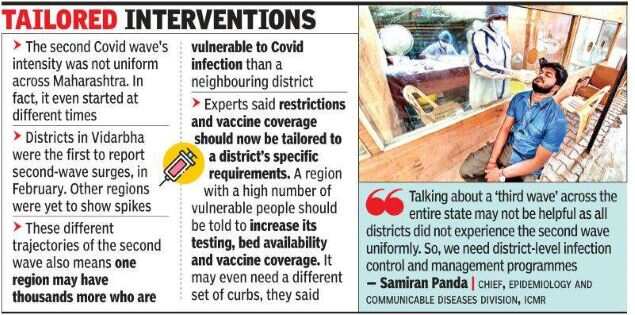
Panda said states like Maharashtra should look into district-level heterogeneity to formulate region and population-appropriate measures. “Talking about a ‘third wave’ across the entire state may not be helpful as all districts did not experience the second wave uniformly. So, we need district-level infection control and management programmes,” he said.
He said this also means that districts that didn’t experience an intense second wave may now have a significant number of people who are vulnerable. It’s then crucial to ramp up measures like vaccine coverage in these at-risk regions, he added.
“It is essential to have vaccine saturation among priority groups in these districts. It’s also important to create an environment that’s not conducive for viral spread as such regions may see a third wave that seamlessly takes off from the descending arm of the second,” he said.
Maharashtra state task force member Shashank Joshi called for district-wise serosurveys, with particular focus on regions that were less affected during the second wave.
“We should have this data. The public health department is already working on collecting the information,” Joshi said.
He, however, said it’s impossible to say when a third wave will come as surge depends on behaviour, vaccination coverage in densely populated regions and level of restrictions.
“Dynamics of the wave for local geographies are different and fundamentally, the virus does not follow simple mathematics, which is why there is a degree of unpredictability,” Joshi said.
He added that while ICMR’s analysis appears plausible and logical, an outlier is the Variant of Concern. “We cannot under-estimate Delta at all,” he said.