MUMBAI: Fewer women in the state have taken the vaccine against Covid-19 compared to men, amounting to a difference of over 3%. The gender disparity in vaccination could be wider within districts and may be growing with more doses administered, experts said.
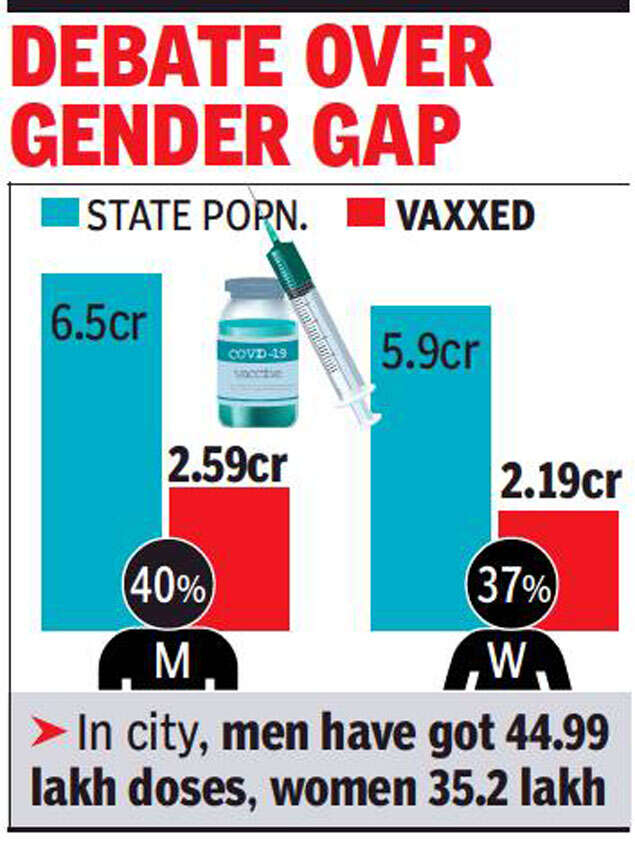
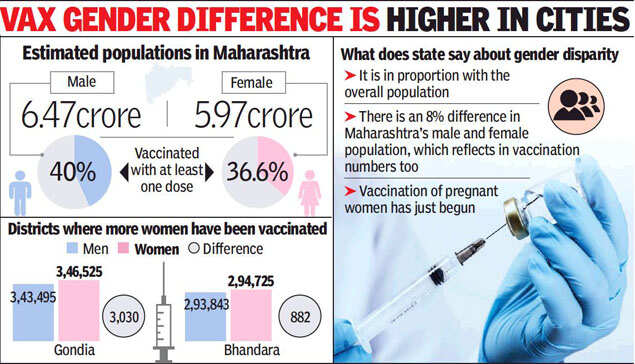
In Maharashtra, 40% of an estimated 6.5 crore men have taken at least one dose of the vaccine. In comparison, 36.6% women of an estimated population of 5.9 crore have taken at least one shot. In absolute numbers, 40 lakh more vaccine doses have been administered to men.
‘Maharashtra govt must see where few women coming for jabs’
Officials have called the gender difference in vaccination statistically insignificant and in line with the state’s male-female ratio. But health experts have called for a district-wise analysis to find pockets where fewer women are getting vaccinated. They also believe fewer women have got the second dose.
The state has till date administered 4.79 crore doses, of which 2.59 crore are male beneficiaries and 2.19 crore female. The difference in doses administered is wider in the mega cities and urban districts such as Mumbai, Pune, Thane, Nashik, Aurangabad, and Nagpur, evidently because higher doses are given in these places.
The difference is highest in Mumbai, where 12% more doses have been given to men: 44.99 lakh doses to men and 35.2 lakh to women. In Pune, seven lakh more men have taken doses. In nine of 35 districts, there is a difference of over one lakh doses in vaccine coverage between men and women—ranging 1.1-9.7 lakh.
Dr Pradeep Vyas, additional chief secretary (health), said the difference in vaccine coverage between genders did not have a major statistical difference. “It is in proportion to the female population out of the total population. Further, pregnant women were permitted vaccination only recently,” he said, adding that it was nothing to be alarmed of. There are an estimated 50-60 lakh more men (about 8% more) in Maharashtra.
Experts are not convinced with the state’s argument. “Even a 4% difference translates into lakhs for a big state like Maharashtra. The state must identify pockets where fewer women are coming to take the vaccine. A gender disparity is seen everywhere in the country and is unlikely that Maharashtra wouldn’t experience it,” said Soumitra Ghosh from the Tata Institute of Social Sciences’ School of Health Systems Studies. Ghosh said a huge share of Maharashtra’s healthcare and frontline workforce, including ASHAs and ANMs, are women. “Even with those numbers taken into consideration, women are falling behind men in vaccination,” he said. “The national vaccine policy was never framed keeping gender in mind.”
Pregnant women and lactating mothers were given a green signal for vaccination at least six months after the drive was started. Maharashtra has over 20 lakh pregnant women. Dr Naveen Thacker, a former civil society representative to the Gavi board, the Vaccine Alliance, said that a lot of misinformation around the safety of vaccination during pregnancy and menstruation has kept women away from booths. “The number of women beneficiaries is particularly low in second-dose seekers. There is definitely a need to address the misinformation through awareness campaigns,” he said.
Gondia and Bhandara are the only districts where more women have taken the vaccine.