MUMBAI: Even as the fear of a third wave looms over the state, barely 50% of its most vulnerable age group—those above 45 years—have got even one dose of the Covid-19 vaccine.
Experts had stressed for 70% vaccination in this group by August since the 45-plus account for 85% of Covid mortalities in Maharashtra.
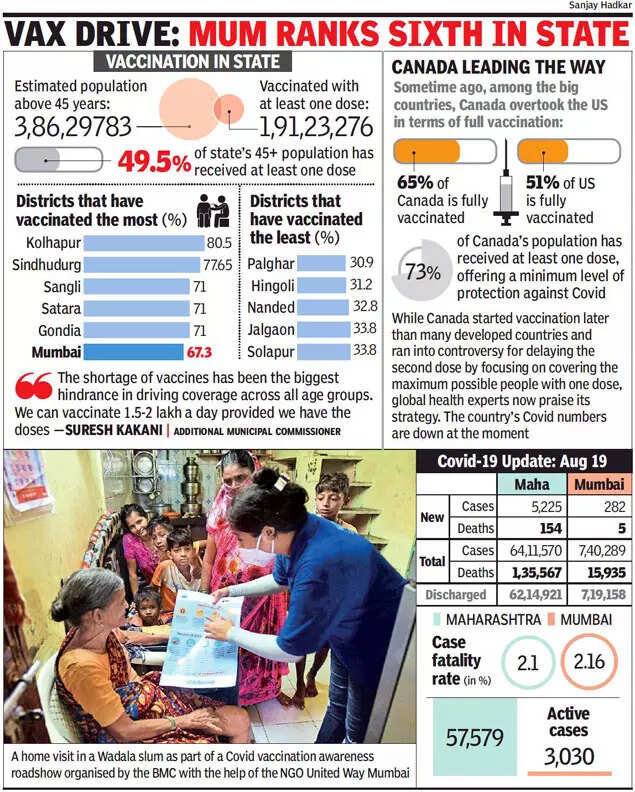
As by per state figures, 1.92crore of the estimated population of 3.86 crore in this bracket have been vaccinated with at least one dose. In that, 98.93lakh (25.6%) have been fully vaccinated while 93.15lakh (24%) have got one dose. Vaccination for this group began in March. Besides low coverage, a persistent worry has been disparity between districts.
Kolhapur is at the top having vaccinated 80.5% of its 45-plus segment with at least one dose, while Palghar brings up the rear having barely managed to vaccinate 31%. The second lowest is Hingoli (31.2%); at least 15 districts have vaccinated less than the state average. Mumbai has vaccinated 67% of its population above 45 years with at least one dose.
Additional municipal commissioner Suresh Kakani said the shortage of vaccines has been the biggest hindrance in driving coverage across age groups. Palghar district officials said they have been experiencing an acute shortage for months now. In the last three months, they have written three letters to the government to increase their vaccine quota, an official said.
In June and July, the district, which has an adult population of 23lakh, received less than 15,000 doses in both months. In August, they received two tranches of 20,000 doses each. “We finished the doses in a single day because there is a huge demand,” said Dr Dayanand Suryawanshi, district health officer of Palghar. He said, overall, 8.63lakh doses have been administered in the district but a significant number has been in the private sector. “Our wastage has been minimal too, but we are not getting adequate doses,” he added. Officials from several other districts told TOI that allocation of vaccines must be looked at as some are routinely handed fewer doses.
Dr Pradeep Vyas, additional chief secretary (health), however, said there was nothing wrong with the allocation formula. “Initially, the Centre’s supply was consumption driven, so districts which had more healthcare and frontline workers and those who vaccinated at a higher pace in January-March, got more doses. Subsequently, when second doses were due, same districts got supply commensurate to second doses due,” he said, adding that it will even out over a period.