Dhyan Chand, the hockey legend who had reportedly played without shoes during the second half of India’s historic final against Germany at the 1936 Berlin Olympics wasn’t the only barefooted athlete to bring home a gold medal that year.
An army of pheta-sporting Maharashtrian and Gujarati men, who had marched behind the British-flag-carrying official Indian Olympic contingent with a curious saffron flag bearing symbols like the tricolour, an upward arrow and a star, returned from the Games with two special gold medals, one of which is known locally as the ‘Hitler Medal’.
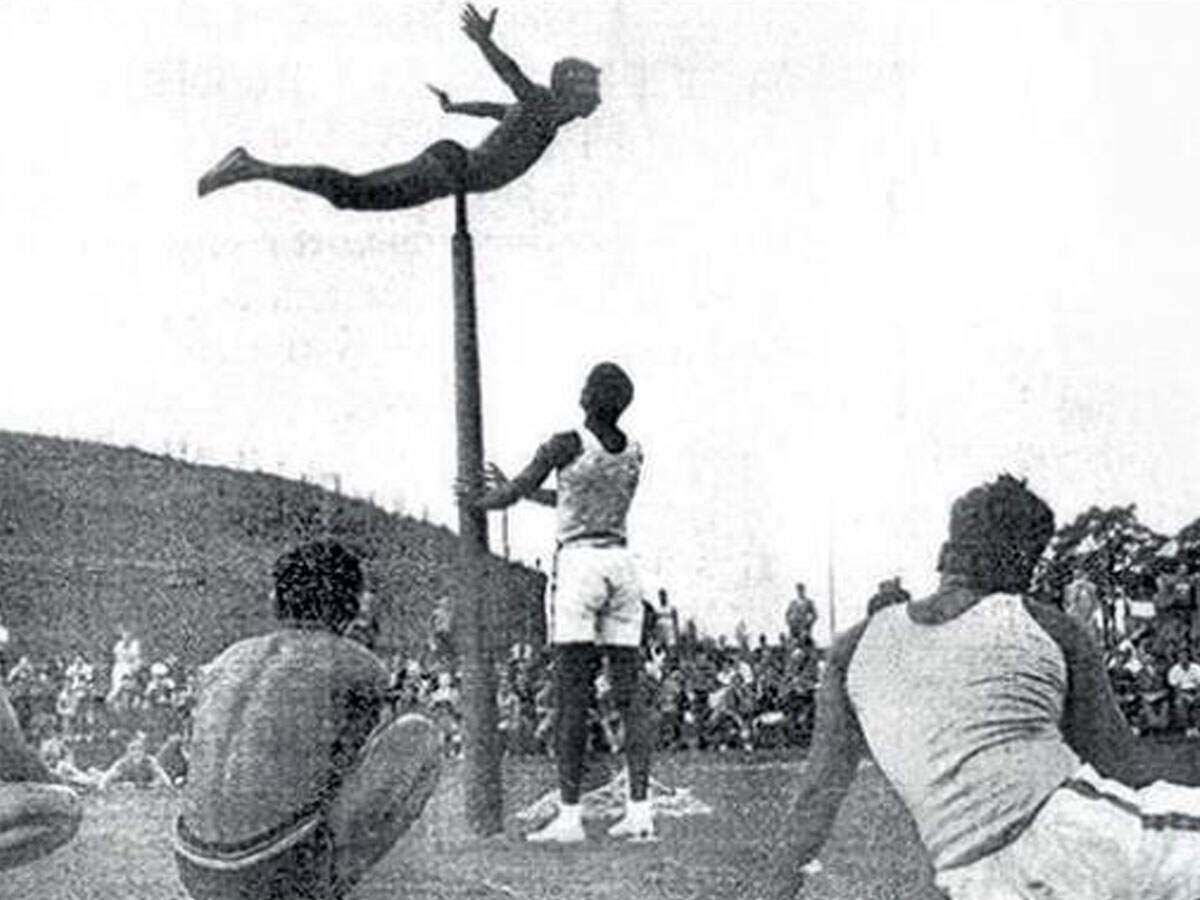
By balancing themselves atop a malkhamb pole, squatting for rounds of kho-kho, chanting ‘hu tu tu’ in kabaddi and contorting into yoga asanas, 24 sportsmen from Amravati’s Hanuman Vyayam Prasarak Mandal, set up in 1914, won an Olympic medal with the Nazi symbol of an eagle clutching a swastika. It was their prize for standing second in “physical culture display” at the World Pedagogic Congress, where nations showcased their indigenous sports.
How desi team got ‘Vande Mataram’ played at a Berlin Olympic banquet
Among the Mumbaikars in the Indian contingent that ended up winning a medal at the first-of-its-kind International Sports Pedagogic Congress during the Berlin Olympics in 1936 were Vile Parle’s Nagindas Mehta and Premji Rajoda, G G Rajderkar, S V Kher and a strapping, 21-year-old sports teacher from Parel named Dattaram Lad aka ‘Lad Master’.
The idea of the first-of-its-kind congress, where various nations showcased their indigenous sports, was born from a friendship between Amravati’s Hanuman Vyayam Prasarak Mandal stalwart L J Kokardekar, who had been studying in Berlin in the 1930s, and Carl Diem, chief organiser of the 1936 Olympic Games, said mandal director Suresh Deshpande.
In a letter to Kokardekar, S D Sondhi, secretary of the fledgling Indian Olympic Association, wrote: “I am taking steps to send your gymnasts’ names (sic) for the Sports Pedagogic Congress where only, according to Diem, your gymnasts can give displays.”
This largely crowdfunded trip to Berlin saw the athletes sailing in an Italian ship called 'Kamteverde' to Venice, bonding with Chinese sportsmen and taking a train to Germany. According to a TOI article, the opening ceremony of the Games saw the earthy team singing Rabindranath Tagore’s ‘Ekla Chalo Re’. A barley-based health drink called Biomalt was favoured by Austria, which stood first in physical culture display, while “curry, meats including mutton, veal, lamb and fowl but no beef, pork or beef suet” formed the special dietary requests of India’s contingents that year, as per a sports portal.
When photos of the desi flexers led by Yavatmal physician Dr S K Kane dotted German newspapers the day after their demonstrations, an intrigued Adolf Hitler invited the pehelwans for an interaction, recalls Kane’s 89-year-old son Padmakar. The Nazi leader had presented his father with a special medal, a certificate with his signature and a question that Kane would repeat on cue for the rest of his life. “Does your team represent the average Indian?” Hitler had apparently asked Kane, referring to the brigade whose spines had been proclaimed by an official as “the most perfect” after examination.
When every participating nation’s national anthem was played during an event in Berlin, the official Indian team stood up for the British national anthem ‘God save the queen’ but the desi army didn’t, says Kane’s son Padmakar.
“My father was a nationalist by temperament. He told his team to remain seated through it,” recalls Padmakar, adding that when a German minister probed them, the musclemen said that they considered ‘Vande Mataram’ to be their national anthem.
“The minister asked them for a recording. That’s how ‘Vande Mataram’ came to be played at the official banquet,” says Padmakar, adding that his father had come in contact with Bengal’s Yugantar, a secret revolutionary party that had started under the guise of a fitness club, while studying medicine in Bengal.
HVPM’s website makes no secret of the mandal’s own nationalism-doused mythology. Founded by the Vaidya brothers, Anant and Ambadas, who wanted to link physical education with the Independence movement, the mandal boasted many freedom fighters, including Shivaram Raj-guru who studied here in 1926-27. Mahatma Gandhi and Sub-has Chandra Bose visited the mandal twice. In fact, Dr S G Patwardhan, the mandal’s then president, “could not go to Berlin in 1936 as he was denied a passport for political reasons”, says Deshpande.
Lad’s Pune-based grandson Somdutt said: “After marriage, he would often leave home at night saying he had some work. My grandmother found out he was a freedom fighter when Veer Savarkar visited him one day in the 1940s… He was killed before Independence in January 1947.” His grandmother Snehlata, an archer and sports teacher, was severely scarred by the loss. “When my father, a black belt in judo, got an offer to train in Japan, she didn’t allow him to go,” says Somdutt. “She didn’t want to lose any more people.”
Today, only time-worn pictures and stories remain of the contingent and the mandal has taken to calling the Olympic gold medal, which sits safe in its Amravati office, the ‘Hitler medal’.