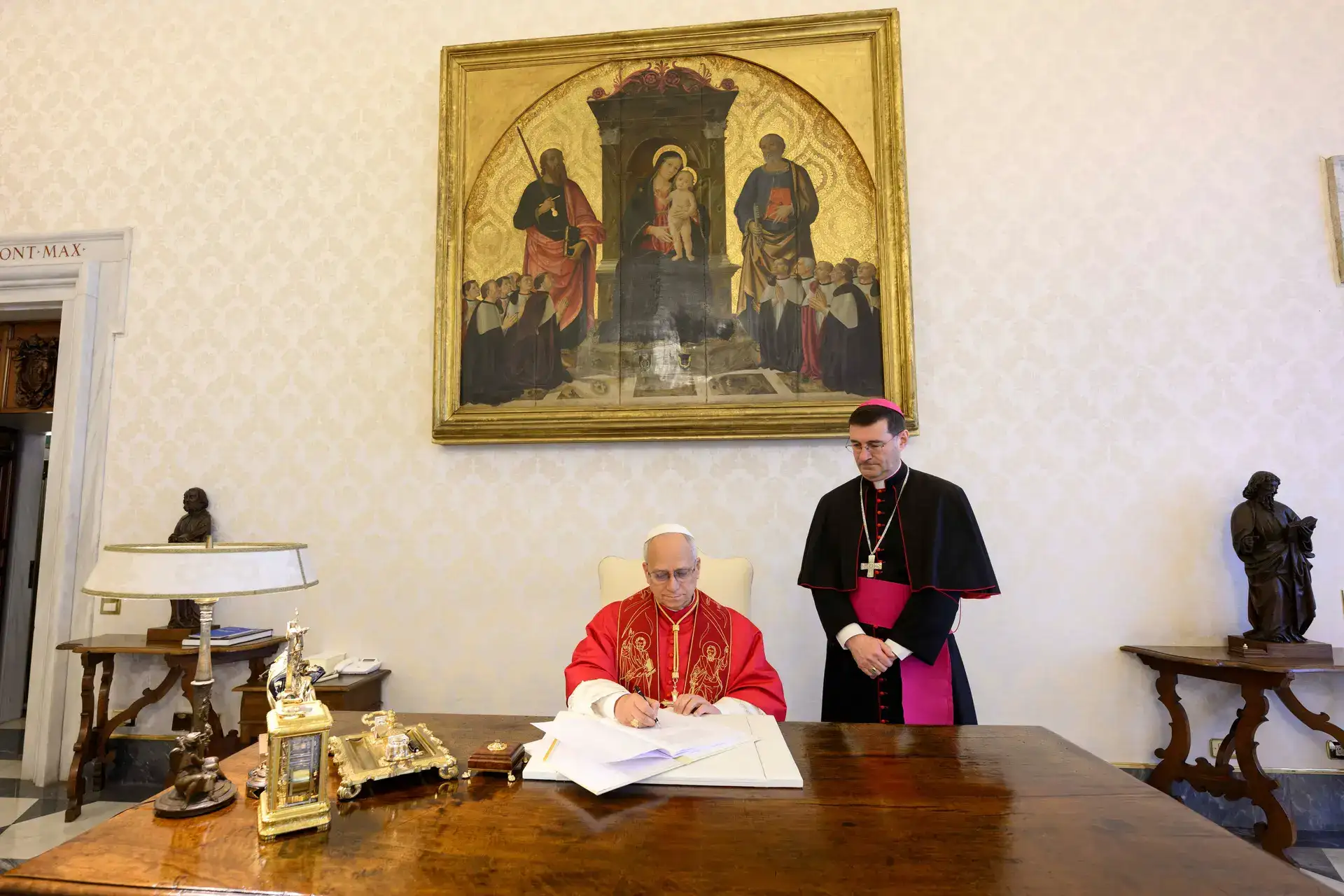
Pope Leo XIV has stepped directly into the global artificial intelligence (AI) debate with the release of Magnifica Humanitas (“Magnificent Humanity”), his first encyclical. (An encyclical is a major papal document that explains the Catholic Church’s position on important social and moral issues.)
The 245-paragraph text focuses on how AI could reshape jobs, politics, war and even human relationships. But at its core, the document is less about technology itself and more about power. More specifically, who controls AI, who benefits from it and who could be harmed by it.
While the pope made clear that AI is not “inherently evil”, he warned that the rapid race to build more powerful systems could deepen inequality, weaken democracy and leave millions vulnerable if governments and companies fail to act responsibly.
Why the encyclical matters
Pope Leo has repeatedly described AI as one of humanity’s biggest modern challenges. In Magnifica Humanitas , he compares today’s AI boom with the Industrial Revolution, arguing that both moments raise difficult questions about workers, ethics and human dignity.
The Vatican even invited Anthropic cofounder Christopher Olah to speak during the launch event. The pope later thanked him publicly, saying: “I accept your invitation to work together, to listen and to speak, and together, to find a way for humanity in this time of artificial intelligence.”
Yet despite opening dialogue with AI companies, the pope also delivered some of his sharpest criticism of the tech industry.
What does the document actually say?
1. Too much AI power is concentrated in too few hands
Without naming companies directly, Pope Leo warned that a small group of firms now control vast amounts of data, computing power and digital infrastructure.
“When such power is concentrated in the hands of a few,” he wrote, “it tends to become opaque and evade public oversight, increasing the risk of distorted forms of development that give rise to new dependencies, exclusions, manipulations and inequalities.”
The pope warned that powerful groups could use AI to shape public opinion, influence democratic systems and steer economies for their own interests. He also criticised the global race for “ever more powerful algorithms and larger datasets”, arguing that technology should serve humanity rather than corporate or geopolitical dominance.
2. AI-driven job losses could become a “social calamity”
Another major concern in the document is employment.
While he acknowledged that AI can improve productivity and make some work safer, he argued that workers must not become disposable in the process.
“The pursuit of greater profits cannot justify choices that systematically sacrifice jobs, because the human person is an end, not a means,” he wrote.
The pope urged governments and businesses to introduce retraining programmes and stronger worker protections before large-scale disruption takes hold.
3. Warning about AI weapons
Pope Leo criticised the development of autonomous weapons and said it should never be acceptable for machines to make irreversible life-and-death decisions without human responsibility.
“Artificial Intelligence now demands to be disarmed, freed from logics that turn it into an instrument of domination, exclusion and death,” he said during the Vatican presentation.
Leo also argued that modern warfare technologies are changing conflict so dramatically that traditional ideas around a “just war” may no longer apply.
4. Regulations needed, not just promises
“It is not enough to invoke ethics in the abstract; robust legal frameworks, independent oversight, informed users and a political system that does not abdicate its responsibility are required,” the pope wrote.
The pontiff also directly addressed AI developers, warning that every design decision reflects “a vision of humanity”.
Interestingly, the document also connects back to Rerum Novarum, the landmark 1891 encyclical by Pope Leo XIII, the current pope’s namesake, on workers’ rights during the Industrial Revolution. By referencing it, Pope Leo XIV positions Magnifica Humanitas as the Church’s response to what could be a major technological shift shaping daily life for humans.