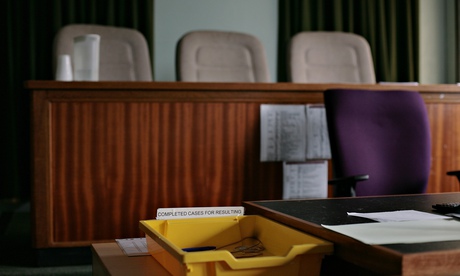
Investment in magistrates’ training has fallen sharply and the lack of support is in danger of devaluing their role in the criminal justice system, according to a report on the future of the unpaid judiciary.
The findings come as recruitment to the magistracy has effectively been frozen in many areas, while the number of JPs in England and Wales has declined from about 30,000 to 20,000. Closures of local courts due to austerity measures, reductions in reported crime and an increase in the number of full-time district judges – formerly known as stipendiary magistrates – have all contributed to the fall.
The report by the charity Transform Justice says spending by the judicial college on magistrates’ training has declined from £110 per magistrate in 2008-09 to £26 in 2013-14.
By contrast, according to the study by Penelope Gibbs, a former magistrate who is the director of Transform Justice, as much as £629 per person was spent on training district judges last year. Additional funding is provided by local court officials and the Magistrates’ Association.
“Since responsibility for magistrates’ training was delegated to the judiciary in 2005,” the report concludes, “there has been no major independent review of its quality and whether it meets the needs of today’s courts.”
“Magistrates’ training, like recruitment, has suffered badly from government cuts and from the government batting reform into the long grass,” said Gibbs. “JPs have been waiting four months already for the government to publish their green paper on the future of the magistracy. Unfortunately, this delay reinforces magistrates’ impression that they are seen as low priority.”
Magistrates are not paid and are alone among judges in being subject to regular appraisal of their competence. Most district judges, who earn about £104,000 a year, are appraised but the checks are not compulsory.
The Magistrates’ Association has been lobbying for its members to have increased sentencing powers, allowing to them to give offenders up to 12 months in custody – a move resisted so far by the MoJ.
One magistrate interviewed for the report said: “As someone who has been involved in education all her life, I am truly shocked by the lack of professional training in what should be a professional role … I believe constructive and worthwhile training to be essential for the bench to keep up to date with not only developments in law, but in changing society too.”
A magistrate who has served 25 years on the bench but did not want to be identified told the Guardian: “Training has gone down over the last few years because of government cutbacks. You have to keep up with changes in the law and other changes in society.
“The essential training is compulsory but there’s not an awful lot of additional training any more. If you sentence someone to a community order or to prison, you would have greater confidence in doing so if you knew what it involves but the cutbacks have made it a lot more difficult.”
The Magistrates’ Association, he added, was considering introducing continuous professional development “to ensure that magistrates are up to the mark”.
Richard Monkhouse, chairman of the Magistrates’ Association, said: “We would like to have a more diverse magistracy, but we haven’t recruited over the last 10 years.
“Three magistrates sitting together are significantly less expensive than one district judge. We all work to the same guidelines and same proceedings. We would like to see more training and would like to make our appraisal system more robust.”
A spokesman for the judiciary said: “Magistrates are still being trained to a high standard. Savings have been made to training costs through measures such as no longer using external venues, increased utilisation of technology, and more focused and flexible training.
“There is no plan to reduce the number of magistrates. While numbers have fallen naturally due to reduced workloads, recruitment continues and there are still over 20,000 magistrates compared to just 150 district judges [magistrates courts].
“The need to recruit magistrates and district judges [magistrates courts] is reviewed annually as a whole. One of the key aims is to ensure optimal use of both magistrates and district judges, each being essential to the administration of justice.”