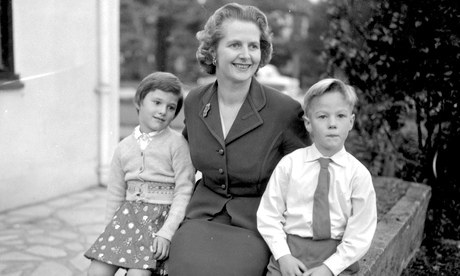
Margaret Thatcher’s official biographer, Charles Moore, says that she regretted not giving her children, Mark and Carol, enough time and attention. As Moore will cover in the third and final volume of the biography, Thatcher felt that she’d failed them.
Was this a distinct feature of Thatcher, Britain’s only female prime minister? There must have been plenty of male prime ministers who neglected their children. Where are the haunting memoirs about male politicos lamenting never making it to their children’s nativity plays? Winston Churchill: A Hero to Millions, But He Never Did Walky-Toes. Tony Blair: Never Mind Iraq, What About the Unread Spot the Dog Books? You’d have thought that neglecting families, spouses and children alike would be an inevitable part of being prime minister for anyone, male or female.
Away from high-end politics, isn’t this just the traditional “autumn years” lament of the workaholic? When their career ends, their life abruptly empties and they are left staring into a void, so sometimes they fill it with guilt. And who better to feel guilty about than your children, who are probably not children any more, but adults whose lives you’ve apparently blighted? It almost turns into a bizarre form of egomania: look at me (me!) and the effect that I (or my absence) had on my children. It’s the kind of remorse they didn’t have time for back when it might have made a difference, but that is suddenly refashioned as all-consuming, in the manner of picking at a giant emotional scab. Perhaps in some cases, it’s not really the guilt that weighs so heavily, but the time.
It’s similar to those parents who have more children later and talk about messing it up the first time and being given another chance at parenthood. I always wonder: was part of this messing up somehow rendering their earlier children deaf, blind and illiterate, so that now (thank God) they can’t hear or see them coming out with such hurtful, diminishing, narcissistic nonsense? It’s as if any child could be viewed as an exam they’d failed the first time around. I suspect it’s codswallop, anyway (I had my children a decade apart and, in many ways, feel that I’m making all the old mistakes, and adding more for luck).
But what’s more disturbing is (again) that worrying crackle of parental egomania – that it’s solely about them and what they’re experiencing. These people should realise that grandparenting is the only time you’re going to get anything akin to a second crack at parenthood. At different times, with different partners, parenting remains a continuum.
Perhaps what the fretting workaholics don’t realise is that pretty much everyone feels guilty about their children. It’s part of the parenting deal. You just have to choose what kind of guilt you’re going to go for, what particular type of turbo-penitent parent you’re going to be. Absent parent, busy parent, overwhelmed parent, lax parent, strict parent, prime minister parent, we’re all “wrong” in some way. I have known stay-at-home, potato-printing supermums who felt guilt-ridden because they weren’t “inspiring” their children.
They felt they should be out there, swinging briefcases, having amazing careers, like all the dynamic, driven, businesswoman mothers – the same dynamic, driven, businesswoman mothers who cried on red-eye flights because they weren’t at home doing the potato printing.
I suppose it just surprises me that an evidently bright woman such as Thatcher didn’t realise that parenting is the ultimate bottomless pit of “shoulda, woulda, coulda”, whether you’re around too little or, indeed, too much. Parental guilt is the tick that buries deep into the soul. All you can do, apart from your pitiful inadequate best, is reverse the famous Philip Larkin quote (“They fuck you up, your kids”), pour a large glass of vino and get over it – and yourself.
Surely a flight of fancy too far

The aircraft manufacturer Airbus has applied for a patent for a system where passengers could be “stacked” inside a plane. So you’d have to climb stairs or an ominous-sounding ladder and sit on an upper level, in the manner of a double-decker bus. This would result in more passenger space. Oh really, Airbus?
How long before this space would disappear into even more seating (profit)?
Another huge downside would be that some of the passengers would be seated facing each other. So, for the entire flight, you’d have to make eye contact with the person opposite, who might not be one of your party or, even worse, might be one of your party.
Some people might say, well, it’s only the same as a train. Wrong. Even though plane journeys aren’t necessarily longer, people’s attitudes are markedly different, by which I mean worse.
While travelling by train, people are still locked into a commuter mentality, which means that they don’t mind mucking in, even to the point of making eye contact, if it’s absolutely unavoidable.
However, put people on a plane and they swiftly adopt a cocooning mentality. On a short flight, this could entail falling into a reverie about whether or not to go for a delicious-sounding microwaved “toasted sandwich”. On a long-haul flight, it could mean hunkering down in front of your “entertainment centre”, with the grim realisation that the flight path diagram has a far more interesting plot and cast than any of the films on offer.
Either way, you’re on your own and that’s the way you like it. As yet it’s only a patent, but Airbus needs to realise that extra space would be nice, but eye contact is a land-commuter abomination that must never be introduced into air travel.
Ben Carson’s gun beliefs are wrong and offensive

US Republican presidential candidate Ben Carson should be congratulated for giving the gun lobby its most preposterous argument yet. In his new book, Carson is arguing that had there been no gun control laws in Europe at the time of the second world war, millions of Jewish people would have fought back and survived. “I think the likelihood of Hitler being able to accomplish his goals would have been greatly diminished if the people had been armed,” Carson told CNN.
After the latest tragedy in Oregon, the gun lobby is liable to say anything. Still, does Carson truly have a vision of Jewish families having shoot-outs with massed Nazi forces? What’s worrying about this is that it taps into a despicable notion, still around on the fringes today, that Jewish victims of the Holocaust were too docile and accepting of their fate, that they somehow “allowed themselves” to be persecuted, incarcerated and murdered.
The implication is that others wouldn’t have been so compliant – surely the ultimate in blaming victims? And Mel Brooks thought that Springtime for Hitler was the zenith of satire.